




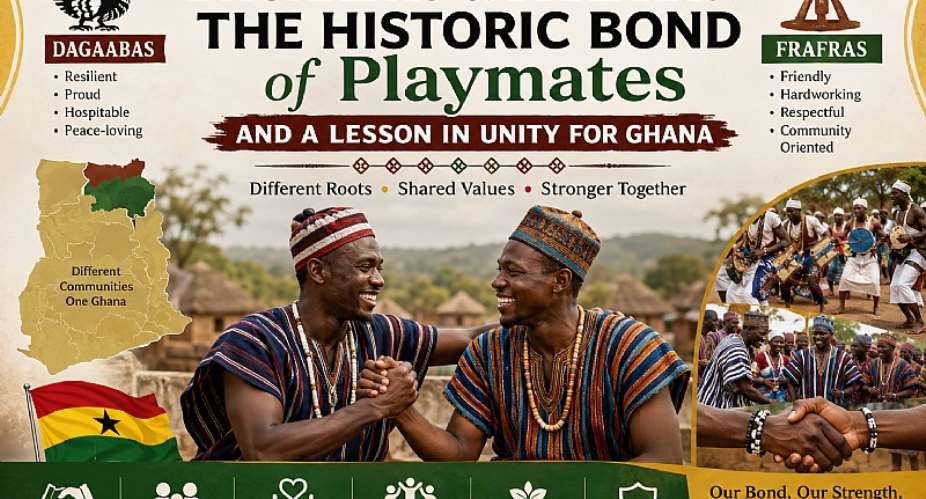
Introduction
Across Ghana, there are many neighboring ethnic groups with shared histories, but few relationships are as remarkable, enduring, and culturally enriching as the playful bond between the Dagaaba and Frafra peoples. What outsiders often mistake for harmless teasing is, in reality, a centuries-old institution of friendship, mutual respect, conflict prevention, and social cohesion.
This unique relationship has survived colonial rule, political transitions, modernization, migration, and urbanization. Today, whether in Wa, Bolgatanga, Tamale, Kumasi, Accra, or even abroad, it is common to hear a Dagaaba and a Frafra exchanging humorous insults before embracing like brothers. The laughter hides a deeper truth: this is one of Ghana's most successful indigenous peace-building traditions.
But how did this relationship begin? Why has it lasted for generations? And what can the rest of Ghana learn from it?
Historical Background
The Dagaaba predominantly inhabit the Upper West Region of Ghana and parts of Burkina Faso and Côte d'Ivoire, while the Frafra (primarily the Gurunsi-speaking peoples such as the Gurene) are concentrated in the Upper East Region.
Long before colonial borders divided communities, these peoples lived as neighbors, sharing trade routes, hunting grounds, markets, intermarriages, festivals, and traditional institutions. Rather than allowing competition over resources to create permanent hostility, their ancestors developed customs that encouraged friendship through humor.
Over generations, this practice evolved into what is popularly known as a "playmate" relationship an accepted social tradition where members of both communities can joke, tease, and laugh with one another without causing offense. Behind every joke is an understanding that they belong to a wider family.
More Than Jokes
The playmate relationship is not about disrespect.
It is built on unwritten rules:
- Mutual respect always comes first.
- Humour should strengthen relationships, not destroy them.
- During difficult times, playmates support one another.
- Conflicts are often reduced through laughter before they escalate.
- Hospitality between the two communities is highly valued.
This explains why a Dagaaba and a Frafra who meet for the first time often behave like old friends.
What Makes This Relationship So Strong?
Several factors have kept this friendship alive for centuries.
Shared history: Their ancestors interacted through trade, farming, migration, and traditional governance.
Mutual dependence: Both communities benefited economically and socially from peaceful coexistence.
Intermarriage: Families became connected across ethnic lines, creating relationships that transcended tribal identity.
Cultural respect: Each community recognizes the traditions and dignity of the other.
Transmission across generations: Elders intentionally teach children about the importance of preserving the playmate relationship.
Perhaps this is why the bond has survived even as many traditional institutions have weakened.
Questions Nobody Else Wants to Ask
If our ancestors, with fewer resources and no modern education, could build a friendship that has endured for centuries, why do many educated Africans struggle to maintain peaceful ethnic relationships today?
Why do politicians sometimes find it easier to divide communities than traditional leaders found it to unite them?
Why are many young people proud of social media rivalries but know little about indigenous systems of conflict resolution?
Why are schools teaching global peace studies while giving little attention to Ghana's own successful traditional peace-building models?
Could Ghana reduce ethnic tensions by promoting more indigenous friendship traditions like that of the Dagaabas and Frafras?
These are difficult questions worth reflecting on.
Why Is This Unity So Rare?
Many ethnic groups coexist peacefully, but few have institutionalized friendship in the way the Dagaabas and Frafras have.
Their relationship goes beyond tolerance.
It creates a social environment where laughter becomes a bridge, not a weapon.
This tradition makes it easier to forgive, easier to communicate, and easier to prevent misunderstandings before they become serious conflicts.
In an era where tribal identity can sometimes be manipulated for political or social gain, this ancient custom demonstrates that identity can also be used to build solidarity.
Lessons for Ghana
Ghana prides itself on being one of Africa's most peaceful countries. Yet peace is not maintained by laws alone.
The Dagaaba–Frafra playmate tradition offers several important lessons:
- Unity grows through everyday interaction.
- Humour can reduce tension when guided by mutual respect.
- Cultural differences should be celebrated rather than feared.
- Children should inherit traditions of friendship, not prejudice.
- Communities become stronger when they see one another as partners instead of rivals.
These lessons are just as relevant today as they were centuries ago.
Why This Tradition Must Be Preserved
Modernization should never erase traditions that strengthen society.
Community leaders, educators, cultural institutions, and young people should actively preserve and promote the Dagaaba–Frafra playmate relationship as an important element of Ghana's cultural heritage.
Documenting its history, encouraging cultural exchanges, and teaching future generations about its values can help ensure that this remarkable tradition continues to inspire unity.
Conclusion
The relationship between the Dagaaba and Frafra peoples is more than folklore. It is a living example of how culture can be used to build trust, prevent conflict, and strengthen communities.
Their forefathers left behind more than a custom of playful teasing they created a lasting framework for peaceful coexistence. In a world increasingly divided by ethnicity, politics, and misinformation, this tradition reminds us that true strength lies not in uniformity but in mutual respect and shared humanity.
Perhaps the greatest question Ghana should ask is this: if two neighboring communities have preserved such a powerful bond for generations, what is stopping the rest of the nation from learning the same lesson?
The legacy of the Dagaabas and Frafras is not merely one of laughter it is a legacy of unity, resilience, and brotherhood that deserves recognition, preservation, and emulation across Ghana and beyond.
By:
Patrick Belebang Yagsori
+233240292413
[email protected]

 'Your statement never said Miracles cannot be found, hiding, declared wanted; st...
 Miracles Aboagye's bail terms 'cruel and oppressive' — Samuel Atta Akyea
 Miracles Aboagye's arrest: EOCO's statement is a 'disgrace to Ghana's democracy'...
 Ghana Armed Forces begins GH¢190million redevelopment of Burma Camp
 Ato Forson to present 2026 mid-year budget review next week
 Dennis Miracles Aboagye can't meet GH¢50million bail conditions — Lawyers
 GNFS recovers body of 11-year-old boy from drowning incident at Adenta Aviation
 'The elephant will never forget what you’re doing to Miracles Aboagye today' — N...
 NDC govt using 'unfounded arrests' to distract from 'terrible job' — Sylvester T...
 NPP holds constituency elections in 245 constituencies as 31 locked-up in disput...

