




The unfolding situation at the Komfo Anokye Teaching Hospital (KATH) in Kumasi has escalated into a national controversy involving the Ministry of Health, hospital leadership, striking health workers, and public commentators like Captain Smart. At the heart of it all lies a single explosive question:
Was the suspension of the KATH CEO justified or is it the trigger for a dangerous breakdown in Ghana’s healthcare system?
What actually happened? The official position
According to verified Ministry of Health statements, the crisis began when the KATH Chief Executive Officer, Dr. Paa Kwesi Baidoo, announced a temporary suspension of emergency admissions at the hospital’s Accident and Emergency Unit.
The Ministry of Health responded by suspending the CEO, describing the decision as an administrative action linked to a breach of protocol and a directive from higher authority that emergency services must never be halted under any circumstance.
The Ministry further argued that:
The CEO acted without proper authorization
The closure of emergency services contradicted national health directives
The suspension was meant to ensure accountability and patient safety
But this official explanation immediately triggered backlash inside the hospital.
What are the doctors and staff saying?
Doctors and nurses at KATH reportedly embarked on strike action following the suspension.
Their position based on media reports is centered on solidarity with management and concern over decision-making processes that they believe undermine hospital leadership and working conditions.
Some staff argue:
The CEO was acting to protect overstretched emergency services
Administrative decisions were imposed without adequate consultation
The suspension reflects deeper governance problems in Ghana’s health system
Reports indicate that the strike has disrupted services and raised concern among patients seeking emergency care.
Was the Health Minister right?
From a governance standpoint, the Ministry has legal authority over public health institutions.
Arguments supporting the Minister:
Emergency departments cannot be shut without national coordination
Ghana’s health policy prioritizes uninterrupted emergency care
Public accountability requires enforcement of operational rules
However, critics argue that:
The decision may appear top-down and politically rigid
It risks undermining hospital autonomy
It may escalate industrial unrest rather than resolve it
So the key question becomes:
Is enforcing policy more important than managing the reality of a collapsing emergency system?
Was the CEO right or wrong?
This is where the issue becomes complex.
If the CEO shut down emergency admissions:
It could be interpreted as administrative insubordination
But also possibly a desperate safety measure if the unit was overwhelmed
If staff interpretation is correct:
The action may have been aimed at preventing medical risk due to overcrowding or resource shortages
But without full internal investigation reports publicly released, the CEO’s intent remains disputed.
Captain Smart’s explosive claim
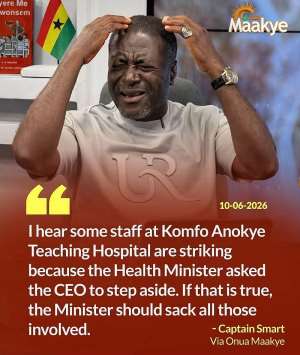
Media personality Captain Smart added fuel to the fire, reportedly stating:
“The Health Minister must sack all striking staff of Komfo Anokye Teaching Hospital.”
This statement raises serious national questions:
Critical questions nobody is asking:
Can mass dismissal solve a healthcare system crisis?
Would sacking staff improve emergency care or collapse it?
Are striking workers being heard, or simply punished?
Where is the line between discipline and authoritarian response in public health?
The real crisis beneath the crisis
This dispute is not just about one CEO or one minister.
It reflects deeper structural issues:
Chronic underfunding of Ghana’s hospitals
Overcrowded emergency units
Staff burnout and shortages
Weak communication between hospital leadership and government
Increasing politicization of healthcare management
KATH, one of Ghana’s largest teaching hospitals, serves millions across the northern and middle belts meaning any disruption has national consequences.
Impact on citizens
The immediate victims are not politicians or administrators.
They are:
Emergency patients unable to access care
Families facing delayed treatment
Overworked staff under pressure
A public losing trust in healthcare reliability
Even a short disruption in a tertiary hospital can lead to avoidable deaths and system-wide strain.
So who is right?
The uncomfortable truth is:
The Minister may be legally right
The doctors may be morally justified in their frustration
The CEO may have acted under operational pressure
But none of these positions alone solve the core problem:
Ghana’s emergency healthcare system is under structural stress and this crisis is exposing it in real time.
Final questions no one is answering
Why does emergency care repeatedly become a political battleground in Ghana?
Why are disputes escalating into strikes instead of mediation?
Who is truly accountable when systems fail the minister, the CEO, or the state?
And most importantly: how many more crises before reform becomes urgent reality, not political promise?
Conclusion
The KATH dispute is not just an institutional disagreement it is a warning signal.
Unless handled carefully, it risks becoming:
A breakdown in hospital governance
A public health emergency
And a trust crisis between healthcare workers, government, and citizens
The question now is no longer who is right.
It is:
How do we prevent the next KATH crisis before lives are lost in the middle of institutional blame games?
By:
Patrick Belebang Yagsori
+233240292413
[email protected]
 World Cup 2026: Brazil and Morocco draw in heavyweight Group C opener
 World Cup 2026: Qatar stuns Switzerland with late equaliser
 'Irrespective of the level of provocation, nobody has the right to attack any he...
 Sinare, Vanderpuye, Azorka tipped for NDC National Chairmanship race
 “Sedina Tamakloe’s case was NPP textbook politics” – Edudzi Tameklo
 Lapaz accident victim at 37 Military Hospital yet to be claimed, family members ...
 Ghana records over 1.3 million tourist arrivals in 2025 as sector generates $4.3...
 We want to see which prison facility housing Sedina Tamakloe – Nana Adutwum
 Social media addiction can derail your career — Prof. Agyare cautions new veteri...
 Wontumi's plea bargain is admission of guilt – Suhuyini


