




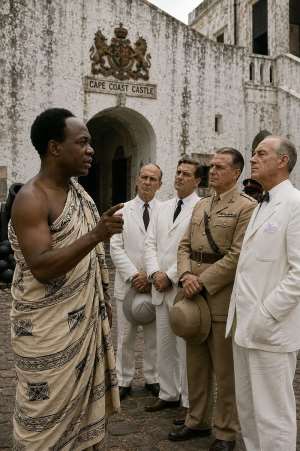
The Speed of Transformation: What Nkrumah Actually Did
Within a relatively short period after independence in 1957, Nkrumah pursued one of the most ambitious nation-building projects in post-colonial Africa.
His government focused on:
Rapid industrialization through state-led development
Massive infrastructure expansion (roads, schools, hospitals, factories)
Creation of major state institutions like Ghana Airways and Volta River Authority
Strong investment in education and scholarships abroad
A bold Pan-African agenda, positioning Ghana as a continental leader
The most symbolic project the Akosombo Dam was not just energy infrastructure; it represented an attempt to power an industrial future for Ghana.
Yet this raises a difficult question:
How did a newly independent country achieve such momentum so quickly, while today’s far more experienced governments struggle with implementation?
The Leadership Style: Vision or Overcentralization?
Nkrumah’s leadership was defined by urgency and central control. Decisions were fast. Bureaucratic resistance was often bypassed. The state became the main engine of development.
But this efficiency came with tension:
Political opposition weakened over time
Ghana moved toward a one-party system in 1964
Centralization reduced institutional independence
Economic planning sometimes outpaced financial sustainability
So another uncomfortable question emerges:
Was Ghana’s early speed a product of visionary leadership or the absence of institutional checks that modern democracies now consider essential?
What Has Changed Since Nkrumah?
After the 1966 coup that removed him from power, Ghana entered decades of political instability, military rule, and economic restructuring.
Since then:
Ghana shifted toward multi-party democracy
Market liberalization replaced state-driven industrialization
Many state-owned enterprises were privatized or weakened
Development planning became more fragmented across political cycles
Today’s Ghana is more democratic but often criticized for slower execution and inconsistent long-term policy direction.
This leads to a critical reflection:
Did Ghana trade speed and unified vision for stability and democracy and if so, has the balance been optimal?
Was Nkrumah “Special,” or Was the Era Different?
It is tempting to describe Nkrumah as uniquely gifted and he was undoubtedly intellectually and politically exceptional. But history also matters.
His era had:
Strong nationalist unity after independence
High public trust in leadership
Less bureaucratic fragmentation
A global Cold War environment that encouraged state-led development funding
So a deeper question is:
Are today’s leaders less capable or are they operating in a far more complex, constrained global and domestic system?
The Questions No One Is Asking in Ghana Today
Beyond admiration or criticism, Ghana must confront harder structural questions:
Why do long-term national development plans rarely survive beyond one government term?
Why does Ghana still depend heavily on imports despite early industrial ambitions?
What happened to the culture of bold, state-led economic transformation?
Are political incentives today aligned with national development or electoral survival?
Can Ghana combine Nkrumah’s urgency with modern accountability systems?
Who defines Ghana’s “development vision” today and is it unified or fragmented?
What Today’s Leaders Can Learn
A fair reading of Nkrumah’s legacy suggests lessons not imitation:
1. Long-term vision matters Development requires thinking beyond election cycles.
2. Execution is everything Ghana does not lack policies; it often lacks continuity and implementation discipline.
3. Industrial ambition cannot be symbolic Infrastructure must connect directly to productivity and jobs.
4. Leadership must balance speed with institutions Fast progress without strong systems creates fragility.
5. National unity around development goals is critical Without shared direction, progress becomes inconsistent.
Final Reflection
Dr. Kwame Nkrumah did not just fight for independence he attempted to define what independence should become. The unfinished debate today is not about whether he was perfect, but whether Ghana has fully answered his central challenge:
What does it truly mean to build a self-reliant, modern African state?
Perhaps the most important truth is this: Nkrumah’s legacy is not only a memory of what was achieved but a mirror reflecting what still has not been completed.
And the real question for today is not just what Nkrumah did.
It is this:
Why is it still so difficult for Ghana to do it again this time sustainably, inclusively, and successfully?
By:
Patrick Belebang Yagsori
+233240292413
[email protected]
 World Cup 2026: Brazil and Morocco draw in heavyweight Group C opener
 World Cup 2026: Qatar stuns Switzerland with late equaliser
 'Irrespective of the level of provocation, nobody has the right to attack any he...
 Sinare, Vanderpuye, Azorka tipped for NDC National Chairmanship race
 “Sedina Tamakloe’s case was NPP textbook politics” – Edudzi Tameklo
 Lapaz accident victim at 37 Military Hospital yet to be claimed, family members ...
 Ghana records over 1.3 million tourist arrivals in 2025 as sector generates $4.3...
 We want to see which prison facility housing Sedina Tamakloe – Nana Adutwum
 Social media addiction can derail your career — Prof. Agyare cautions new veteri...
 Wontumi's plea bargain is admission of guilt – Suhuyini


