




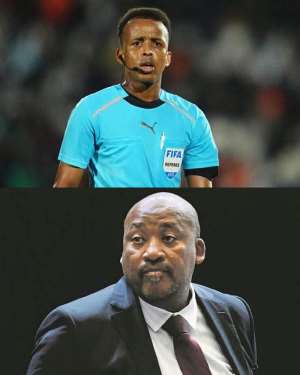
In the heat of global football politics, where sport, diplomacy, and national sentiment often collide, South Africa’s Sports Minister Gayton McKenzie has sparked fresh debate after strongly reacting to reports involving referee Omar Artan and claims about his alleged use of a diplomatic passport.
Speaking in an interview with Robert Marawa, McKenzie reportedly said:
“The information we got is that this ref (Omar Artan) travelled on a diplomatic passport. He’s not a diplomat. Let’s start there. Even if I am the President, I’ll not allow him in the country. What is this ref doing with a diplomatic passport? Is he a politician?”
The statement has ignited intense public discussion far beyond football raising uncomfortable questions about identity, privilege, migration rules, and how African voices are represented during global sporting events.
But beneath the emotion lies a far more complex truth that few are carefully unpacking.
⚖️ First Question Nobody Is Asking: Is This Even Unusual?
One of the most misunderstood aspects of international sport is the status of travel documents used by officials.
FIFA referees, like many international sports officials, may sometimes travel under special arrangements issued by their home countries or federations. In some cases, these can include diplomatic or service passports not because they are diplomats in the traditional political sense, but because their roles require expedited international movement.
So the real question is not just “Does he have a diplomatic passport?”
It is:
Who issued it, under what authority, and for what official sporting function?
Without these answers, the debate risks becoming emotional rather than factual.
🌍 The Bigger Context: Somalia, Travel Restrictions, and Global Inequality
Reports circulating online also suggest that Somalia has faced various travel restrictions in recent years, including periods where citizens were affected by broader visa or entry limitations in countries like the United States under past policies.
However, connecting such geopolitical realities directly to a football referee’s eligibility or legitimacy can be misleading.
This raises a deeper concern:
Are global institutions treating African professionals as neutral participants or as political risks first?
And even more uncomfortable:
Do perceptions of “security” and “diplomacy” unfairly shape how African officials are judged in global sport?
🧠 The Media Question: Are We Amplifying Division?
McKenzie’s frustration also included a broader warning:
“The media must stop interviewing xenophobes during this World Cup; they embarrass us as a continent.”
This statement opens a critical debate about media responsibility.
In moments of tension, media platforms can either:
Clarify facts and reduce misinformation
or
Amplify emotional, divisive narratives that deepen mistrust
So we must ask:
Are journalists reporting facts or manufacturing outrage for engagement?
At what point does coverage become complicity in division?
🔥 The Political Layer: Why This Reaction Matters
Whether one agrees or disagrees with McKenzie’s tone, his statement reflects a growing trend: African leaders becoming more vocal about how their citizens and professionals are treated globally.
But strong rhetoric also carries consequences.
It risks:
Escalating diplomatic sensitivities
Influencing public perception before facts are confirmed
Placing individuals like referees under unnecessary scrutiny
So another difficult question emerges:
When does defending national dignity cross into pre-judging individuals without full verification?
⚽ The Football Question Everyone Is Avoiding
Beyond passports and politics, the most important issue is being overlooked:
Are referees being trusted for their competence or judged through political identity?
Football depends on neutrality. But when referees become subjects of political debate, it risks undermining:
Match integrity
Public trust in officiating
The idea of sport as a unifying force
💬 What People Are Saying
Public reaction has been sharply divided:
Some argue:
Officials should be fully vetted regardless of status
No special treatment should exist at borders or airports
Others insist:
The issue is being exaggerated
African professionals are too often questioned unfairly on international platforms
Media framing is fueling unnecessary tension
In between these extremes lies a quieter truth:
Most people are reacting emotionally before understanding the full administrative and institutional facts.
🧩 The Core Question No One Wants to Answer
At the heart of this controversy is not just a referee or a passport.
It is this:
Who gets to move freely in global sport and who must constantly prove they belong?
And more painfully:
Why does African legitimacy so often become a subject of public debate, while others pass through systems without scrutiny?
🧭 Conclusion: Beyond the Headlines
The situation involving Omar Artan and remarks from Gayton McKenzie is still surrounded by incomplete information, interpretation, and emotional reaction.
What is clear, however, is that this is no longer just a football discussion.
It is about:
Trust in international institutions
The politics of mobility
Media responsibility
And how Africa tells its own story in global spaces
Until these deeper questions are addressed, every new controversy will feel like déjà vu louder, more emotional, but still unresolved.
Because the real issue is not just what happened.
It is why the same kinds of questions keep coming back without satisfying answers.
By:
Patrick Belebang Yagsori
+233240292413
[email protected]
 World Cup 2026: Brazil and Morocco draw in heavyweight Group C opener
 World Cup 2026: Qatar stuns Switzerland with late equaliser
 'Irrespective of the level of provocation, nobody has the right to attack any he...
 Sinare, Vanderpuye, Azorka tipped for NDC National Chairmanship race
 “Sedina Tamakloe’s case was NPP textbook politics” – Edudzi Tameklo
 Lapaz accident victim at 37 Military Hospital yet to be claimed, family members ...
 Ghana records over 1.3 million tourist arrivals in 2025 as sector generates $4.3...
 We want to see which prison facility housing Sedina Tamakloe – Nana Adutwum
 Social media addiction can derail your career — Prof. Agyare cautions new veteri...
 Wontumi's plea bargain is admission of guilt – Suhuyini


