




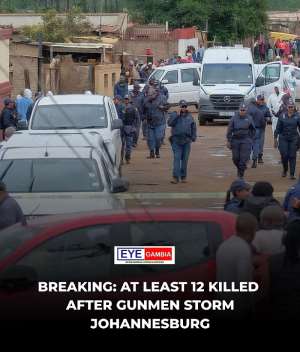
A chilling late-night mass shooting at the Jumpers Informal Settlement in Cleveland, east of Johannesburg, has once again thrust South Africa into a painful national conversation about violent crime, policing capacity, and the deeper fractures within its society.
According to the South African Police Service (SAPS), at least 12 people were killed and 9 others injured when more than 10 heavily armed men stormed the settlement around 11:10 PM on Tuesday. The attackers, reportedly dropped off by a white Toyota Quantum near a petrol station, split into groups, entered through multiple access points, and opened fire on residents before fleeing the scene in the same vehicle.
Authorities have described the assault as “coordinated,” but the motive remains unknown. Investigators have launched a manhunt, appealing for public assistance as the country struggles once again with the aftermath of mass civilian bloodshed.
A Pattern Emerging or an Isolated Horror?
While the brutality of this attack is shocking, what makes it even more unsettling is how it fits into a growing pattern of heavily armed group attacks in certain parts of South Africa. Informal settlements, often under-resourced and densely populated, are increasingly becoming flashpoints for violent crime involving organized groups.
This raises uncomfortable but necessary questions:
Why are informal settlements repeatedly becoming targets of coordinated attacks?
How are heavily armed groups moving undetected across urban security networks?
Is this purely criminal violence or is something more structured evolving beneath the surface?
These are questions that investigators may eventually answer, but they are also questions the public is increasingly asking in the absence of clarity.
Why Now? The Timing That Raises Eyebrows
One of the most pressing concerns is timing. Such coordinated attacks do not occur in isolation, and the “why now” question looms heavily over this tragedy.
Could this be:
A territorial dispute between rival criminal networks?
A retaliatory attack linked to earlier violence in the region?
A demonstration of power by organized crime groups testing state response capacity?
Without confirmed answers, speculation fills the vacuum and that vacuum itself becomes dangerous, fueling fear and mistrust.
Is There a Political Dimension?
Although there is currently no verified evidence linking this attack to political actors, South Africa’s history makes the question unavoidable.
In a country where:
local power struggles sometimes intersect with criminal syndicates,
informal settlements are politically sensitive zones,
and service delivery disputes can escalate tensions,
it is fair to ask:
Could instability in certain communities be indirectly enabling criminal networks?
Are weak governance structures being exploited by armed groups?
Who benefits from sustained insecurity in vulnerable areas?
These are not accusations they are critical governance questions that demand transparent investigation rather than silence.
Impact on South Africa’s National Stability
The immediate impact of the Cleveland massacre is devastating for affected families and communities, but the broader consequences stretch far beyond one settlement.
1. Public Fear and Erosion of Trust
Repeated mass shootings deepen public anxiety and erode confidence in law enforcement’s ability to protect citizens, especially in high-density urban settlements.
2. Pressure on SAPS and Security Systems
The coordinated nature of the attack places renewed pressure on SAPS intelligence, rapid response capacity, and inter-agency coordination. Questions about surveillance gaps and intelligence failures are inevitable.
3. Economic and Social Strain
Violence of this scale discourages investment, disrupts community stability, and places additional burdens on already strained social services.
How the World May Now See South Africa
Internationally, incidents like this risk reinforcing long-standing perceptions of South Africa as a country struggling with violent crime and security challenges.
However, global perception is not shaped by violence alone it is shaped by response:
If investigations are swift, transparent, and effective, confidence can be restored.
If accountability is weak or arrests fail to materialize, reputational damage deepens.
Foreign investors, tourists, and diplomatic observers closely watch how states respond to internal security crises. In this sense, the aftermath may matter as much as the attack itself.
The Bigger Question Nobody Wants to Ask
Beyond the headlines, there remains a more uncomfortable question:
Has violent crime in certain regions evolved from isolated criminality into a more coordinated ecosystem that the state is struggling to map in real time?
And if so:
What does that mean for future urban security?
Are current policing strategies sufficient for modern organized violence?
Is South Africa entering a new phase of criminal complexity?
Conclusion: Between Grief and Urgency
The Cleveland informal settlement massacre is not just another crime report it is a warning signal. A reminder that communities remain vulnerable, that policing gaps still exist, and that organized violence may be adapting faster than institutions can respond.
As investigations continue, the demand is not only for arrests, but for answers clear, honest, and uncomfortable ones.
Because the most dangerous outcome of tragedies like this is not only the loss of life, but the normalization of unanswered questions.
By:
Patrick Belebang Yagsori
+233240292413
[email protected]
 Why should sick people suffer because of your ‘too known’ — Hopeson Adorye blast...
 You chose to be a doctor, do the work with passion – Hopeson Adorye
 We have paid too high a price to allow freedom of speech diminish — Osahen Afeny...
 No disciplinary concern justifies violence against students - EduWatch condemns...
 Introduce regular criminal background checks into teacher recruitment — EduWatch...
 Bank of Ghana mops up GH¢17.24bn in major liquidity tightening move
 NDC marks 34 years of political influence and democratic governance
 UTAG threatens nationwide strike over delayed book and research allowances
 808 presidential staffers on payroll as Parliament receives annual staffing repo...
 24-Hour Economy cannot succeed without data — GSS tells Parliament


