




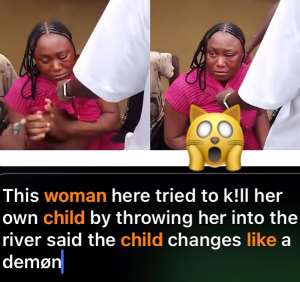
A disturbing incident has emerged involving a woman who reportedly attempted to kill her own child by throwing the child into a river, allegedly claiming the child “changes like a demon” and is a witch. The incident has sparked outrage, confusion, and deep concern about what could drive a parent to such an extreme act.
At the heart of this case lies a painful question: how does a caregiver transition from protector to perceived executioner?
According to accounts circulating around the incident, the woman justified her actions through spiritual or supernatural reasoning, suggesting that the child was not “normal” and was possessed or influenced by evil forces. In her post-incident remarks, she reportedly maintained that the child was not herself, reinforcing the belief that something beyond the physical was at play.
But beyond the immediate shock lies a far more complex and uncomfortable reality.
What Really Happened and What We Still Don’t Understand
While details remain limited and must be treated with caution until verified by authorities, the core allegation raises urgent social and psychological questions:
What circumstances led to the belief that a child was “a witch”?
Was this an isolated personal conviction, or influenced by external voices such as religious teachings or community pressure?
Could this be a case of untreated mental illness, extreme stress, or psychological breakdown?
Or is it part of a wider pattern of harmful witchcraft accusations that continue to affect vulnerable children in some communities?
These are not simple questions, and rushing to conclusions risks missing the deeper systemic issues.
The Dangerous Intersection of Fear, Faith, and Vulnerability
Across various regions, including parts of West Africa, accusations of witchcraft against children have been documented as a recurring social problem. In many cases, such beliefs are fueled by fear, economic hardship, misinterpretation of behavioral or medical conditions, or extreme religious interpretations.
Children labeled as “witches” are often those who display:
Unusual behavior linked to developmental or mental health conditions
Disabilities or chronic illness
Family conflict or social stigma
When these factors collide with fear-based belief systems, tragedy can follow.
The Critical Question Nobody Wants to Ask
Is this purely an individual act of violence or a reflection of something deeper embedded in society?
If a mother can believe her child is not human, then where did that belief originate?
Was she influenced by spiritual leaders or prophets who reinforce fear-based narratives?
Was there a lack of mental health awareness or access to psychological support?
Did poverty, stress, or isolation distort her perception of reality?
Or is this the outcome of unchecked misinformation and cultural narratives that go unchallenged?
These questions matter because they shift the conversation from blame alone to prevention.
Mental Health: The Silent Factor Often Ignored
While it would be irresponsible to diagnose the woman without professional evaluation, such incidents often raise concerns about possible mental health crises. Conditions such as severe psychosis, postpartum mental disorders, or trauma-induced breakdowns can distort perception of reality.
However, in many societies, mental health is still misunderstood, stigmatized, or attributed to spiritual causes delaying or preventing proper treatment.
The Child at the Center of It All
Beyond the theories and questions, one fact remains painfully clear: a child is the victim of a life-threatening act by the very person meant to protect them.
This raises urgent concerns about:
Child protection systems and their effectiveness
Community reporting mechanisms
Early intervention in cases of suspected abuse or spiritual labeling
Moving Forward: Prevention Over Shock
If society only reacts after incidents like this occur, then the cycle continues. Preventing such tragedies requires:
Public education on mental health and child development
Responsible religious leadership that discourages harmful labeling
Stronger child protection enforcement
Community awareness programs addressing witchcraft accusation myths
Final Reflection
This case is not just about one woman or one child. It is about the fragile space where belief, fear, and mental strain collide and where children too often pay the price.
The most uncomfortable truth may be this: until societies confront the roots of these beliefs and the silence around mental health, similar tragedies will continue to emerge in different forms.
And the question will remain again and again:
How does a mother come to believe her own child is something inhuman… and who, or what, taught her to see it that way?
By:
Patrick Belebang Yagsori
+233240292413
[email protected]
 Thousands attend Kenya opposition rally amid anger over political violence
 Trump slams AI sceptics as Altman pauses OpenAI IPO plans over safety concerns
 WASSCE: School officials helped students cheat for years, but we now see the tru...
 Probe alleged military killing of lecturer in Bawku – Kusaug Youth demands
 ‘If we all pay GH¢1,000 each, we should be able to construct National Cathedral’...
 Mahama inspects proposed site for Upper West Regional Airport
 Mahama reiterates government's commitment to end double-track SHS system
 Police interdict officer over death of 23-year-old Ivan Baidoo on Tema Motorway
 Improved invigilation is exposing true performance of Ghanaian students — Mahama...
 There's no policy to introduce Arabic, Chinese in all public schools — Mahama


