




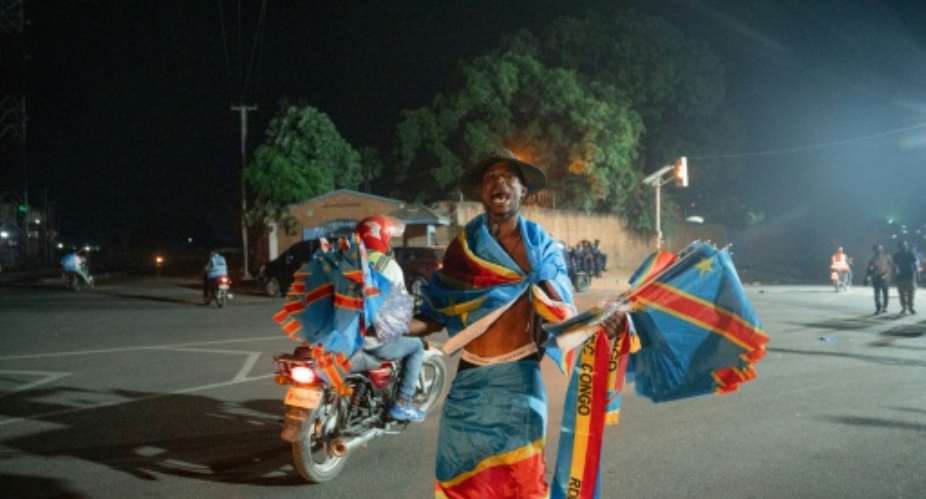
The Democratic Republic of Congo's first ever World Cup point on Wednesday gave their compatriots in Bunia, the epicentre of the Ebola outbreak, a rare chance to celebrate.
Yoane Wissa's goal in Houston -- also a first in his nation's short World Cup history -- secured a point against a star-studded Portugal side that included all-time great Cristiano Ronaldo.
DR Congo's French coach Sebastien Desabre said he was proud of his players "because they represented the Congo in a very positive way and the entire country deserves it."
That was certainly reflected in Bunia, the capital of Ituri Province in the northeast of the country, which has borne the brunt of the DR Congo's 17th outbreak of the haemorrhagic fever.
The virus has infected 837 people and resulted in 196 deaths in DR Congo and Uganda, according to the latest official figures.
In Bunia there have been 215 confirmed cases, though testing capacity is limited.
Watching the World Cup on the few functioning TV sets available provided some respite there.
The goal by Wissa, who plays for English Premier League side Newcastle, sparked scenes of undiluted joy.
Youngsters jumped up and down with their arms raised and faces lit up with delight, celebrating on the streets outside shops clad in corrugated iron.
A cacophony of noise drowned out their cheering as others performed doughnuts on motorbikes.
 Congolese supporters roared with delight at the Democratic Republic of Congo's first ever World Cup goal. By Jospin Mwisha (AFP)
The bars were bursting at the seams -- despite the authorities' decision at the end of May to restrict gatherings to 50 people to try to stop the spread of Ebola.
"It is an honour to support my country," Antoinette Makasi, who was delighted to have found a bar with a TV, told AFP.
Makasi added however that she was concerned at the lack of social distancing, and vowed that once she got home, "I will make sure I disinfect myself".
The bar she was in erupted when Wissa scored, all the clients rising and screaming in unison in a room lit by a single bulb.
Whatever happens in the rest of the tournament, this squad have laid to rest the ghosts of their 1974 predecessors who represented Zaire, as it was then known, and returned home without a point and having conceded 14 goals.
'I am angry'
But the gloominess of the bar reflects the state of the province.
Ituri is one of the DRC's most unstable regions, where armed groups shape daily life. Rebels linked to the Islamic State group and local militias carry out frequent attacks.
"We need moments which bring us a little happiness and allow us to forget for just an instant the loss of our brothers and sisters," Heritier Kimbimbi, a national flag draped over his shoulders, told AFP.
Not all, though, was sweetness and light ahead of the kick-off.
 Despite social distancing rules because of the Ebola outbreak, DR Congo fans were determined to watch the country's first World Cup match since 1974. By Jospin Mwisha (AFP)
Around a hundred youngsters, the DRC colours painted on their cheeks and wearing the team's jersey, gathered round the giant screen which had been erected at a roundabout in the city centre.
However, they went there in vain as the screen remained blank.
"All day and every day they broadcast adverts on Ebola, but for the match they turn off the big screen," said an annoyed Heritier Dubo.
"I am angry," said taxi driver Claude Maniwa. "Many of us do not have a television and, in any case, there are constant problems with the electricity.
"The authorities have let us down," he added, before threatening to break the screen.
Fortunately the tension eased, the youngsters jumping on motorbike taxis so they could find a business or restaurant to watch the match.
It turned out to be worth the fare on a rare night of good news for the country.

 Gunfire at airport in Niger's capital: residents
 Tehran and Washington sign interim peace deal to end US-Israeli war on Iran
 Why are Kenyan kids burning schools and killing their classmates?
 Yirenkyi's late flourish launches Ghana's World Cup party
 World Cup 2026: Ghana break Panama resistance with stoppage-time winner
 VIDEO: Watch the only community toilet carried away by floods
 We don’t owe Tema Motorway contractor any amount of money — Agbodza
 Swift response by Saki High Tension residents helps contain warehouse blaze in K...
 Bank of Ghana converts 147 rural and community banks into community banks
 Five fake soldiers grabbed for armed robbery at Ashanti mining community


