




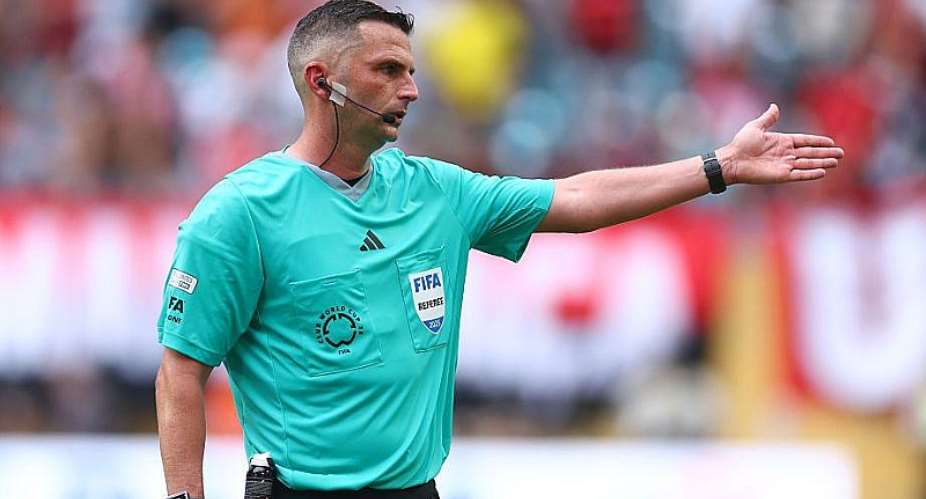
The 2026 World Cup is going to be unprecedented for a variety of reasons - and that includes the sheer number of law changes.
Fifa has introduced 11 measures specifically for the tournament.
Pierluigi Collina, the head of referees, is determined to speed up the matches and to reduce the potential for match-changing mistakes.
But get used to them, because you will see most applied in the Premier League, English Football League and Scottish Premiership next season.
There are new powers for the video assistant referee (VAR), a whole host of measures to protect the tempo of the game and a couple of adjustments around player behaviour.
Here is what you need to look out for and how the new laws will work.
- Time-saving measures for goal-kicks, throw-ins and substitutions
Fixing timewasting has been one of Collina's top issues for quite a few years.
At the Qatar World Cup in 2022, the Italian told his officials to be precise and add everything on to stoppage time.
The opening matches all exceeded 100 minutes, with 24 minutes added on across both halves for England's 6-2 win over Iran.
For this World Cup, the plan is to make sure players get on with the game and save lost time this way.
The idea is not strict enforcement, but deterrent measures to alter player behaviour.
Countdowns for goal-kicks and throw-ins (five seconds): If a player deliberately delays the restart of play, a goal-kick could become a corner or the throw given to the opposition.
The count will not begin when the ball goes out of play. A referee will choose to activate it if a player is taking too long.
Like the eight-second countdown after a goalkeeper has caught the ball, the referee will visibly make a count by moving an arm up and down.
This law change should be a deterrent to goalkeepers who take a long time over their kicks towards the end of games.
Previously, the only tool a referee would really have is to show one yellow card. And the keeper might just keep on doing it knowing an official is not likely to book them twice and be forced to send them off.
It is hoped that conceding a corner which could lead to conceding a goal is a more effective deterrent.
Time-limited substitutions (10 seconds): Substituted players have 10 seconds to leave the field at the nearest point. If they fail to do so, the substitute cannot enter the field for at least one minute and the team must play with 10 players.
There are a couple of exemptions - if a player is injured or there are security concerns about where they can go off, though the latter should not be an issue at the World Cup.
The new law says that the substitute will not be able to come on until play next stops. That means a team could in theory be left with 10 players for several minutes.
Take the international friendly between Japan and Iceland on 31 May.
An Iceland player took too long to leave the field, so the team had to play with 10 men for more than two minutes. The first time play stopped was when Koki Ogawa scored the only goal of the game for Japan.
The idea is not to make teams play with 10 men, but to make it such a clear deterrent that players do not waste time on substitutions.
- Physio on? Players must now stay off for one minute
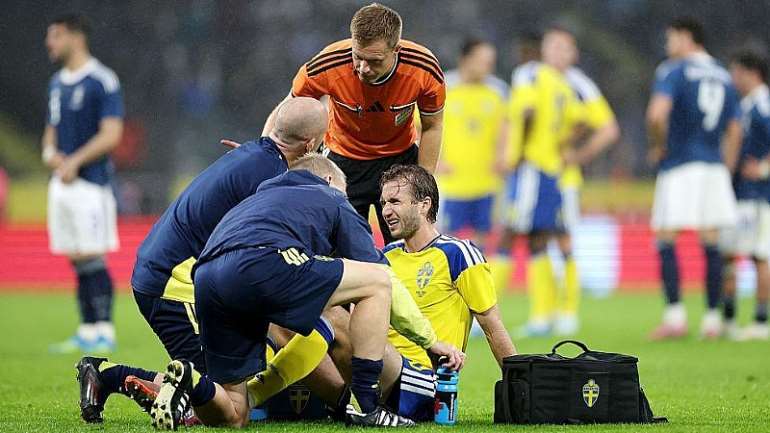
Image source: Getty Images
Image caption: Players who required treatment in the World Cup warm-ups were the first to experience being told to stay off the field for one minute
For a couple of seasons fans of Premier League and EFL teams have been used to players staying off the field for 30 seconds after the physio has been on the pitch.
Now the time has been upped to one minute. And not just for the World Cup, it will be in the laws of the game too. Every league and competition must apply it next season.
Fifa had trialled two minutes at the Arab Cup in December, but the domestic leagues pushed back on that. Eventually, one minute was agreed as a compromise.
There are some concerns that one minute is too long, that it could penalise players who are genuinely injured.
Or that a player could be less likely to ask for the physio in fear of hampering their own team.
There are a handful of exceptions when a player would be able to come straight back on:
a goalkeeper is injured
a goalkeeper and an outfield player or players from the same team have collideda severe injury has occurred, especially a head injury (e.g. concussion)
a player is injured and the opponent is booked or sent off
a penalty has been awarded and the injured player will be the taker
No more goalkeeper tactical timeouts?
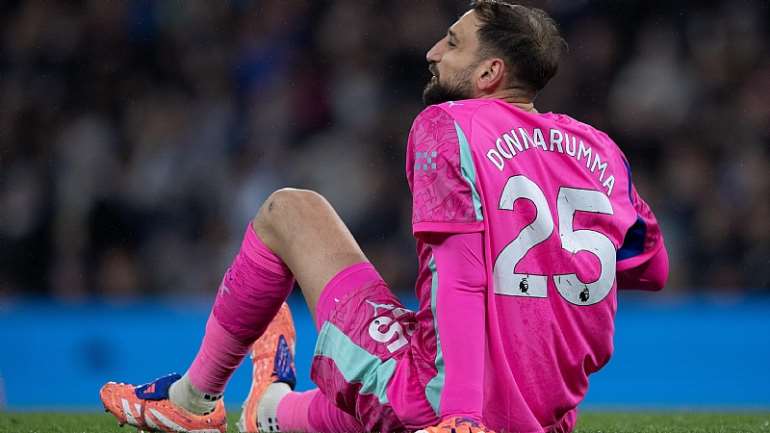
Image source: Getty Images
Image caption: Leeds United boss Daniel Farke accused Manchester City goalkeeper Gianluigi Donnarumma of feigning injury to create a tactical stoppage during a Premier League game last season
The 'goalkeeper tactical timeout' has become a hot topic in recent seasons.
It is used by a manager to get new instructions to his players, or to impact the momentum of the opposition.
The goalkeeper sits on the turf and signals for the physio, the other players rush to the technical area for a team talk. As soon as the coach has got his message across, the keeper stands up to play on.
Football's lawmakers have so far failed to agree on measures to tackle it.
But Collina has told coaches of the 48 World Cup teams that players will be stopped from going to the technical area when goalkeepers are injured.
This only tackles part of the problem. It will not stop the tactic being used simply to break up the momentum of the other team late in the game.
The effectiveness is open to debate with coaches having a three-minute hydration break in each half as a natural timeout.
Just how officials will be able to enforce it is open to question, too, as they will not be able to show yellow cards or take disciplinary action.
- More VAR, and lots of it
It is not the kind of news most fans want to hear, but there are going to be four new areas covered by VAR.
Check that a corner is correct: The VAR will make sure that a corner has been correctly awarded. But they won't do the same for goal-kicks which should be corners.
Fifa says this cannot cause a delay and must be completed before the corner is taken.
On average, there is a 25-second delay and Fifa believes this should be enough time.
Fifa is aided by having a bigger VAR team than other competitions. It also have new 'out of bounds' technology which will indicate who touched the ball last, though it might be too slow to be used to fix a corner.
This is only a competition opt-in, so it is not expected to be adopted in the Premier League.
Players sent off for two yellow cards: The VAR will be able to look at the second caution for players shown a red card.
There can be no review for potential second bookings for players on a yellow.
Importantly, it has to be a clear error to give the foul and not just a subjective difference of opinion about the card.
Attacking foul before the ball is in play: The Ifab has given Fifa permission to allow a VAR review if it directly leads to a goal, penalty or disciplinary sanction.
Collina used an example involving England from March, when Adam Wharton blocked the run of Uruguay's Jose Maria Gimenez before Ben White scored.
Then the VAR could not disallow the goal, but they will be able to at the World Cup.
The restart would be a retake of the corner. The logic remains that a free-kick cannot be awarded if the ball is not in play.
For this reason the VAR will not be able to review defensive fouls before the ball is in play because it is not possible to give a penalty.
This will be reassessed by the Ifab after the tournament.
Mistaken identity: This is an incredibly niche addition which Collina requested. If a player is booked or sent off but the foul was actually committed by the opposition team, the decision can be changed.
- Powers to combat poor player behaviour
Fifa was unhappy with two high-profile disciplinary incidents earlier this year and was eager to avoid a repeat at the World Cup.
Both are competition opt-ins for the tournament.
Player covers their mouth in a confrontational situation: A referee can send the player off.
This refers to Benfica winger Gianluca Prestianni being given a six-match ban by Uefa after he admitted using homophobic language towards Real Madrid's Vinicius Jr during a Champions League match in February.
"If the conversation is friendly, they can continue to do it without any problem," Collina explained.
"When the conversation is confrontational, covering the mouth means that you are doing something very wrong, potentially, and the sanction is the red card."
Player leaves the field to protest a referee's decision: The referee can also now show a red card card.
This is a reaction to the controversy in the final of the Africa Cup of Nations final on 18 January.
Senegal beat Morocco 1-0 in a match that was overshadowed when the Senegalese players refused to play after the hosts were awarded a stoppage-time penalty with the match goalless.
Following a delay of around 17 minutes, the players did eventually return. Real Madrid forward Brahim Diaz missed the penalty, then Villarreal midfielder Pape Gueye scored the winning goal in the fourth minute of extra-time.
In March, Morocco were declared the winners after the Confederation of African Football (Caf) overturned the result.
 Roads Ministry needs 1,000 additional staff — Governs Agbodza
 Stop tweeting and brief Parliament on South Africa situation — Patrick Boamah to...
 Roads Minister reassigns Bogoso–Prestea road project to new contractor over dela...
 Government must be held accountable for Black Stars’ poor state — Enam Hadzide
 Any SMS or platform offering discounted DVLA fines is fraudulent — DVLA cautions...
 Gov't resources GBC to acquire Free-to-Air broadcast rights for 2026 FIFA World ...
 Flooding crisis: 'Current NDC gov't the laziest and weakest since 1992' — Miracl...
 President Mahama’s approval rate remains positive at 58.9% — IEA survey shows
 'Take note of Sedina Tamakloe's extradition and come home' — Kwame Jantuah to Of...
 Nigerian evacuees set to arrive in Lagos Thursday amid South Africa xenophobic a...


