




A recent survey by the National Development Planning Commission has revealed that, child poverty is still a major problem in Ghana.
The work shows that 70% of Ghanaian children lack access to adequate welfare.
This means that only a few young ones have access to proper security, education and other amenities necessary for proper growth of a child.
“Looking at monetary poverty alone the number was 28% but once we delved deeper and looked at various dimensions of poverty, we saw the average sum is well over 70% of Ghanaian Children,” recounted Dr. Felix Addo-Yobo, Acting Director, Development Policy Division of the NDPC.
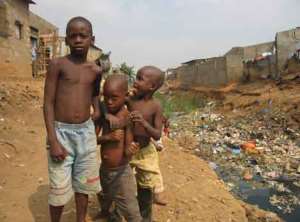
Joy News’ Piesie Nana Yaw Sarfo reported from Agbogloshie, the sorry state of children roaming the commercial District in the Greater Accra region with careless abandon.
Three boys of school-going age are tagged along what seems to be an endless spread of garbage; they head towards the Korle lagoon where odour from the polluted lagoon fills the air. No school, no supervision and no parent to help them navigate their future.
Many children come to this place as a result of accompanying their working mothers, mostly traders.
Vida, a trader who shared her concern said: “it is a really disturbing situation, many of the children migrated from other places without their parents and so they leave their lives anyhow.”
---myjoyonline

 'I am ready to lead Ashanti region NPP with less talk and more action' — COKA
 'NDC said they did not need too many loans, but are now borrowing heavily' — Osa...
 Chairman Wontumi’s 20-year sentence is a clear case of selective justice — Adoma...
 Ghana’s public debt stock hits GH¢720.8bn, equivalent to 45.1% of GDP — BoG
 Ghana to replace periodic education surveys with real-time data system
 Bank of Ghana keeps policy rate unchanged at 14%
 Wontumi's 20-year sentence raises concerns about proportionality and fairness — ...
 Describing me as the worst-performing MP is demotivating and dangerous — Stephen...
 CAF chief Motsepe backs Infantino despite criticism
 'We are not satisfied with Wontumi's plea bargain proposal in EXIM Bank case; so...

