




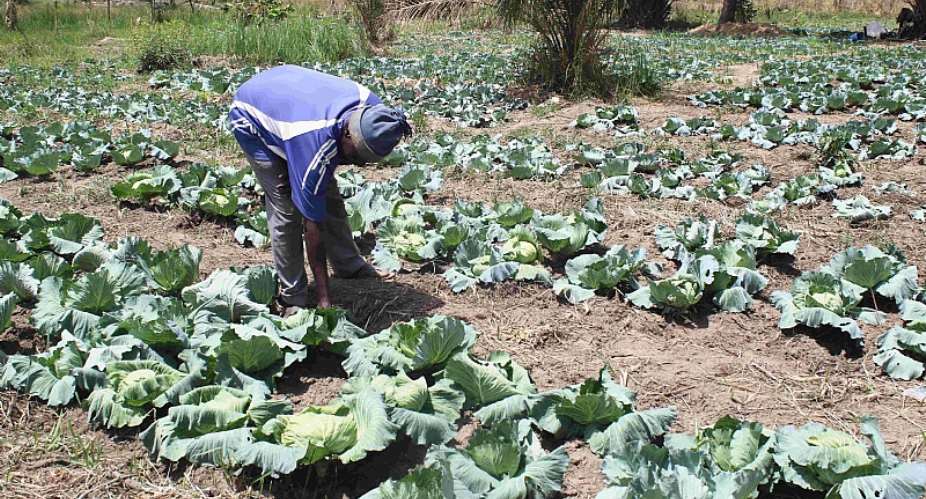
“We are very very happy”, says Rose Azumah, a dry season gardener at Walembelle in the Upper West Region of Ghana.
Like many people in rural communities in Ghana, Rose’s main economic activity is farming. Over 80% of the residents in her region and in Northern Ghana as a whole, depends on rain-fed agriculture for their food, income and livelihoods. With climate change, the incidence of droughts continues to increase, having devastating impacts on the people, especially women.
Women in rural communities in most developing countries like Ghana are often vulnerable to climate change because they depend a lot on local natural resources for their livelihoods. They secure water, food and fuel for cooking. Despite this, most women do not own and control resources especially land.
“Most of us do not farm during the dry season and life becomes difficult as we don’t earn any income”, stated Agabeni Abaa in Yindongo, Upper East Region of Ghana.
To respond to this, a dry season garden initiative is currently being implemented by the Government of Ghana, in partnership with the United Nations Development Programme (UNDP), as part of a 4-year project, to build community resilience to climate change impacts. The project, being supported by Adaptation Fund, is building the resilience of women and men in over 50 communities. Agabeni and Rose are among the over 2500 women benefiting directly.
“In Yindongo, we have a 24-acre dry season garden and we are about 100 women benefiting from the initiative. Every 3 days is market day here, so we sell the vegetables and also consume some”, Agabeni indicated.
The dry season gardening is not only benefiting women but men as well. Both women and men are being supported with land preparation, seedlings, irrigation facilities, pesticides and with technical support to produce different exotic and local vegetables (onion, cabbage, lettuce, green pepper, pepper, tomatoes, spring onion, beans etc.).
“We have 10 men and 20 women being supported in our village Goli and this is helping us. I have already made good income from my first harvest, more than Ghc1000 ($200) from the sale from 3 beds green pepper and 4 beds lettuce and cabbage. I also have onions, cucumber and pumpkin leaves which are almost ready for the market”, Godfred Datuah, Vegetable Farmer at Goli, Upper West Region of Ghana.
Beside the dry season gardening, the adaptation fund project is also supporting the communities with boreholes, rehabilitation of dams for irrigation and other water uses; and providing other alternative livelihood interventions such as agro-processing, beekeeping, fish farming, and tree seedling nurseries, all in Northern Ghana.
As the world embarks on years of ambition to tackle climate change, it is important to integrate gender issues in climate change mitigation and adaptation efforts. This will help minimize women and children’s risks to climate change impacts.

 Mahama reassigns Labour Minister Rashid Pelpuo as Minister of State for Special ...
 Police interdict officer over alleged role in Accra Race Course demolition
 Put me on NPP’s frontline in 2028 and I’ll unleash ‘pure fire’ on NDC – Mustapha...
 Ghana’s biggest problem is lack of intentionality about development – KSM
 Traditional leaders must become agents of development, not just ceremonial figur...
 GoldBod never made the GH¢5.5 billion surplus it claims – Tiah Mahama
 GoldBod’s reported profits raise questions over its financials – Gideon Boako
 Afenyo-Markin’s credibility could be shattered if he loses defamation suit again...
 NDC’s economic bragging rights come from Bawumia’s gold policy – Miracles Aboagy...
 Gov’t declines MTN’s GH¢20m offer for Ghanaian victims of South Africa xenophobi...

