




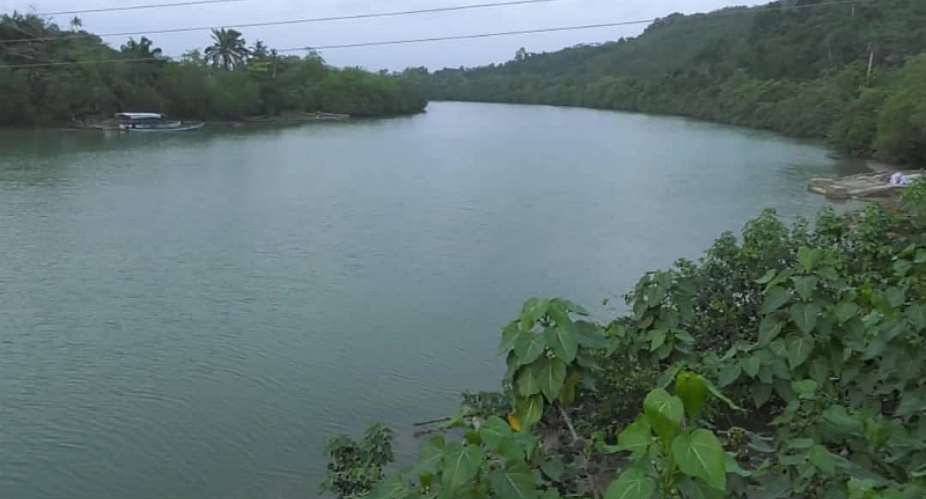
On 16 January 2019, ModernGhana.com published an article on its website that should gladden the hearts of all those who want to see our river-bodies brought back to life
The article, by DANIEL KAKU, stated:
QUOTE: "the work of the Inter-Ministerial Committee on Illegal Mining (ICIM) seems to be getting the much-anticipated results, as the once most polluted Ankobra river has returned to its original state, after years of threat by activities of galamsey. The Ankobra River had, hitherto, become brownish in colour, and muddy, highly polluted with mercury and other chemicals making it unsafe for use by the indigenes.
"Residents living along the Ankobra River have, for years, cried over the polluted nature of the river. [But] a visit ….on Tuesday, January 14th 2019, [to] Ankobra, a community in the Ellembelle District of the Western Region, revealed clear signs [that] the Ankobra River [has] regenerated its natural ecology. The banks of the river, which previously were muddy, have now become clearer.... The residents are singing praises to the Inter-Ministerial Committee on Illegal Mining in the fight against galamsey, which has led to a clean river Ankobra now.
"The residents tell us, the river is now friendly to their major occupation, which is fishing. [Others are] wi now using [Ankobra water] in their homes for drinking and other purposes. 'The river has been very clean for some weeks now,... We are very happy, as we can now go to fishing and come back home with a lot of catch. [We] attribute this achievement [to] the President’s will in fighting the galamsey menace.... which was [destroying] the river. We hope the fight continues; we can now use [the Ankobra's water] for cooking and other house chores”, Joseph Ndede a fisherman indicated.
"Another fisherman, Emmanuel Ackerson, noted that 'The river was not good at all previously, but since the [fight against] galamsey began, the river [has become] very clean now. We now get fish, so we thank the Government for this achievement'. The upsurge in illegal small scale mining in the country over a decade [ago] led to several illegal miners, including foreign nationals, invading ... our major water bodies, giving rise to [an] imminent threat [to] Ghana’s water resources. The heavy pollution affected the supply of potable water, as water treatment became difficult for the Ghana Water Company Limited, which led to the shutdown of many of their treatment plants." UNQUOTE
Read More: Galamsey fight gets result, Ankobra River regenerates its natural ecology
The writer concluded by quoting the Secretary to the Inter-Ministerial Committee on Illegal Mining, Mr. Charles Bissue, as confirming that “some other major water bodies in the country will soon witness similar achievements.”
No sooner had the article appeared on the website of ModernGhana.com than some doubting Thomases began to pour scorn on the writer. One of these described the article as QUOTE: “Total fiction. If he [the journalist] really went to the community, he should have taken snapshots of landmarks. Ankobra has not changed in colour. It is [the] dry season and the water level is not what you see. The plants are not as green either. Arm-chair journalism will kill us. Galamsey is still being practised upstream. UNQUOTE
Another person commented|: “When at all is Ghana [going to] call [a] spade [a] spade?. Let's be a bit truthful and stop throwing dust into the eyes of innocent Ghanaians. The state of River Ankobra is even worst (sic) than the brownish colour in de picture. Please take Galamsey out of the rivers.”
Are all these people talking about the same River Ankobra? It is true that some people can see water in a glass as making the glass-half-full while others see the glass as “half-empty.” But where views are so diametrically opposed to each other, it's difficult to determine where the truth lies.
So I asked Mr Charles Bissue, executive secretary of the IMCIM, what he thought of these opposing views. He was emphatic that the water in the Ankobra and other rivers had improved considerably. He said some television stations had been to the rivers and were already showing pictures of the current state of the rivers to their viewers.
Mr Bissue was absolutely right. Here is a link to one of the TV reports which will enable you to judge for yourself:
For let us not forget that there are propagandists about who cannot see anything good in what the Government does or tries to do. The truth is, however, the greatest enemy of propaganda.

 Sandema: Funeral clash leaves four injured, army recruit loses hand
 Upper East: Residents raise concerns over Mahama’s 24-hour market policy
 Ex-Buffer Stock CEO and wife were not denied legal counsel on rearrest — EOCO
 PDS case: Lawyers detained were invited as suspects a day earlier -- EOCO
 Government explores autonomous rapid transit system to modernise intra-city tran...
 AU mourns demise of former Botswana President Festus Mogae
 Economic recovery came at a cost to BoG — Sammy Gyamfi on 2025 losses
 NPP's criticism of BoG 2025 losses disingenuous, hollow — Sammy Gyamfi
 Ghana Armed Forces to conduct counter-insurgency exercise in Bono, Upper East re...
 Site for Adaklu District 24-hour economy market handed over to contractor


