




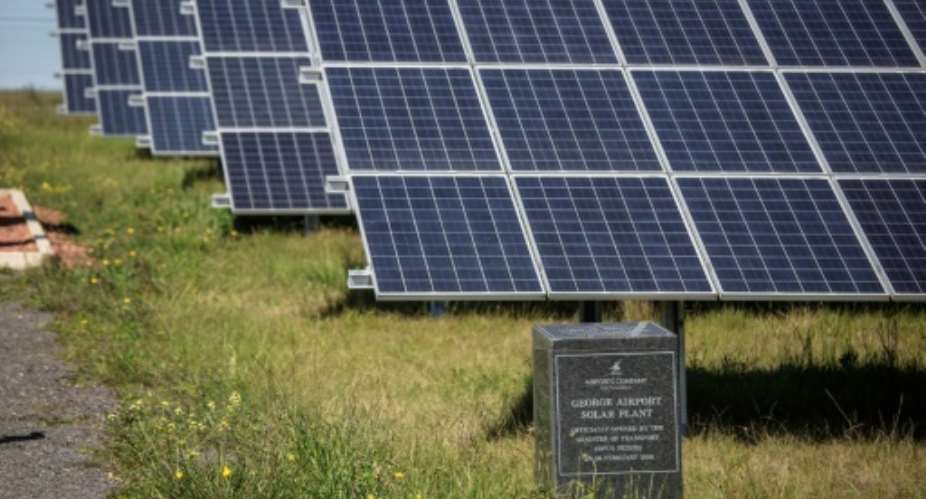
Solar energy could be a huge source of power in Africa, but its potential has been stymied by storage batteries that are too expensive and inadequate for use in poor countries.
The World Bank aims to break through that bottleneck, announcing plans Wednesday to invest $1 billion -- and leverage it by another $4 billion -- to boost developing countries' energy storage capacity from 4.5 to 17.5 Gigawatt hours by 2025.
While solar energy is abundant, the sun goes down around 5:00 or 6:00 pm in most of the African continent, making storage capacity crucial to providing a continuous supply of electricity.
It is a limitation with no impact on diesel and other fossil fuels in wide use to generate electricity.
Africa, where solar power is an "unmissable" source of energy, will be the first to benefit, said Riccardo Puliti, head of energy practice at the World Bank.
Bangladesh and other developing countries of Southeast Asia also will benefit from the World Bank's investment, which aims to stimulate a fledgling market and to create a "virtuous circle."
"We want to develop the market for batteries in developing countries," Puliti told AFP. "Storage has a great future."
Lithium batteries are available today, but they are made principally for electric vehicles.
Instead, the World Bank would like to see affordable batteries that are scaled to village life, capable of lasting seven or eight hours at night, resistant to extreme temperatures and require little maintenance.
The cost is a crucial factor. Today, the best batteries available in industrialized countries cost $200 to $300 per kilowatt hour of installed capacity, or less.
In developing countries, they are prohibitively expensive, ranging in price from $400 to $700 per kilowatt hour.
The World Bank's goal is to bring those prices down in the coming years.
"Battery storage can help countries leapfrog to the next generation of power generation technology, expand energy access, and set the stage for much cleaner, more stable, energy systems," said World Bank President Jim Yong Kim.
Now it's up to manufacturers to heed the call, and develop the appropriate technologies.


 Supreme Court to rule on bid to halt High Court trials during legal vacation on ...
 Minority is right, Ghanaians need to know how GoldBod losses came about — Manass...
 Accra–Tema Motorway project reaches 50% completion as roads minister demands fas...
 Nationwide blackout: Power supply expected to stabilise next month – Energy Mini...
 GES interdicts two BOGISS watchmen over alleged sexual assault of special needs ...
 Mineworkers protest, demand release of locked-up funds for over 19,000 miners
 August 20: Cedi sells at GHS12.25 on forex market, GHS11.08 on BoG interbank
 'Bow your heads in shame for employing people with huge Facebook followers as pr...
 Sammy Gyamfi admitted $1.7bn GoldBod loss but blames other institutions – Afenyo...
 ‘A loss is a loss’ – Prof Atta Peprah rejects GoldBod’s defence of $1.7billion l...

