




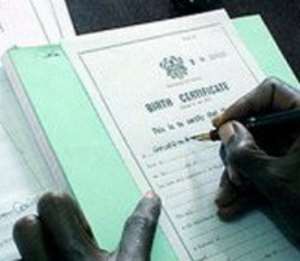
I was shocked when I read that the Department of Birth and Death Registry is raising questions about some Ghanaian names. Some Ghanaians are compelled to have their names changed to reflect the current of 'civilisation' of the colonised person. It is a truism that we always live in the colonial moment. Considering the fact that colonialism lasted for less than a century, some scholars have suggested that the colonial enterprise was simply a passing interlude in African history.
The truth of the matter is that such scholars look at colonialism simply from the point of view of the formal establishment of colonial rule over Africans, following the Berlin Conference in the latter part of the 19th Century. Such a narrow perspective has the tendency of blinding us to the enduring effect of the colonial enterprise. Everyday, we find ourselves living in the colonial moment. Whether in popular or/and academic discourses, the colonial moment is always a reference point.
The colonial moment finds deeper expression in our culture of naming. My name Charles gives me a kind of identity that reflects the colonial moment. However, my name Prempeh links me to my cultural root and ancestral background. And to show that I belong to two worlds: the world of my ancestors and the colonial moment, I bear two names: Charles Prempeh. I have taken the trouble to read about some of the persons who bore the name Charles in history, and the legacy they left behind. Persons like Charlemagne, Charles Finney, Charles Wesley, Charles Parham, Charles Spurgeon, and Charles Martel left indelible mark in history. But sadly, I cannot relate to any of these persons, beyond the fact that I bear the name Charles. If anything at all, the name ‘Charles’ reminds me of how my ancestors were brutally subjugated by the colonisers!
Prempeh rather links me to my ancestral history. Prempeh's life is a catalogue of controversies. Prior to his rise to the stool of Asanteman, Komfo Anokye had prophesied that Asanteman was likely to breakup if a ‘light-skin’ person rose to the stool. As fate would have it, Prempeh was a ‘light skin’ person. His choice as Asantehene, therefore, inspired protests among some of the old guards who knew about Komfo Anokye’s prophecy. Unfortunately, his ascendance to the stool coincided with British move to colonise Asante. Knowing the prophecy of Komfo Anokye, he avoided conflict, by going into negotiation with the British.
Even with such negotiation, he was not spared. War broke out. He was picked, and after fruitless pleads to remain in Cape coast, for fear of the sea, he was still carried to Seychelles Island. While in Seychelles, he converted to Christianity in 1904; and supposedly dropped his entire stool wives, and kept only one. He started learning how to read the Bible and encouraged his people back home in Asante to send their children to school. To demonstrate his ties with English ‘civilisation', he took Edward as his English name. He also joined the Anglican Church to draw closer ties with the monarch of England.
When Prempeh was allowed to return to Gold Coast, he went back for his numerous stool wives; engaged more in tradition, and resumed his responsibilities as the liaison between the ancestors/living dead and the living. But he kept his relationship with the church. On the day of his death, his driver drove him to the St. Cyprian Anglican Church in Kumasi, but he was too weak to come out of his car. So he gave his offering to his assistant, who went and dropped it in the offertory bowl. Prempeh returned home and died a few hours later. Prempeh also had Agyeman, which means ‘saviour of the nation’ to his name. When I read about Prempeh, I read different meanings into the history of the Asante. I also peep into my own life. What does Prempeh mean for me: oscillated-minded? Strategic? Diplomat?
Among many groups in Ghana, naming is not done without contextualisation. Among the Akan, names have historical, economic, and religious significance. In other words, Akan people name to reflect the day of birth, honour ancestors, mark special events surrounding the birth of a child, and indicate where one belongs to in line of many children. Names show the circumstance of the parents at the birth of one. Theophoric names also show the theological outlook of many Africans.
A person could be named Nana Yaw Nyamekye Bediako. Such a collection of names has meaning. Nana means that the person was named to reflect a particular ancestor. Yaw tells that the person was born on Thursday; while Nyamekye indicates that the child is God's gift. Finally, Bediako is a militaristic name, which indicates that the child was born at a time of protracted warfare.
The whole notion of surname is a colonial imposition on the Akan. Plus or minus, surname concept has become part of the naming culture of many Akan people. Nonetheless, it would be self-imposed recolonisation/neocolonisation if Ghanaians were compelled to drop names like Nana and Maame. These names are histo-cultural names, which reflect the ancestral connections of the bearer. My younger sister is called Maame Ama Aduah. My father, while he was alive, rarely called her by her name. Since she was named after our paternal grandmother, my father mostly called her, ‘me maame.' One of my names is Nomafo, which was the name of one of my paternal grandmothers, who was called Nomafoa. The children of that paternal grandmother of mine never call me by my name. They call me, 'me maame.' I get feminised when I meet them.
If we have no objection to some names with arbitrary meanings in the Ghanaian context like, 'Woodson', 'Rockson' 'Roland', 'Scholastica', 'Livingstone', 'Majorine', and 'Fidel', then we need to reorient our understanding of how we engage the colonial moment. Both Christians and Muslims are guilty of projecting their names as Christian or Islamic names. All the names we refer to as Islamic or Christian were names that preceded both Islam and Christianity. It is sad that when one becomes a Muslim, one is 'compelled' to take Arabic name, which as I have said is wrongly assumed to be Islamic name. Abu Bakr did not have to change his name when he became a Muslim. Mohammed bin Abdallah's father was called 'Abdallah, which means slave of Allah, and yet he was not a Muslim. All the Ansar and Muhajirun that I know maintained their names when they became Muslims.
James, Thomas, Philip, and John maintained their names when they became Christians. Sadly, African Muslims and Christians have to take Arabic and European names to show that they are better colonised. What a pity! We need to reconsider our engagement with other cultures. I would have loved to change my name 'Charles,' but sadly the demise of my father constrains me, since I want to keep his honour. But certainly, my children will have none of such names.
That said, I must point out that bearing an African name does not necessarily mean one would think from the African perspective. The idea of ‘Africanness’ is not just about names. What names do is to connect us to our ancestral root. I know that the children of mixed-raced marriages or miscegenation tend to have two names that connect them to their dual ancestral roots.
The officers at the Department of Death and Registry should consider the harm they are doing, and the cultural retrogression they are placing Ghana on. If we need to recapture our culture, which was plunged into near oblivion by the colonisers, then we need to start from our names. There is something in names that connect us to our root. Without root, we would wither. A borrowed water does not quench thirst!
Satyagraha
Charles Prempeh
African University College of Communications


 "Arrest contractors of Achimota–Ofankor road over potholes" – Kofi Gharbin urges...
 'I am ready to lead Ashanti region NPP with less talk and more action' — COKA
 'NDC said they did not need too many loans, but are now borrowing heavily' — Osa...
 Chairman Wontumi’s 20-year sentence is a clear case of selective justice — Adoma...
 Ghana’s public debt stock hits GH¢720.8bn, equivalent to 45.1% of GDP — BoG
 Ghana to replace periodic education surveys with real-time data system
 Bank of Ghana keeps policy rate unchanged at 14%
 Wontumi's 20-year sentence raises concerns about proportionality and fairness — ...
 Describing me as the worst-performing MP is demotivating and dangerous — Stephen...
 CAF chief Motsepe backs Infantino despite criticism


Comments
That's really true we need to stand up against what they are saying. Now I wish to change my Victoria and use my local name Maame Ama Gyamerah. Its really tells me where I come from and the kind of person I am. Our local names are really good. Am proud to be a Ghanaian. God bless our motherland.