




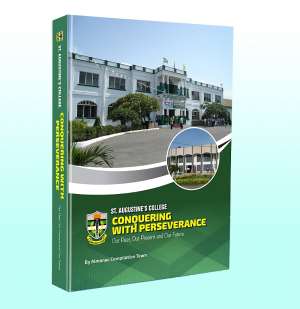
Reviewer: Nana Awere Damoah
When I picked up a copy of St. Augustine’s College – Conquering with Perseverance, considering how detailed and voluminous it was, I decided to play a game and to do a quality control of the work. I opened straight to Chapter 13, Celebrating our Teachers Through Reminiscence, and went through the list of teachers: Jacob Kwesi Bart Plange (APSU 1942), Joseph Jorie ‘JJ’ Mensah-Kane (APSU 1942), H.P. Nelson (APSU 1944), amongst others. These are names I grew up reading about. For seven years, I slept in a house of residence that bore the name of Kwesi Plange. So, in this chapter, I relived the history of the formation of my own school. And I was hooked! More on this historical link later, but, first, let’s take a tour of this almanac.
The Metropolitan Archbishop of Cape Coast first outlines how “as the premier Catholic Secondary School in Ghana, the history of St. Augustine’s College has been intricately linked to the Church.” This is as much a history book on Catholicism in Ghana, as it is on the church’s contribution to education, as the College was the major model for Catholic secondary schools (and vocational and basic schools) in Ghana.
It is worth noting that when two French Missionaries arrived in Elmina in 1880 after an initial lull, the Chief and his elders “appealed for a school for their children, much in line with the objectives of the missionaries” (emphasis mine, p. 5). This led to the establishment of the first Catholic school with five pupils.
This objective is well-captured in the opening paragraph of Chapter 2 (p. 23): “Education has generally been advertised as the best known instrument or process for moulding citizens in the right manner for personal and national development.” The Catholic Church has lived by this process “as part of its social agenda” and in furtherance of this, the St. Augustine’s Teacher Training College, established “for the training of teachers for Catholic schools” (p. 32) (after the institution of a seminary at Amisano), was a natural progression; as narrated in Chapter 3, with the inclusion of a meticulous first-hand report of the official opening of the Training College by the Gold Coast Governor, at Amisano, from the January 1930 edition of The Gold Coast Catholic Voice. Here, we first come across the name ‘Bucknor’, which same surname we later encounter in the stimulating interview with Charles Kofi Bucknor (APSU 1970) who gives more insight into his family’s association with the school. Charles, a famous Ghanaian actor and Television professional/personality (APSU President 2011 – 2013, Assistant Senior Prefect 1972/73), who was instrumental in the commissioning of this work, unfortunately passed away before this book was launched. Getting his story reinforces the urgency of documenting the lives and times of our forebears.
An the appeal for a secondary school ensued, for “inasmuch as the Training College and Seminary were of essential necessity to the growth of the Mission, some members did not believe their establishment was the right sequence of events…these members wanted the secondary school badly and nothing else” (p. 39). Chapter 4 to 7 tell the story: laying of foundation stone in 1935 and acceptance of 143 new students on 22nd January 1936. In Chapters 8 and 9, we learn how the College expanded, growing into a formidable institution of excellence. Chapter 5 tells about the person of St. Augustine and how the College was named after him.
Chapter 6 takes us into the life and soul and mind of St. Augustine’s College and those who passed through the college: the philosophy, ethos, identity and principles. Everyone who has been through boarding school has a special attachment towards his house and this sentimentality is honoured in Chapter 10 where the history of the houses of residence are recounted.
Much of the rest of the book gives us the APSUnian way of life through the eyes of those who went through the school and the school went through them. Chapters like Student Campus Life, Augusco as a Citadel of Arts and Myths and Legends are a delight to read. Take a galley through the Augusco lingua and how the APSU-HOPSA marriage evolved and you won’t be amiatu when it comes to buying this book!
In celebrating teachers who have toiled to make the College what it is today, the history of Augustine’s College and my school merge, where we learn about how the sacking of three teachers and students from the College in 1948 led to Osagyefo Dr Kwame Nkrumah founding another College, with the first set of students and teachers being the sacked ones from St. Augustine’s.
My favourite chapter is titled Reminisces through the decades by APSUNIANS. The interviews are personal, insightful, anecdotal and funny. This chapter encapsulates all the book is about, and summarises the APSU spirit.
What is an old-school book without a roll call? Augustine’s College does have an enviable list! The roll of College Senior Prefects since 1930 (p. 253-255) is an insightful read. One can easily recognize names that went to achieve laurels nationally and globally, a lesson that leadership is honed in the formative years of secondary school and the need to develop critical social skills apart from academic acumen.
What an astonishingly-comprehensive work St. Augustine’s College – Conquering with Perseverance is! The writers did a fantastic job accessing archives and records – ancient scrolls. Names of pioneer staff, cost of fees, course structure and curriculum…which will excite the history aficionado.
In a way, this review became personal. In the list of founders in Appendix Two, I found the name Nana Intsiaku Bonin II, Akropong (Wasa Amenfi), who is listed as Number 13, having contributed a minimum of 10 British pounds “to qualify as Patron”. ‘Intsiako’ is spelt ‘Ntiako’ in my holy village – I have a brother with that name – Ntiako Mensah. And, under the list of special donators, I found another personal link at Number 264: ‘Nana Paramantoe II, Omanhene of Upper Wassa’. Spelt in our family as ‘Nana Premang Ntow II’, this Omanhene previously known as Nana Kwabena Damoah, is my paternal grandfather.
With such a connection, it is no wonder that my uncle and future Omanhene of my traditional area – Kasapreko Nana Kwame Bassanyin III – would become an APSU, listed under Prominent Past Students, Chieftaincy section. My cousin, Vincent Damoah, the son of the eldest son of Nana Premang Ntow II, is APSU ’90.
As I conclude, I humbly submit that the book is missing a good index, as it will be difficult for a reader to track all the detailed information therein without one.
We don’t document our history enough and much of our oral history – which is what we have in many cases – is dying as the main actors pass away. Which is why the book St. Augustine’s College – Conquering with Perseverance is such an important addition to the world of literature.
The writer is an author of seven books, a publisher/co-founder of DAkpabli & Associates and a lecturer with the Creative Writing Academy, Accra.
[1] APSU – St. Augustine’s Past Students’ Union
 No room in our standing orders for reconsideration of anti-LGBTQ+ Bill – Sam Geo...
 Court threatens to struck out Mamprobi Baby theft case over disclosure delays
 How ex-convict allegedly sealed teenager's mouth with super glue, raped and murd...
 About 70% of buildings in Ada East lack permits, to be demolished – DCE
 Accra will no longer be sanctuary for indiscipline — Linda Ocloo declares after ...
 Bono Region: Police investigate murder of retired veterinary officer
 GMA says no emergency patient was denied care at KATH despite congestion concern...
 VIDEO: Fuel tanker driver burnt to death in fiery crash at Adubinso, seven shops...
 IMF boosting financial support for four African nations over war impact
 Anti-LGBTQ+ bill: Public clash between Speaker Bagbin and Majority Leader needle...



Comments
believe it is a very good initiative l dont really know if its the first of its kind in Ghana.