




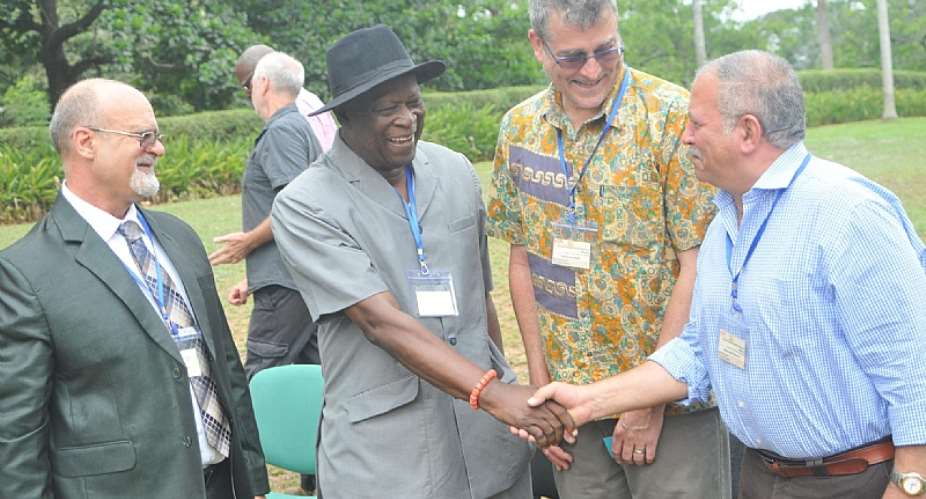
Researchers working under the International Institute of Tropical Agriculture led Cassava Weed Management Project (IITA-CWMP) will this week share findings and recommendations on how to tackle weeds in cassava farming systems.
The sharing of research findings is part of activities marked for a week-long annual review and planning meeting and Steering Committee meeting scheduled to hold 27-30 March 2017 at IITA in Ibadan.
“We are optimistic that the key findings from our research will help farmers to tackle the problem of weeds in cassava, with the view to having more yield,” says the Project Leader of IITA-CWMP, Dr Alfred Dixon, who is also a Director with IITA on Monday.
Declaring the meeting open, Dr Kenton Dashiell, IITA Deputy Director General, Partnership for Delivery, said the goal of the project was to take off drudgery due to weeding in cassava farming systems.
“I am happy that this meeting will share findings that will impact positively on weed control,” Dr Dashiell said.
Grown on about 7 million hectares, cassava is a major staple in Nigeria and it has transited from a food security crop to a cash crop. However, yield per ha of the root crop is about 8 tons per ha or less than half the amount realised on research stations. One of the major factors affecting the yield of cassava is weeds. Most of those involved in weeding are women and children, often times skipping classes to assist in weeding in Nigeria.
In 2014, the Cassava Weed Management Project was conceived to address the problem of weeds in cassava. The 5-year project which is supported by the Bill & Melinda Gates Foundation is exploring diverse weeds control methods including the use of simple motorised implements, use of safe and environmentally friendly herbicides, and the use of best-bet agronomic practices.
This year, which is the fourth, researchers, will make available findings of what has been done over the period.
Lawrence Kent of the Bill & Melinda Gates Foundation said the findings of the project would contribute to improvement of cassava with positive impact on women and children who bear the burden of weeding in cassava.
“Our major task in this meeting is to translate research findings into recommendations that farmers can use to improve cassava farming and their livelihoods,” he said.
Dr Dixon said the project is in an exciting phase. “This is an exciting time for us… Because we are going to begin the sharing of new findings to farmers and farmers will begin to benefit,” Dr Dixon said.
The IITA Cassava Weed Management Project is being implemented in Nigeria by IITA in partnership with the National Root Crops Research Institute (NRCRI) Umudike, Federal University of Agriculture Abeokuta, University of Agriculture Makurdi, and the state-based Agricultural Development Programs of Abia, Benue, Ogun, Oyo; and non-governmental organisations including the Justice Development and Peace Movement (JDPM) in Oyo and Abeokuta, and KOLPING in Abia.
For more information, please contact: Godwin Atser, [email protected], Communication & Knowledge Exchange Expert.

 Adu-Boahene’s lawyers ask court to strike out fabricated, invented evidence in D...
 'He is part of National Film Authority' – Kwasi Kwarteng exposes Obuasi SHTS hea...
 'Mahama should have appointed Edudzi Tameklo to EC to teach hypocrite NPP some s...
 'You have no moral right to complain about cost of living' – Prof Anankware to B...
 'You did the same thing' – Solomon Owusu defends EC appointment
 GFL vows to pursue justice for worker who lost five fingers at Afienya Industria...
 State to call first witness on January 12 in Canadian murder case
 Haruna Iddrisu refers Obuasi SHS headmaster's sexual misconduct allegations to C...
 Bawumia is a ‘prophet of pocket economy’ in opposition, ‘priest of paper economy...
 Bolgatanga Technical University Council Chairman allegedly locks up Vice-Chancel...


