




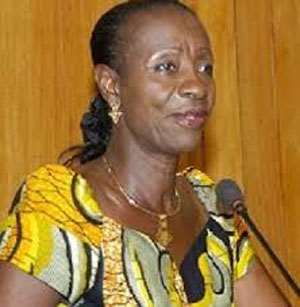
The Minister of Health being interviewed by journalists
The Minister of Health, Sherry Ayittey, has called for more prudent management of the health sector's financial resources.
According to her, funds channeled into the sector are dropping, hence the need to ensure the effective management of what 'little' the sector receives from government and development partners.
'We have to reduce the unbudgeted spending and cut out waste in the system,' she charged health care professionals and heads of departments at the 2014 Health Summit in Accra.
Ms. Ayittey said although the Ministry of Health is noted to have one of the best financial management systems, there are concerns about unbudgeted expenditure and lack of data in a timely manner.
'One of the key characteristics of a good financial management is budget discipline, which forms the basis for efficient running of an organization,' she noted.
The minister also observed that the future of the health sector would be determined not by the amount of money spent on drugs and health infrastructure, but primarily by efforts to manage the external factors and the limited resources.
She indicated that steps had been initiated to ensure that as much as possible, the sector spends only what has been budgeted for.
The 2014 Health Summit brought together healthcare professionals, government officials and beneficiaries to review the performance of the sector and deliberate on ways to accelerate target achievements.
Ms. Sally Taylor, representative of the development partners, said they (partners) understood the challenges facing the sector but urged the ministry to work toward bridging the gaps.
She said the post-2015 Millennium Development Goals (MDGs) talks were already underway with the goal of equal access to healthcare for all.
Professor Kwamena Ahwoi, guest speaker for the opening ceremony, reiterating the need for health sector decentralization, said the idea is a constitutional imperative.
He said the devolution of the sector would bring some challenges such as training health professionals, unionizing the staff of the health institutions and the confidence in the capacity and capabilities of the district level political leadership.
However, he noted that the challenges were not insurmountable and therefore called for a collective effort in ensuring that the proposal works.
By Jamila Akweley Okertchiri
 More evacuees arrive from South Africa as government rolls out jobs support plan
 More than 1.2 million people attend Pope's mass in Madrid
 Nigeria: Hundreds of kidnapped women, children freed from Boko Haram jihadists
 Kosovo votes again in snap election as frustration grows over political gridlock
 Young Entrepreneurs call for increased Adwumawura funding, conversion of NEIP to...
 Tanyigbe Dzafe unveils new divisional chief, roll out development agenda
 Somalia says 1 killed, 55 hurt in this week's political violence
 How overexploitation of sand is threatening ecosystems and livelihoods
 Ablakwa Vows Compensation for SA Returnees as Ghana’s Evacuation Drive Hits 637
 Avenor Building Collapses; One Critical, More Feared Trapped as Rescue Mission I...


