




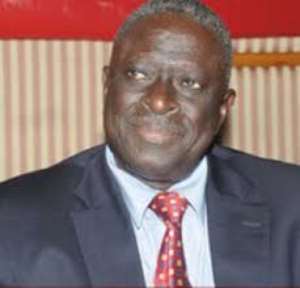
Mr. Paul Victor Obeng, a senior Presidential Adviser, has called on stakeholders in the water and sanitation to work hard to improve the sectors. The occasion was the 24 th edition of the Mole Conference in Kumasi, under the theme, 'Building Effective Partnership for Scaling-Up Sustainable Sanitation Service in Ghana.'
It was organised by the Coalition of NGOs in Water and Sanitation (CONIWAS), with support from many sector players, including the Ministries of Water Resources, Works and Housing and Local Government and Rural Development.
The Mole Conference annually brings together state agencies, civil society organisations, and private participators in water and sanitation to brainstorm on how to improve access to these services.
Delivering a keynote address on behalf of the President, Mr. Obeng reflected on the current level of access to improved toilets of 15% against the MDG target of 54% with just 29 months to go, and admitted that this was an indication that all was not well with Ghana's sanitation management.
He urged the conference to focus on building 'new coalitions of the willing' that will appreciate our limitations, codify our sanitation challenges, and apply appropriate technologies to improve access to sanitation services.
Mr. Obeng further urged the stakeholders to call themselves to order, and be prepared to name and shame the non-performers.
He stated that Ghana had not achieved its MDGs in water and sanitation with less than three years to 2015, the target year, hence the theme, maintaining that something went wrong, and that there was the need to focus and evaluate on the sector's objectives.
Professor Mrs. Esi Awuah, Vice Chancellor, University of Energy and Natural Resources, Sunyani, said even though private sector participation had increased, work could not progress due to bribery and corruption, which had made contracts land in the hands of incompetent people.
She said political interference had also had a negative impact on the sector. This, she said, discouraged people from being responsible, and encourages nepotism, tribalism, and bribery.
According to her, countries were becoming dependent on development partners for service delivery, since governments had low knowledge on quality delivery, adding that the quality of every community is determined by the quality of the mindset of its leadership.
Mr. Akwasi Opong-Fosu, Minister of Local Government and Rural Development, tasked District Chief Executives (DCEs) to root-out indiscipline and politics, and execute government policies and bye laws in the sector.

 Adu-Boahene’s lawyers ask court to strike out fabricated, invented evidence in D...
 'He is part of National Film Authority' – Kwasi Kwarteng exposes Obuasi SHTS hea...
 'Mahama should have appointed Edudzi Tameklo to EC to teach hypocrite NPP some s...
 'You have no moral right to complain about cost of living' – Prof Anankware to B...
 'You did the same thing' – Solomon Owusu defends EC appointment
 GFL vows to pursue justice for worker who lost five fingers at Afienya Industria...
 State to call first witness on January 12 in Canadian murder case
 Haruna Iddrisu refers Obuasi SHS headmaster's sexual misconduct allegations to C...
 Bawumia is a ‘prophet of pocket economy’ in opposition, ‘priest of paper economy...
 Bolgatanga Technical University Council Chairman allegedly locks up Vice-Chancel...


