




Community sentence is a statutory order imposed by the court, which provides the framework for a probationary programme that aims at rehabilitating the offender through the community, with the focus of the intervention strategy at addressing the multi-faceted challenges of criminal behavior.
It is never a soft option, as it combines punishment with changing behaviour and making amends, sometimes directly to the victim(s), if not the community, a sentence that is both suitable for the offender and commensurate with the level of seriousness of the offence.
Community sentence order can and should only be available to certain types of offences and for certain types of offenders. The serious offender who is at significant risk to the community will not satisfy the criteria for such an order, given that the order should be aimed at those offenders who would normally attract a short sentence for minor offences or misdemeanors and who do not pose any significant risk to community safety.
The order is also designed to offer offenders with the framework within which they can develop and acquire new skills and the opportunity for practical learning in real situations, which can prepare them for employment and or formal training.
Management/supervision of community sentence order: The community sentence management or supervision officer, mostly a trained probation officer( professional training in offender management and rehabilitation ) , would involve the offender in an assessment process which will include offence analysis, offending related needs of the offender and risk of re-offending and or of self-harm.
A process which informs the professional judgment of the probation officer, in devising a most suitable, relevant and appropriate supervision / work plan with the offender, incorporating offender management intervention strategies, with focus on the individual's participation in support groups, individual one-to-one counseling sessions, cognitive behavior modification therapy and other specified activities such as alcohol/drug education , anger management or conflict resolution and sexual education programmes.
A further intervention initiative may include restorative justice, victim awareness and victim empathy, and or victim-offender conferencing, mediation and reparation. The probation officer would also provide the offender with the unique opportunity to raise issues that may be important to them, such as family and relationship issues, employment, education and or training, and engages with the offender, helping to keep him/her motivated to undertake the tasks necessary to reduce their risk of re-offending and risk of harm. Supervision sessions can also be used to monitor progress and address issues as they may arise.
Practitioners would be mandated to share information with agencies such as the police, prisons and the ministry for gender, children and social protection, so as to protect others who may be vulnerable, given robust partnership working would be critical to the successful management and rehabilitation of offenders.
Enforcement of the community sentence order: The probation officer is responsible for ensuring that the offender complies with all aspects of a community sentence order. Duration of the community sentence order: For a community sentence order, the maximum sentence would normally be three years and dependent on the prerogative of the sentencing court, albeit taking cognizance of the level of risk posed to community safety and that of re-offending, although the minimum tariff could be six months.
Community service order: The sentencing court can involve unpaid work requirements, known as community service, as part of a community sentence, with the objective of providing unpaid work, which is of value to the community, as an alternative to custody to be undertaken within a determined time scale, fixed by the sentencing court. Thus community service order is an opportunity offered by the sentencing court for the offender to compensate society for the wrong he/she committed, by performing work for the benefit of the community.
The court can impose a community service or community reparation order on an offender, following professional assessment for suitability by a community service/ probation officer , taking cognizance of the level of seriousness of the offending behaviour, with the expectation for the offender to undertake some hours of unpaid work within the community.
Clearly, community service is an order of the court, where the offender is provided with unpaid and useful work for community benefit. Under the unpaid scheme of work requirement, the offender can undertake work between 40-300 hours on a local community project, under the supervision of a community service supervisor.
The offender would normally receive induction at the beginning of the order, which may cover essential information as: Conditions of the community service order, Standard of behavior, Expected work placement, Attendance and punctuality, Disciplinary procedures, Health and safety. Range of placements: Horticulture and or gardening, Painting and decoration, Carpentry and joinery, Bricklaying and construction, Street auditing, maintenance, repair work at lorry parks and or community access roads, Environmental and sanitation management, Any such other activities relevant to the development of the community Enforcement of the order: Community service order is normally enforced vigorously in accordance with laid down guidance and procedures. If the terms and conditions of the order are breached, the order will have to be taken back to court, where the court can impose a fine for the breach and request the order to be continued.
The court may so desire to revoke the order entirely and re-sentence the offender on the original offence. Significantly therefore, there exists a clear distinction between community sentence and a community service order, the latter being a one element of the previous, which covers other such orders as probation order or a community punishment order. Training needs: Invariably, all key players within the criminal justice system will require and benefit from all aspects of training,( refresher courses, workshops and seminars ) relevant and appropriate for the shift in penal policy towards the agenda for community sentences.
These will include judges, magistrates, prosecutors/police, prison officers and probation officers/ community service supervisors. Given that the probation officer will be the focus of managing the offender in the community, a greater emphasis will be placed on their training and education, as they will require almost new skills, knowledge and expertise if they are to deliver quality and best practice service to both the courts and offenders, in meeting national and any international standards of probation practice.
It may become appropriate to set up a centre for criminal justice studies, which should have the necessary capacity to co-ordinate and facilitate relevant and appropriate training. There is the prospect of accessing technical co-operation and support from the penal reform international and the international directorate of the justice ministry of the United Kingdom.
Expected practice outcome: There is no doubt that promoting the agenda for alternative to custodial sentencing or developing community sentences in Ghana, will contribute a great deal to: Addressing prison congestion or prison overcrowding, save considerable financial resources for national development, address the numerous criminogenic needs of offenders, assist , support and promote their rehabilitation, provide the scope for their reintegration and resettlement, offer considerable public protection and promote the prevention of reoffending.
It is my professional opinion that a penal policy with the characteristic features of rehabilitation ethos should and must be the direction Ghana's penal policy should go, as in line with the United Nations Standard Minimum Rules for Non-Custodial Measures and Penal Reform International's (PRI) global agenda.
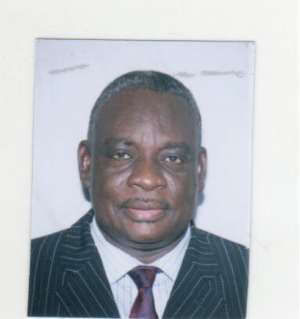
The author is a social care, offender management and rehabilitation consultant, and the operations director of offender management and rehabilitation organization, a Ghanaian non-governmental organization ( Omro ),is also an ardent penal reform advocate.
Editor's Note:
The author is a social care, offender management and rehabilitation consultant, and the operations director of offender management and rehabilitation organization, a Ghanaian non-governmental organization ( Omro ),is also an ardent penal reform advocate.
For further enquiries contact- email: [email protected] /Telephone: 0248 416 287

 Fire Service rescues trapped victim after STC Bus, Taxi collision at Konongo
 Private SHSs in Free SHS pilot programme demand payment of outstanding governmen...
 Police foil planned robbery, recover weapons at Kukuom
 A 53-year-old mechanic remanded for allegedly stabbing another over car battery ...
 Asiedu Nketiah urges IGP to speed up justice for victims of election 2024 killin...
 Each family receives GH¢15,000 support after Accra Police Barracks Fire
 Mussa Dankwah urges ministers to focus on performance amid MoFA–finance minister...
 Selling single cigarette sticks illegal – FDA
 Hungry, unhealthy workforce cannot protect nation’s health – GRNMA
 Health Minister orders suspension of KATH CEO over Emergency admissions directiv...


