




Since the end of the 11-year civil war in Sierra Leone (1991-2002), life continues to be very tough for Sierra Leoneans, particularly war victims.
Despite various international supports to boost the living conditions of Sierra Leoneans, the result is still not encouraging.
From the time peace was declared in 2002, leading to the holding of elections, the country has been graded as one of the poorest in the world, hugely depending on international aid for survival, whilst reconstruction has become one of the serious challenges in the country.
Over 50,000 people died as a result of the war, with thousands of people having their hands and legs chopped off and many more people displaced. Much of the country's infrastructure is in shambles, whilst over two million people are displaced, seeking refuge in neighbouring countries, mainly in Guinea http://en.wikipedia.org/wiki/Guinea , which is home to more than 600,000 Sierra Leonean refugees http://en.wikipedia.org/wiki/Infrastructure . http://en.wikipedia.org/wiki/Refugees
On 23 March 1991, the Revolutionary United Front (RUF), with support from the special forces of Charles Taylor's http://en.wikipedia.org/wiki/Charles_Taylor_%28Liberia%29 National Patriotic Front of Liberia http://en.wikipedia.org/wiki/National_Patriotic_Front_of_Liberia (NPFL), intervened in Sierra Leone in an attempt to overthrow Joseph Momoh http://en.wikipedia.org/wiki/Revolutionary_United_Front 's government. http://en.wikipedia.org/wiki/Joseph_Momoh
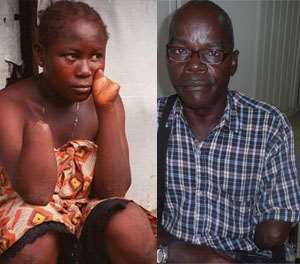
Although there is peace across the entire country currently, most of the war victims- orphans, widows, amputees and raped survivors and family members of war victims in Freetown- still cannot live as normal human beings as they are traumatised.
Apart from the serious economic hardships facing amputees and most war victims in Sierra Leone, the amputees are still discriminated against, and most of them cannot even get on a vehicle.
However, some of the amputees do not rely on handouts as they have a profession in football, from which they are making a living. The Sierra Leonean team was part of the recent amputees' football tournament hosted by Ghana and won by Liberia.
The Black Challenge, as the Ghana amputee team is known, won the silver medal in the Cup of African Nations for Amputee Football (CANAF) championship.
Ghana, winners of the inaugural edition in Sierra Leone, will join reigning champions, Liberia, for the World Cup slated for California, US early next year.
Nigeria and Sierra Leone, who battled it out in the third place game, will engage in a play-off and the winner will join Ghana and Liberia for the California tourney.
The president of the War Victims in Sierra Leone, Edward Conteh, in an interview with Daily Guide in Freetown on Thursday, November 24, 2011, lamented that amputees in Sierra Leone are being discriminated against in everything.
http://www.dailyguideghana.com/wp-content/uploads/2011/12/amputee.jpg 'The challenge we face is that nobody seems to have time for us, not even government. People in Sierra Leone feel or believe that having time for amputees would only waste their time or make life more uncomfortable for them in their current harsh conditions.
'Although we were full of hope when the 11-year conflict ended in 2002, the situation is still worse. Our major challenges are discrimination, not making public buildings disability friendly, getting access to education and health, and gaining employment.'
Presidential Intervention
Sierra Leonean President Ernest Bai Koroma , who was sworn in on 17 September 2007, shortly after being declared the winner of a tense run-off election over then incumbent http://en.wikipedia.org/wiki/Incumbent vice president http://en.wikipedia.org/wiki/Vice_President_of_Sierra_Leone , Solomon Berewa http://en.wikipedia.org/wiki/Ernest_Bai_Koroma of the Sierra Leone People's Party (SLPP), has been making several attempts to put the economy into shape but there is little improvement as was witnessed by http://en.wikipedia.org/wiki/Solomon_Berewa Daily Guide .
The people of Sierra Leone, as part of efforts to put things in order, told Daily Guide that they have formed a steering committee to ensure a successful conference to commemorate the country's on-going 50th independence anniversary.
The main duty of the steering committee, which consists of civil society, political parties, faith-based organizations and statutory institutions, among others, is to discuss the conference's progress, report and provide guidance and direction to tackle emerging challenging issues facing Sierra Leone as a country.
President Koroma is the chairman of the committee towards the conference dubbed 'Development And Transformation'.
At the second steering committee meeting on Wednesday, November 23, 2011, at the State House in Freetown, which Daily Guide was in attendance, President Koroma urged his countrymen to take control of their destiny by fully taking part in the discussions of the conference.
According to him, the conference is to map out ways for the development of the country and said Sierra Leoneans should use the past experience as an experiment for the next 50 years to come. President Koroma noted that the conference is aimed at mapping out ways for the development of the country.
President Koroma reiterated that the country can use the 50 years' experience to learn not to go back to where they came from as any such mistake can worsen the plight of the citizens, stressing that the conference should be used to unify the people.
Amputees' Reactions To The Conference
However, most amputees interviewed by the paper in Freetown are of the view that there is no need for the formation of the committee as the stakeholders are already aware of the challenges in the country.
They lamented that all promises that had previously been made by the president had not been fulfilled, adding, 'Nothing good could come out from this conference.'
Mr. Conteh bemoaned the plight of amputees in Sierra Leone, saying, 'I'm just from the provinces and I had been going round the city to find out what is happening to my colleagues. It is really heartrending. Most war victims, as I am speaking, are still suffering from bullet wounds and I can emphatically say that the current president is not even aware of it as he does not talk about.'
President Koroma has given an assurance that government will release some funds for health officers to go to the aid of some of the war victims and provide medicines to others.
According to Mr. Conteh, the war victims have been promised free health but nothing positive seem to have come out of it.
'My feelings are for the young boys who were amputated by the rebels at that time. Unfortunately, most of the victims were from the rural areas and farming was their only occupation. Since they were not business people, aid given to them are not enough and therefore depend on others.
'Our children are not in schools as a result of high cost of living and my fear is that these children will become future burden,' he said.
Victims' Testimonies
Mr. Conteh, who is one of the few amputees in the country fortunate enough to have a job and a high education level, narrating his ordeal he went through, said at age 58, in Freetown, he was amputated by rebel soldiers who, in the course of their shooting spree, arrested him and cut off one of his hands.
'I am of the view that no matter the cost, the leaders should try to support the children of amputees and provide the victims and their children with free education and health services. These children, if care is not taken, could in the future become fresh rebels, if their condition of living becomes unbearable'.
Mohamed Terawali from Waterloo in Freetown, Tamba Ngaujah, is one of the amputees of the war who had both of his hands cut off by rebel soldiers.
Narrating his ordeal to Daily Guide , he said, 'I was approached by the rebel soldiers in Freetown who asked me to join them to go on shooting spree. I was so afraid so I told them I cannot kill. The soldiers got furious and told me that if I do not want to use my hands, then they have to cut them off for me.'
Terawali, in tears, said the soldiers placed both of his hands on a wood and chopped them off.
'Most people, when they see us, say we are lazy and we want to just hang around the streets begging. But who is going to employ us, considering our state? Currently, it is really difficult for amputees to get a bus driver to pick us as they are of the view that we do not have money and even if we have, we will waste their time.'
“They just drive by us because they say we are useless 'cut men' with no money to pay them,” said Maxwell Kornah, who was shot by rebels and had to have his leg amputated 10years ago.
NGOs' Support
According to the International Organization for Migration, which is providing technical assistance and expert advice to the government in implementing the reparations programme, 21,000 people in 2009 received micro-grants, and out of the number, 235 female victims of sexual violence received fistula surgery or other medical treatment, some 50 victims had surgery or other treatment for life-threatening injuries and symbolic reparations ceremonies took place in more than 40 communities.
A sign of the disinterest is that no one can say how many amputees are in the West African country.
Estimates from the government and non-governmental organizations put the figure between 1,500 and 3,500.
Under the agreement that ended the war, and resolutions from the country's Truth and Reconciliation Commission http://www.seattlepi.com/?controllerName=search&action=search&channel=national&search=1&inlineLink=1&query=%22Truth+and+Reconciliation+Commission%22 , the government promised amputees free education, medical care and transport on public buses.
Currently, many war victims in Sierra Leone whom the paper met in Freetown seem to be losing patience and have accused the government of making empty promises.
Since the war ended in 2002, Peter Anderson, spokesperson for Sierra Leone Special Court, in an interview with Daily Guide in Sierra Leone, said ex-fighters have been receiving training and cash for disarming.
However, the people most mutilated by both sides in 11-year war have to make their living by begging in the capital city of Freetown, he added.
After the war, thousands of amputees housed at a camp in the western part of Freetown, dubbed the Amputee Camp, were relocated to their home districts.
But only 400 of them, the paper was told, have so far benefited from a shelter scheme organized by the Norwegian Refugee Council.
 Fire Service rescues trapped victim after STC Bus, Taxi collision at Konongo
 Private SHSs in Free SHS pilot programme demand payment of outstanding governmen...
 Police foil planned robbery, recover weapons at Kukuom
 A 53-year-old mechanic remanded for allegedly stabbing another over car battery ...
 Asiedu Nketiah urges IGP to speed up justice for victims of election 2024 killin...
 Each family receives GH¢15,000 support after Accra Police Barracks Fire
 Mussa Dankwah urges ministers to focus on performance amid MoFA–finance minister...
 Selling single cigarette sticks illegal – FDA
 Hungry, unhealthy workforce cannot protect nation’s health – GRNMA
 Health Minister orders suspension of KATH CEO over Emergency admissions directiv...


