




DABAGA, Niger (AFP) - "The Tuareg rebellion has brought nothing good to our zone, and armed bandits and the Libyan conflict are pushing us further into poverty."
Tchimaden Ahmed, a 36-year-old mother of eight from Dabaga, in northern Niger's desert region, did not mince her words.
"We live like in the Middle Ages: no electricity, no telephone, not even a mill for our grain to relieve us from the drudgery," she added, in the local Hausa language.
Dabaga lies some 50 kilometres (30 miles) -- a white-knuckle, two-hour drive along the Air mountain range in a district that was once the heartland of the Tuareg rebellion.
A sign warns travellers arriving in this town of some 4,000 people of the land mines scattered in the region during the 2007-2009 Tuareg uprising.
The desert nomads wanted their share of the wealth generated by the uranium mined in northern Niger.
It is barely daybreak, but the women and children are crowding around the drinking wells to replenish their stocks for the next few days.
On the Saturday, people come in on the back of donkeys or on foot for the weekly market -- and for the latest on the local unrest or the situation in Libya. A number of local people still live over Niger's northeast border in the troubled nation.
A group of 10 soldiers, armed with Kalashnikovs and posted with an armoured vehicle near the market, check cars and pedestrians alike.
The army presence, explains deputy mayor Rhissa Mohamed, highlights the persisting insecurity from the former rebels who, since laying down their weapons, have had to fend for themselves as best they can.
Traditional chief Ghoumour Koussou, dressed in a white turban and boubou -- the flowing, wide-sleeved robe common to this part of Africa -- also lamented their plight.
"Enough is enough!" he said. "The tourists and the aid agencies have fled."
And the land mines scattered throughout the region had had not only disrupted trade but also made moving cattle a perilous affair.
Add to that the threat posed by Al-Qaeda in the Islamic Maghreb (AQIM) and it was little wonder westerners had abandoned the region. Al-Qaeda's north African branch currently holds four French hostages and an Italian tourist kidnapped in southeast Algeria in February.
Ellias Maha, who works for Handicap International, is still working in the region -- and given the proliferation of mines, he has his work cut out for him.
"Watch where you put your feet," he told a group of local women and children gathered in the courtyard of a house. "Don't pick up strange-looking objects."
He accompanies his talk with pictures of the deadly weapons that await the unwary.
"We live with danger," says Mahaman Ghissa from his perch on a palm tree at a nearby oasis, where he is picking dates.
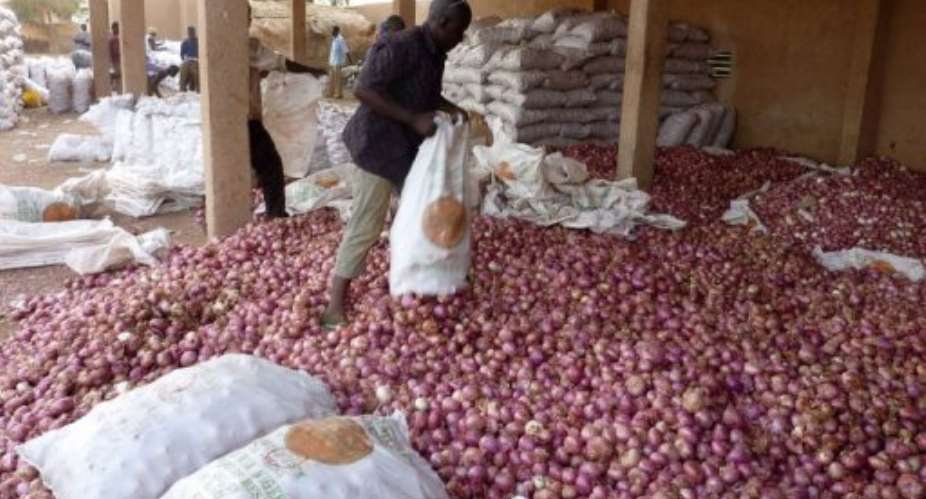
His companion, Amoumoune, piling up sacks of locally grown onions, laments the collapse in sales neighbouring Libya, normally a major customer.
"Exports to Libya are paralysed, which has meant a sharp fall in takings," he said.
Rhissa Mohamed, who also runs a major onion-growing operation, said his turnover had fallen this year to just 300,000 CFA francs (450 euros, $635) from several million in 2010.
Given the sudden drop in demand, the price of a sack of onions has plummeted to less that 5,000 CFA francs, four times cheaper than the previous year, to the point that unsold stocks are beginning to rot away in the warehouses.
While the women of Dabaga are glad to see their husbands, forced to flee the unrest in Libya, back home, that does create its own problems.
Fatima, a mother of six, said her husband had returned with little but a mobile phone to his name.
"I have just sold one of my goats to buy powdered milk and tea," she said.
Local chief Ghoumour Koussou spoke of his fears regarding the returnees -- that desperate to survive, they might join the growing ranks of armed bandits.
© 2011 AFP
 Mussa Dankwah urges ministers to focus on performance amid MoFA–finance minister...
 Selling single cigarette sticks illegal – FDA
 Hungry, unhealthy workforce cannot protect nation’s health – GRNMA
 Health Minister orders suspension of KATH CEO over Emergency admissions directiv...
 Our expenditure ceiling for first half of 2026 was capped at GH¢910 million - Ag...
 Agric Ministry refutes Finance Ministry’s GH¢1.6bn allocation claim
 NIA begins one-month mop-up Ghana Card registration for children in Volta, Oti r...
 Barekese Water Treatment Plant to be closed from June 9 - 11 for maintenance — G...
 Prioritize safety and security of nurses and midwives — GRNMA urges government
 Man who assaulted midwife at Tema Community 22 Polyclinic to face court on June ...


