




A retired educator and a former Council member of the Mfantseman Municipal Assembly, Mr. Dag Akyeampong has called on Ghanaians to treat unfortunate people with mental health issues with respect. He also called on the the government to put structures in place and to offer the necessary incentives to support the good works of some Non-governmental organisations who are offering good services and programmes that are shaping national policies and inspiring positive change in many communities in Ghana.
Mr. Akyeampong made the call during a special seminar to commemorate the WORLD MENTAL HEALTH Day and was hosted by three NGOs, the Centre for Human Development & Social Change,Ghana, and two branches of US Non-profits, the International Centre for African Culture & Arts, and the OBAATANPA International at Mankessim in the Central region of Ghana.
To bring home the importance of this day, we want readers to help themselves with the following information below:
World Mental Health Day, according to the organisers, is supported by the United Nations (UN), is annually held on October 10 to raise public awareness about mental health issues worldwide. This year's was special because it fell on a special date 10/10/10.
World Mental Health Day, though is not a public holiday, is observed in more than 100 countries on October 10 through local, regional and national World Mental Health Day commemorative events and programmes. Mostly among the activities are:
• Officials signing the World Mental Health Day proclamation.
• Public service announcements.
• Educational lectures and the distribution of research papers on mental health issues.
• Awards to individuals or organizations who made significant contributions in improving mental health issues.
World Mental Health Day is an initiative of the World Federation for Mental Health (WFMH). The World Health Organization (WHO), which is the UN's directing and coordinating authority for health, supports this event. The Mental Health Foundation is another organization that is proactive in promoting World Mental Health Day.
World Mental Health Day is observed in more than 100 countries on October 10 through local, regional and national World Mental Health Day commemorative events and programs. Activities include:
• Officials signing the World Mental Health Day proclamation.
• Public service announcements.
• Educational lectures and the distribution of research papers on mental health issues.
• Awards to individuals or organizations who made significant contributions in improving mental health issues.
World Mental Health Day is an initiative of the World Federation for Mental Health (WFMH). The World Health Organization (WHO), which is the UN's directing and coordinating authority for health, supports this event. The Mental Health Foundation is another organization that is proactive in promoting World Mental Health Day.
Mental disorders affect nearly 12 percent of the world's population – about 450 million or one out of every four people around the world – will experience a mental illness that would benefit from diagnosis and treatment. WHO statistics for 2002 showed that 154 million people globally suffered from depression, which is a form of mental illness. According to WHO, mental health is defined as a state of well-being in which people realize their own potential, can cope with normal life stresses, can work productively, and can contribute to their community.
Mental health services lack human and financial resources in many countries, particularly low and middle income countries. More funding is needed to promote mental health to increase people's awareness of the issue. In response to making mental health a global priority, World Health Day was first celebrated in 1992 as an initiative of the WFMH, which has members and contacts in more than 150 countries. Each year the UN, through WHO, actively participates in promoting this event.
Mr. Dag Kofi Akyeampong, the former Assemblyman and currently the interim Chief Executive of the International Centre for African Culture & Arts, in his speech focused on the mental disorders affecting many people in the communities especially young women and many young men. He attributed many of the causes of mental health challenges to lack of religious upbringing and the abandonment of cultural values. He said many of the causes are through relationship break ups and its effects of heart breaks and that of the young men through the abuse of drugs.
He said it is important that civic clubs are formed in schools and communities to create awareness about many important issues. He continued that it is to meet this mission that the three organisations are pulling resources together to build a community centre at Mankessim that will offer programmes that will help address some of the challenges and to train the young people to take leadership roles in their communities.
He also spoke about mental disorders affecting children such as hyperactivity and attention deficits.
Such disorders can be treated by improving the awareness of the family, teachers and fellow students as well as the academic performance of the child.
Addressing the event Dr. Fredua Agyeman, a director of the Fredua Agyeman Homoepathic Clinic said psychiatric health was essential for health of the individual and to enable the society to perform its role.
He cited and made reference to the latest statistics of the World Health Organisation (WHO) which states that more than 450 million people suffer from psychiatric disorders which result from socio economic, biological and environmental factors.
Dr Sackey, a psychiatry consultant at the Ehunyankwa Clinic also spoke about the factors affecting the psychiatric health of an individual such as the lack of religious and moral values, weakness of the personality, the low economic status and social pressure.
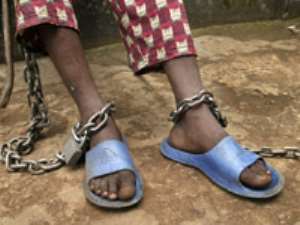
Ms. Juliana Serwaa Badu, a community director of S.P.A.C.E, Kumasi , a youth programme of the CHDSCGhana called on the government to prosecute religious leaders and health centres that violate the rights of many depressed people who are sent there for healing from mental issues. She said, the victims need protection and the only genuine security always comes from the government through the law and how they are enforced.
Ms. Felicia Okine, a staff of the OBAATANPA International also said the upbringing of a child has a key role in shaping his social behaviour. She called on parents to become positive role models for their children.
Mrs Felicia Naa Morkor, the Director of the CHDSCGhana highlighted the role of the Centre in reinforcing integration of recovered mental health patients back into the society. She said communities have to change their stigmas about people with mental challenges and to help them in their recovery and healing efforts.
She said these people are still human beings but with special needs and integrating them with the mainstream society has to be supported by all. She also called on local and international non-profits to come to their aid with financial support to help complete their community centre at Mankessim. She continued that the Centre which will house a library, recreational centre and training rooms to support their efforts at offering services and programmes that will continue to shape community, regional and national policies and to inspire positive social change and progress.

 Obuasi SHTS alleged sexual abuse: Kwasi Kwarteng criticises Education Minister o...
 ECOWAS’ $250,000 flood relief donation arrives in Ghana – Ablakwa
 Kennedy Agyapong has not resigned from NPP – Kwasi Kwarteng
 State failure, not GoldBod, driving galamsey – Daryl Bosu
 A Rocha Ghana raises alarm over human rights abuses in mining communities
 ECOWAS, AfDB discuss ways to advance West Africa’s development priorities
 October 16: Cedi gains against dollar, sells at GHS12.25 on forex market, GHS11....
 Galamsey: Ghana’s rivers now run chocolate and milk colour — Sam Jonah
 A nation of job-seekers will always be poor — Sir Sam Jonah
 “If you attack us with pepper spray, we’ll fight back” — NDC Yakubu Tony Aidoo w...



Comments
This is why we tolerate Rawlings !!