




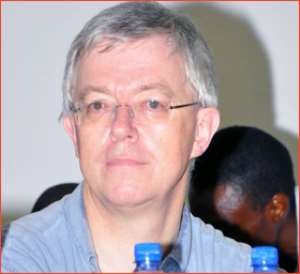
THE VISITING UK prosecutor in the infamous Mabey & Johnson bribery scandal involving some Ghanaian public officials has ruled out lies on the part of the bridge construction company during their trial in Britain.
Speaking yesterday during one of the lectures he is in the country to deliver, he defended all that transpired during the trial stating “we have no reason to suppose that M & J were being untruthful in what they told us, but the persons named face only allegations.
Those allegations, if they are to result in trials at all, will result in trials elsewhere than in the United Kingdom”.
Mr. John Hardy's delivery on international corruption discounted any racist undertone in the naming of the Ghanaian former ministers and public officials.
Careful consideration was given to naming the accused Ghanaian public officials because at the time “there was no prospect at that stage that they would be investigated or brought to trial in their home jurisdictions. The risk of prejudice at trial was therefore impossible to evaluate”.
The level of corruption, according to the UK prosecutor, was not petty corruption of minor, local bureaucrats; it was corruption at a very senior level of government.
“It would have been impossible to identify that level of seniority by only referring to position since the name of the position holder would have come out in the press in any event.
Therefore the usual course was followed; that is people were identified by name unless these payments were supplied directly by M & J to the SFO and supported by documentary evidence” he said.
His explanation was necessitated by what he said was a widespread misunderstanding concerning the naming of the Ghanaian pubic officials during the proceedings in London.
Also named alongside the Ghanaian pubic officials, he said, was a Jamaican public official to buttress his position.
“Why were the Ghanaians identified by name (so, too, I should say at this point was senior member of the Jamaican government) when the directors and managers of Mabey & Johnson were anonymised, that is referred to only as Directors A, B, C, D and so forth. Is this evidence of some neo-colonialism or latent racism?”
He answered emphatically in the negative, explaining that the Ghanaian personalities were so treated because of the absence of any prospect of their being prosecuted in a British court over the bribe scandal.
That is however not the case with the British directors and managers of the bridge construction company M & J, who remain under investigation, he explained to his audience.
The company, he went on, was prosecuted earlier on, having cooperated with the investigation process and changing both its personnel and management practices since the date of the committal of the offence.
Since the offence was historic he pointed out there was the need to expedite the trial and that it did not remain in limbo pending a long drawn-out and protracted investigation of the role of individuals.
Such a procedure, he explained, was not in the interest of an innocent workforce numbering several hundreds who stood the risk of losing their jobs in the event that the situation was not resolved expeditiously.
The foregone considerations, he stated, did not apply to the directors and managers of the bridge construction company under investigation.
They could not have had fair trials in the UK had their names been mentioned, he said, adding that was how come they were anonymised.
A number of Ghanaian public officials were cited in a bribery scandal involving a British bridge construction company.
The company was fined an amount of seven hundred and fifty thousand pounds for bribing a number of public officials in Ghana and Jamaica. Ghana, the court ordered, must be paid reparation of six hundred and fifty eight thousand pounds.
Dr. George Sipa-Yankey, one-time Health Minister, Alhaji Amadu Seidu, a former Minister of State in the Presidency, Alhaji Boniface Abubakar Saddique, Alhaji Baba Kamara were some of the alleged beneficiaries of the bribe so they could facilitate the winning of bridge contracts in the country during the reign of ex-President Jerry John Rawlings.
The Commission on Human Rights and Administrative Justice will start hearing the case from Monday.
By A.R. Gomda
 24-Hour Economy cannot succeed without data — GSS tells Parliament
 Captain Smart declares bid for NDC parliamentary slot in Gomoa West
 24-Hour Economy will promote prostitution – NPP Chairman warns government
 US, Iran exchange airstrikes after Trump accuses Tehran of downing army helicopt...
 BoG's $260 million building: It was Ato Forson who first proposed 'sell-and-leas...
 'We have to do soul-searching' — Mahama orders nationwide flood assessment
 Court orders woman beater to pay GHS5,000 compensation to midwife at Tema Commun...
 Over 12,000 women living with obstetric fistula in Ghana — Asokwa MP
 Mahama secures 1,840 farm equipment deal from Belarus
 Titus Glover slams Mahama’s flood report directive, calls it “waste of energy an...


