




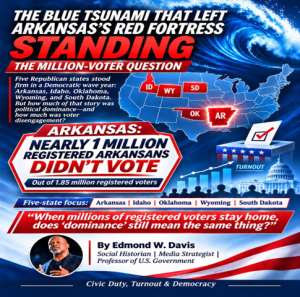
The American electorate unleashed a political blue tsunami on November 3, 2026, handing Democrats control of both chambers of Congress and flipping several governorships. Yet five Republican strongholds—Arkansas, Idaho, Oklahoma, Wyoming, and South Dakota—remained standing.
But here is the million-voter question: Did Republicans win because their supporters overwhelmingly outnumbered Democrats, or because enormous numbers of registered voters never participated?
Arkansas offers an especially troubling case study.
According to the Arkansas Secretary of State's Office, approximately 1.85 million Arkansans were registered to vote. Before Election Day, 605,486 had voted early, while 10,559 absentee ballots had been returned—616,045 ballots altogether. That left approximately 1.23 million registered voters who had not yet voted before November 3.
But that figure is not the final nonvoter count. The University of Florida Election Lab now estimates approximately 896,000 ballots cast statewide, suggesting roughly 954,000 registered Arkansans—51.6%—did not vote. These numbers remain preliminary, but their implications are extraordinary.
In the 2022 midterms, Arkansas recorded 914,227 ballots, with approximately 508,000 early votes and 17,815 returned absentee ballots. In 2026, participation before Election Day increased by approximately 90,000 ballots. Yet the preliminary statewide total suggests overall participation may have declined.
How does early voting surge while overall turnout potentially falls?
It appears more voters may simply have shifted when they voted, rather than enough additional voters joining the electorate to change Arkansas's political direction.
Republican Gov. Sarah Huckabee Sanders won reelection. Republican Sen. Tom Cotton retained his seat. Arkansas's four Republican U.S. House members also survived. However, Arkansas was not untouched. Democrat Dr. Chris Jones came remarkably close to unseating Congressman French Hill in the Second Congressional District. Hill prevailed by approximately 4,400 votes, according to preliminary returns. Jones's campaign demonstrated that Arkansas's red fortress was not politically impenetrable. Furthermore, Democrats gained at least 10 Arkansas House seats, ending a Republican supermajority that had existed for a decade, while also flipping a state Senate seat.
A tsunami did not overturn Arkansas's federal delegation, but democratic shock waves certainly reached its legislature. Consider this hypothetical: What if even 20% of the estimated 954,000 nonvoters—approximately 190,800 additional people—had voted?
What if 35% had participated, adding nearly 334,000 ballots? Those votes could have reshaped competitive contests. However, nobody can honestly claim they would have favored Democrats, Republicans, or independents without evidence establishing those voters' preferences. Arkansas's registered nonvoters are not automatically dormant Democratic voters. And therein lies the question that political parties must confront:
Who stayed home, why, and which candidates failed to earn their participation?
The consequences reach beyond party politics. The state government makes decisions about education, health care, criminal justice, economic development, and voting rights that affect every Arkansas family. The state's considerable Black electorate, growing Latino communities, younger voters and politically disengaged residents deserve serious study—not simplistic assumptions about their loyalties. Arkansas's racial and congressional redistricting controversies also deserve scrutiny. Political representation involves more than counting votes; district boundaries determine how communities exercise political power. Meanwhile, four other Republican fortresses tell different turnout stories.
Oklahoma: According to the Oklahoma State Election Board, 2,455,735 voters were registered. Preliminary reporting showed only slightly more than 45% participated, leaving approximately 55%—around 1.34 million registered voters—outside the electorate. Republican Mike Mazzei retained the governorship for his party, while Republicans maintained their congressional dominance.
Idaho: The Idaho Secretary of State initially reported approximately 731,980 ballots, a remarkably strong midterm showing. Preliminary turnout stood near 69%, meaning roughly 31% had not voted. That nonparticipation percentage may rise toward 34% as Election Day registrations are processed. Republicans nevertheless retained statewide and congressional power, although Democrats gained several state legislative seats.
Wyoming: Official voter-registration records identify 281,219 registered voters on Election Day. Approximately 191,688 ballots were reportedly cast, suggesting 89,531 nonvoters, or 31.8%. Republican victories included the governorship, the U.S. Senate, and the state's lone congressional seat.
South Dakota: Its Secretary of State's unofficial results reported 628,563 registered voters and 310,298 ballots cast. That means 318,265 registered voters—50.6%—did
not participate. Republicans maintained control of the governorship and both congressional seats on the ballot. Just imagine if those ballots were cast.
Third-party candidates also deserve attention. Arkansas Libertarian candidates received approximately 3.3% in the Senate race and 7.6% in the gubernatorial contest.
Independent, libertarian, constitutional, and other candidates appeared elsewhere. Such alternatives can influence close elections by attracting voters dissatisfied with the major parties. However, their supporters cannot automatically be reassigned to Democrats, and available results do not demonstrate that third-party voting specifically diluted Black or Latino political power. In Arkansas, for example, Jones's narrow congressional loss occurred in a two-candidate race.
Finally, faith and citizenship deserve consideration.
Jesus never issued a biblical command instructing Americans—or anyone else—to vote. But in Matthew 22:21, He taught that people should render to Caesar what belongs to Caesar and to God what belongs to God. In Proverbs 31:8–9, Scripture calls believers to speak up and defend the rights of the vulnerable.
Neither passage mandates voting. Both invite reflection on responsibility, justice, and participation in society.
The conclusion is inescapable: Arkansas did not simply remain Republican because Democrats failed to win. Hundreds of thousands of registered Arkansans apparently did not participate at all.
A GOP GIFT TO THE NATURAL STATE OR THE NATURAL STATE’S GIFT TO THE MAGA?
Here is the arithmetic that should concern every Arkansan: Out of approximately 1.85 million registered voters, about 616,045 had voted early or returned absentee ballots, while preliminary estimates suggest approximately 896,000 voted altogether. That leaves roughly 279,955 additional ballots—approximately 280,000—attributable to Election Day and any ballots counted afterward. The exact Election Day-only total remains unverified. Meanwhile, an estimated 954,000 registered Arkansans, or nearly 52%, did not vote at all. Arkansans, let that marinate! Was that enormous absence a political gift to the GOP in the Natural State? Republicans retained their statewide dominance, but without knowing how those absent voters would have cast their ballots, we cannot establish which party benefited most. What we can establish is that nearly half of Arkansas's registered electorate participated in determining the future of the entire state. If the preliminary estimate holds, approximately 51.6% of registered Arkansas voters missed all three opportunities—absentee voting, early voting, and
Election Day participation. That does not establish why they stayed home or how they would have voted. But it raises a question far bigger than MAGA, Democrats, or political affiliation:
Can a democracy genuinely claim to represent its people when approximately half its registered voters never participate in choosing their government?
The blue tsunami changed Washington. Arkansas's greatest political storm may still be the silence of its own registered electorate. What many Arkansans want to know is: Why Arkansas? Why?
About the Author:
Edmond W. Davis is an American social historian, media strategist, international journalist, Grambling State University graduate, a Louisiana Tech University graduate, a professor at Arkansas Baptist College and Philander Smith University, and the founder of the National HBCU Black Wall Street Career Festival. His work focuses on history, education, emotional intelligence, civic engagement, economic mobility, and the advancement of historically Black colleges and universities. Davis was a grand marshal at the National African American History Month Parade, the largest in the U.S. during Black History Month.

 Barred Nigerian presidential hopeful vows to stay in race
 Israel's Eisenkot claims 'progress' in coalition talks as opposition eases on ul...
 Soldiers allegedly shoot sand and stone tipper truck drivers in Afienya
 Minority demands answers over nationwide shutdown of health information systems
 Wontumi’s bail application delayed as JUSAG strike disrupts court proceedings
 President Mahama, Boeing agree roadmap for establishing Ghana’s national airline
 Passports director interdicted over alleged $50,000 sale of service passports
 "There is no substantive Chief in Gomoa Ekwamkrom" – Nana Ekwam X dismisses rumo...
 Questions raised over impartiality of committee investigating passport scandal
 'Don't take metaphorical NPP serious, they should be apologising to Ghanaians' –...


