




America experienced a political earthquake Tuesday night. From Georgia and Texas to Iowa and South Carolina, voters delivered results that dramatically altered the balance of power in Washington. Democrats captured both chambers of Congress, Republican incumbents fell, and the MAGA movement confronted an unmistakable national political setback. The American electorate had spoken.
But apparently, somebody forgot to tell Arkansas!
While much of the country was experiencing what some might call a blue tsunami, Arkansas reelected Republican Governor Sarah Huckabee Sanders, Republican Senator Tom Cotton, and three Republican congressional incumbents. The fourth, Republican Congressman French Hill, was fighting for his political survival against Democrat Chris Jones. And that is where this story becomes especially interesting.
Why Arkansas? Why?
How does a state confronting persistent poverty, educational challenges, healthcare affordability concerns, and economic inequality continue supporting the same political leadership while much of America moves in another direction? Perhaps Arkansas voters have different priorities. Perhaps party identification remains stronger than economic dissatisfaction. Or perhaps the state's electoral boundaries and political institutions deserve closer examination. The answer is not as simple as accusing voters of ignorance. It involves political culture, party loyalty, campaign money, incumbency, organizational strength, and something that has shaped American democracy for generations: who draws the congressional maps.
Arkansas: The GOP's Four-Leaf Clover?
According to theArkansas Advocate's November 4 election coverage, Sanders defeated Democratic state Senator Fred Love, Cotton defeated Democrat Hallie Shoffner, and Republican Representatives Rick Crawford, Steve Womack, and Bruce Westerman secured reelection. Yet French Hill's race was a different political story. Early Wednesday, with approximately 99% of the vote counted,Talk Business & Politics reported:
| Candidate | Votes | Percentage |
| French Hill (R) | 127,427 | 50.9% |
| Chris Jones (D) | 123,025 | 49.1% |
| Hill's lead | 4,402 | 1.8 points |
The race remained uncalled in the early Wednesday reporting. Consider the historical contrast. In 2024, Hill defeated Democrat Marcus Jones by nearly 18 percentage points. Two years later, Chris Jones had narrowed the reported margin to fewer than two percentage points. That is a dramatic electoral shift. It does not establish why the shift occurred, but it demonstrates that political preferences in Central Arkansas cannot be understood exclusively through statewide Republican victories.
The Redistricting Question: Did Arkansas Draw Away Democratic Political Power?
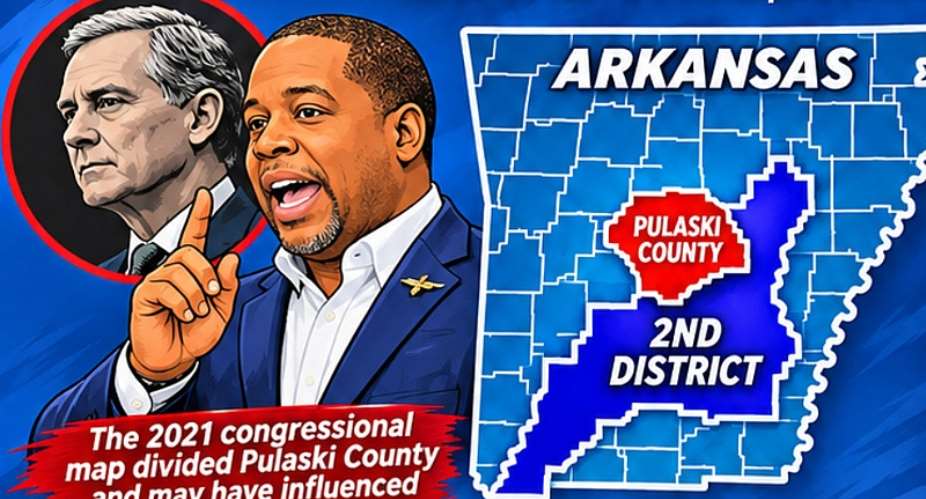
Here is perhaps the most consequential question arising from Arkansas's 2026 election. Did the congressional boundaries adopted in 2021 influence the extraordinarily close contest between Chris Jones and French Hill? Before the 2021 redistricting process, Pulaski County was entirely within Arkansas's 2nd Congressional District. The Republican-controlled legislature subsequently approved a map dividing portions of Pulaski County among the 1st, 2nd, and 4th Congressional Districts. The change moved approximately 23,000 Pulaski County residents out of the 2nd District while bringing Cleburne County residents into it. Black communities in southeastern Pulaski County were particularly affected.
Critics called the change racial gerrymandering and argued that it diminished Black voters' collective political influence. Republican defenders emphasized population equality, geographic considerations, and the number of counties remaining intact. Federal legal challenges followed. Courts dismissed challenges to the map, and the allegations of unlawful racial discrimination were not judicially established. Nevertheless, the political implications remain worthy of examination. The November 3 election returns offer a revealing starting point.
The Numbers: What Pulaski County Actually Revealed
According to Pulaski County's November 3 unofficial election summary, updated at 10:29 p.m., Chris Jones overwhelmingly defeated French Hill among county voters assigned to the 2nd Congressional District.
| Pulaski County — District 2 | Votes | Share |
| Chris Jones (D) | 78,824 | 65.44% |
| French Hill (R) | 41,628 | 34.56% |
| Jones's advantage | 37,196 | 30.88 points |
Read that again. Chris Jones led French Hill by 37,196 votes in the Pulaski County portion of their congressional district. But Pulaski County is no longer wholly represented by that district. The same unofficial county report recorded Democratic advantages in Pulaski's other congressional districts. In District 1, Democrat Terri Yarbrough Green received 1,940 votes compared with Republican Rick Crawford's 641—a 1,299-vote Democratic advantage. In District 4, Democrat James “Rus” Russell III received 5,051 votes compared with Republican Bruce Westerman's 1,357—a 3,694-vote Democratic advantage.
Together, those two margins amount to 4,993 votes. That figure is particularly striking because it exceeds Hill's reported districtwide lead of 4,402 votes. But an essential distinction matters: these were votes for different congressional candidates. They cannot automatically be treated as votes Chris Jones would have received under another district map. A proper historical comparison would require reconstructing the previous congressional boundaries, examining precinct-level returns, accounting for Cleburne County, and evaluating how different candidates and turnout patterns might have affected the election.
Even with that limitation, the evidence raises a significant question about electoral geography. When a congressional race is decided by a few thousand votes, how much can the placement of district boundaries matter? The answer deserves serious research rather than partisan assumptions.
Cleburne County: A Small Geographic Change With Potentially Large Consequences
Another critical part of the 2021 redistricting decision was the inclusion of heavily Republican Cleburne County in the 2nd Congressional District. The shift altered the district's political composition while portions of Democratic-leaning Pulaski County were assigned elsewhere. The underlying issue is not whether Republican voters in Cleburne County deserve representation. Of course they do. The question is whether the combination of these changes affected the political competitiveness of the district and the ability of communities to exercise collective electoral influence.
Opponents of the map argue that it weakened Black electoral power. Supporters maintain that lawmakers were fulfilling the constitutional requirement for districts with approximately equal populations. Both arguments must be examined against census data, actual boundaries, and voting patterns. And although the courts rejected challenges to the enacted map, the 2026 election presents an important opportunity to reassess its political effects. A legally sustained map can still produce electoral outcomes that warrant public examination.
The Arkansas Affordability Paradox
Beyond congressional boundaries lies an equally important question about public policy. According to Census-based estimates, Arkansas's poverty rate stood at approximately 15.5% in 2024. These figures represent people experiencing genuine financial pressure, not abstract political talking points. Healthcare access, educational attainment, housing expenses, wages, and food prices remain important issues for Arkansas families. Yet economic hardship does not automatically determine political affiliation. Many Republican voters support their party because of taxes, religious values, abortion policy, firearms rights, immigration, or confidence in conservative leadership.
Democratic voters may prioritize healthcare access, educational funding, worker protections, civil rights, or the distribution of economic opportunity. These preferences do not always align neatly with income. Nevertheless, every elected official should face a fundamental accountability question:
Are the policies being enacted measurably improving the economic circumstances of the people represented?
That question belongs to Republicans, Democrats, independents, and everyone seeking public office. It also belongs in every election cycle, not merely those in which one political party experiences a national victory. Can I get an amen, America!
The Democratic Victories Arkansas Cannot Ignore
Beneath Arkansas's statewide Republican victories, another political story unfolded. Democrats flipped five state House seats in Benton and Washington counties. The victorious candidates were Jacob Allen, Rey Hernandez, Mitchell Smith, Daniel Holtmeyer, and Jamie Atkinson. These were significant legislative changes in a state where Republicans entered the election holding an overwhelming majority. Democrat Wendell Griffen also became the first Black person elected Pulaski County judge, while Little Rock Mayor Frank Scott Jr. secured a third term. These outcomes demonstrate that Arkansas's electoral landscape contains important regional differences.
Northwest Arkansas, long associated with Republican strength, produced several Democratic legislative victories. Central Arkansas continued to produce substantial Democratic support. Meanwhile, much of rural Arkansas remained Republican. Political change, therefore, was neither uniform nor absent. It occurred in specific communities, among different electorates, and in races with different candidates and local concerns.
Arkansas Was Not Alone
Arkansas was not the only state where Republicans maintained significant control despite national Democratic gains. South Dakota and Wyoming also recorded Republican victories in their gubernatorial, U.S. Senate, and U.S. House contests. These results illustrate an important feature of American federalism. There is no single national electorate that votes identically in every state. Political identity is shaped by local history, demographics, religious traditions, regional economies, community networks, and candidate relationships. National election trends can be powerful without producing identical outcomes in all fifty states. Arkansas's distinction in 2026 is that statewide Republican victories coincided with notable Democratic legislative gains and an extraordinarily competitive congressional race.
The Low-Information Voter Question
Some frustrated observers will inevitably ask whether Arkansas voters fully understand the policies and candidates they support. As an educator and social historian, I believe civic literacy matters tremendously. But civic education should not be reduced to the notion that people who vote differently are uninformed. Voters should understand congressional responsibilities, state budgets, tax policy, healthcare legislation, constitutional protections, and how redistricting affects representation. They should also know how to distinguish campaign advertising from independently verified facts.
The responsibility for improving civic understanding belongs to schools, universities, journalists, civic organizations, candidates, and voters themselves. Political disagreement is part of democracy. Political disengagement, misinformation, and a lack of accountability deserve scrutiny regardless of party.
What Should Washington Learn From Arkansas?
The next Congress will operate under Democratic majorities in both chambers, while Arkansas's confirmed Republican congressional incumbents will serve in the minority.
That change affects congressional leadership, committee control, oversight authority, and the legislative environment. But Arkansans' concerns do not disappear because their representatives belong to the minority party. Rural economic development, agriculture, education, healthcare, infrastructure, and poverty remain important federal policy questions. Arkansas's elected delegation will still have responsibility for representing its constituents and negotiating within a divided federal government. Meanwhile, the Jones-Hill contest shows the importance of analyzing local voting patterns instead of assuming that statewide results tell the entire political story.
Why Arkansas? Why? The Question for 2028
The November 3, 2026, election produced two seemingly contradictory truths. Republicans retained Arkansas's governorship, U.S. Senate seat, and three confirmed congressional seats. At the same time, Democrats flipped five state legislative districts, won important local offices, and came within approximately 4,400 votes of Republican Congressman French Hill in early returns. Those developments reveal a state with distinct and sometimes competing political trends. And they leave us with an unresolved question about the 2021 congressional map. Had Pulaski County remained entirely within the 2nd District, what would the 2026 congressional contest have looked like? We cannot answer that conclusively by adding election-night margins. But the question is legitimate, historically significant, and capable of being studied with the proper data.
Democracy demands more than accepting election results. It also requires examining the rules, boundaries, and institutions that structure political representation. Arkansas may have resisted much of the national blue tsunami. But beneath its Republican statewide victories, important political changes were visible.
The question now is whether those changes represent a temporary midterm pattern or something that will continue into future elections. Why Arkansas, why? And perhaps the bigger question is this: When the presidential election of 2028 arrives, will Arkansas's political map, voting patterns, and governing priorities look the same? Only the voters—and the democratic institutions governing their elections—will determine that answer. Why Arkansas? Why didn’t your voters follow the same voting patterns as the overwhelming majority of American voters? Why Arkansas? Why?
Selected references
- Associated Press — November 4, 2026, midterm election coverage
- Arkansas Advocate — 2026 election coverage
- Talk Business & Politics — Hill and Jones election results
- KUAR — Arkansas congressional redistricting, 2021
- Loyola Law School — Simpson v. Thurston redistricting litigation
- U.S. Census Bureau — Arkansas QuickFacts
- Pulaski County Election Commission — unofficial election summary results, November 3, 2026, 10:29 p.m., as provided for this article.
About the Author:
Edmond W. Davis is an American social historian, media strategist, international journalist, Grambling State University graduate, professor at Arkansas Baptist College and Philander Smith University, and founder of the National HBCU Black Wall Street Career Festival. His work focuses on history, education, emotional intelligence, civic engagement, economic mobility, and the advancement of historically Black colleges and universities. Davis was a grand marshal at the National African American History Month Parade, the largest in the U.S. during Black History Month.

 45 tonnes of cocaine were brought in by two Gulfstream jets in 2023 under Akufo-...
 22 drug seizures under Mahama means NACOC operations improved, intelligence now ...
 'NPP withdrawal of NACOC from port inspection teams in 2018 was major cause' – A...
 'NPP not morally qualified to lecture NDC on cocaine issues' — Akwatia MP hits b...
 Former Head of Civil Service explains why corruption is high in civil service
 SA evacuation: 'Some got GH¢2,000 instead of GH¢5,000; where is their money?' – ...
 Takoradi NPP MP threatens to boycott 2027 budget over stalled market circle proj...
 November 5: Cedi sells at GHS12.25 on forex market, GHS11.67 on BoG interbank
 Foreign Affairs Ministry pledges support to family of Ghanaian PhD graduate kill...
 How father and son allegedly beat 31-year-old man to death over cocoa beans at A...


