




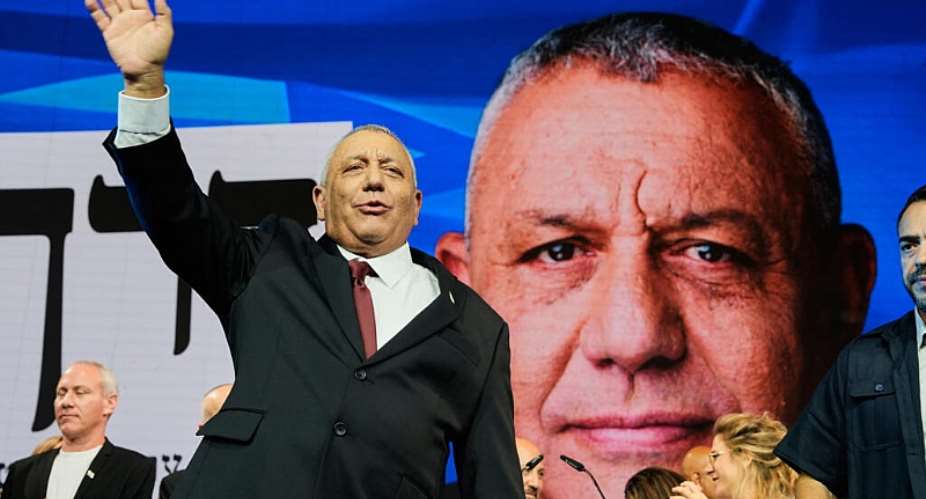
Israel's opposition saw a new path Friday to oust Prime Minister Benjamin Netanyahu as one of its leaders backtracked on demands that ultra-Orthodox Jews serve in the military, opening the door to a once improbable alliance with the community.
Neither Netanyahu nor opposition chief Gadi Eisenkot reached a majority in the October 27 election, with Israeli society highly polarised over Netanyahu's leadership and worn down by three years of war.
Eisenkot, a former military commander whose campaign sought to appeal to secular and liberal Israelis, could form a government with Israeli-Arabs, whose seat count soared on anger over Netanyahu's far-right government.
But an alliance with Israeli-Arabs faces strong disagreement from opposition partner Avigdor Liberman, a one-time aide to Netanyahu, who now sharply criticises the prime minister but shares his hawkish views on Palestinians.
Liberman said Friday he would not back down on refusing to work with Israeli-Arabs but called for talks with ultra-Orthodox Jews – even though he has berated the community for years and ran on promises to end its exemption from Israel's mandatory military service.
Listing the most important goals as removing Netanyahu and avoiding new elections, Liberman said it was time to compromise and "understand that trying to have everything risks getting nothing".
"This also includes the issue of the conscription law," he said in a social media statement.
"This pains me, and I know it pains many others as well. But given the full range of challenges we face today, the national interest of the State of Israel and the Jewish people must take precedence over all other considerations."
President Isaac Herzog plans to announce on Sunday who will have the first chance to form a government – logically most likely Eisenkot, as so far he has received the most endorsements thanks to support from Israeli-Arabs.
Eisenkot said Friday he was making headway in forming a government to replace Netanyahu and that he expected to receive a mandate from the president.
"We have made significant progress and achieved breakthroughs, quietly and modestly, with much still happening behind the scenes," Eisenkot wrote on X.
Yair Golan, Israel's main left-wing leader and part of the opposition bloc, said "serious work" was underway to form a coalition.
"I'm more optimistic than I was on the Wednesday morning after the election results. There is progress. There is a will," he said.
Ultra-Orthodox wield power again
Israeli police fire stun-grenades to disperse ultra-Orthodox Jews angry against the prospect of being forced to serve in the military in a protest in the city of Bnei Brak on October 29, 2026.Ultra-Orthodox Jews' exemption from military service has fuelled widespread resentment among other Israelis, with reservists serving multiple tours in the wars that Israel has been fighting since the October 7, 2023 attack by Hamas.
Netanyahu, while personally secular, has long relied on the ultra-Orthodox, accepting that the community – which accounts for around 14 percent of the population and has a much higher birth rate than the Israeli average – can send children to religious schools rather than the army.
But he stopped short of enshrining the military exemption into law, angering the two main ultra-Orthodox parties which left his government, although they did not seek to remove him.
One of the parties, United Torah Judaism, declined Thursday to recommend Netanyahu to form the next government during consultations with Herzog, but without supporting Eisenkot.
Read more Israel's Arab list backs Eisenkot as Netanyahu loses ultra-Orthodox support
Yaakov Asher, a lawmaker from the party, welcomed Liberman's U-turn and said that its rabbis would assess any formal proposal of an alliance.
"It is encouraging to learn of the flexibility of all political actors on the subject of conscription," Asher said.
"It is painful to think how much incitement and hatred between brothers could have been avoided had that same flexibility been demonstrated in recent years."
His party and the other ultra-Orthodox formation, Shas, together have 13 seats, enough to put Eisenkot in power.
Liberman put up posters during the campaign vowing to crack down on the "draft-dodgers". During an appearance earlier this year, he described ultra-Orthodox Jews as "anti-Jewish" for their demands.
His Yisrael Beiteinu party won seven seats, the fewest among the five core opposition parties. Naftali Bennett, a former prime minister, also ran heavily on promises to end the military exemption, repeatedly vowing "not one shekel" from the government for religious students who do not serve in the army.
Bennett has not commented on Liberman's about-face.
Only Golan, the left-wing leader, explicitly backed cooperation with lawmakers from the Arab minority, who make up 20 percent of the population.
Netanyahu campaigned by warning that voting for the opposition would empower Israeli-Arabs: descendants of Palestinians who stayed after Israel's creation in 1948.
(FRANCE 24 with AFP)


 Barred Nigerian presidential hopeful vows to stay in race
 Israel's Eisenkot claims 'progress' in coalition talks as opposition eases on ul...
 Soldiers allegedly shoot sand and stone tipper truck drivers in Afienya
 Minority demands answers over nationwide shutdown of health information systems
 Wontumi’s bail application delayed as JUSAG strike disrupts court proceedings
 President Mahama, Boeing agree roadmap for establishing Ghana’s national airline
 Passports director interdicted over alleged $50,000 sale of service passports
 "There is no substantive Chief in Gomoa Ekwamkrom" – Nana Ekwam X dismisses rumo...
 Questions raised over impartiality of committee investigating passport scandal
 'Don't take metaphorical NPP serious, they should be apologising to Ghanaians' –...


