




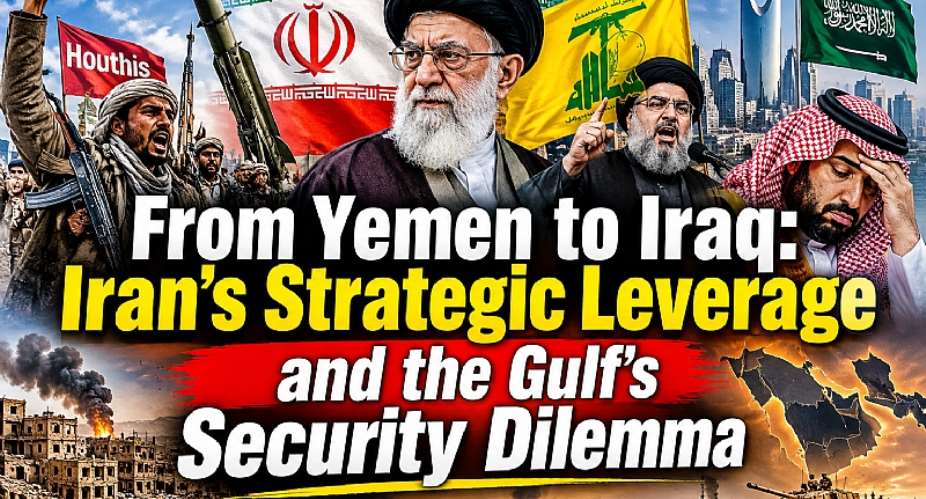
The Middle East has become both a geographical hotspot and a geopolitical challenge to live in. Political unrest in Yemen and Egypt, Iraq's exiled political leadership, and the Kurdish dilemma are collectively raising the political temperature of the region. Recent attacks on Saudi Arabia, the besieged government in Yemen, Iraq's confusing political assurances and the uncertain future of the Kurdish political entity have created a geopolitical roller coaster, with developments unfolding almost daily. The security vulnerabilities of individual states, blame games, accusations and external interference have pushed the Middle East into the centre of every major dispute, escalating the possibility of another regional war.
Yemen's Politically Weak Legitimacy?
Last week, The Wall Street Journal (WSJ) reported that the Houthis were demanding $50 billion and international recognition in exchange for halting attacks on Saudi Arabia. Subsequently, Yemen's Information Minister accused the Islamic Revolutionary Guard Corps (IRGC) of backing the Houthis, claiming that Iran provides warheads, drones, technology and technical expertise. He portrayed the Houthis as an instrument of Iranian regional influence.
However, the weakness of this argument raises another question: If Yemen's internationally backed government enjoys genuine political legitimacy, why does it require Saudi financial and military assistance to remain in power, particularly when sections of the Yemeni population support an alternative political arrangement?
Logically, the Yemeni government depends heavily on Saudi financial backing, which provides Riyadh with a strategic shield and potentially a victim card in the regional confrontation. If the IRGC is assisting the Houthis, Yemen's security architecture has already suffered a serious collapse. Political identity must emerge from public choice, not external selection. If the present Yemeni government has failed politically, it cannot simply blame Iran for intervention while overlooking the intervention that has already taken place.
Secondly, the Houthis do not necessarily share identical strategic interests with Iran. Why, then, should their relationship automatically be interpreted as a single political and military command structure? If IRGC assistance to the Houthis is considered destabilising, Saudi Arabia's backing of Yemen's government must also face scrutiny under the same principle. Yemen's dilemma requires a politically aligned diplomatic solution in which the decisive factor is the voice of the Yemeni people. They are the ones entitled to choose their government, not neighbouring states that turn their country into a regional battleground.
The Iranophobic House of Saud and Its Irritating Dilemma?
A telephone conversation between Saudi Foreign Minister Faisal bin Farhan and Iran's Abbas Araghchi took place, apparently reflecting the same diplomatic trust-building efforts that Tehran has pursued with Oman, Qatar and Kuwait. But why has this diplomatic engagement become necessary now?
One possible explanation is that Gulf leaders possess considerable diplomatic leverage in influencing Trump's calculations over a potential attack on Iran. With the US midterm electoral considerations becoming less of an immediate political obstacle, the possibility of renewed military escalation cannot be dismissed. Iran, therefore, must remain diplomatically prepared. Through Qatar, Tehran has communicated its proposed seven-point conditions concerning the reopening of the Strait of Hormuz. Mohsen Rezaei has also made it clear that reopening cannot be separated from the fulfilment of the stated conditions.
Iraq: A Regional Factor on the Back Foot?
Iraq's Prime Minister has reportedly spoken with Trump and assured him that Iraqi territory will not be used against neighbouring Saudi Arabia. However, how reliable is this assurance when Washington itself has limited control over Iraq's complicated political and security environment?
Baghdad also appears interested in securing economic concessions, including a diesel-related offer from Trump's administration, to maintain its relevance in the equation. A month earlier, Trump had reportedly assured Gulf states that Iraq would remain neutral in the event of an attack. Nevertheless, drone attacks originating from Iraqi territory have continued to raise serious security questions.
The Kurdish dimension further complicates the situation. Kurdish political developments, including the emergence of a speaker associated with an insurgent political group in the public parliamentary arena, highlight the fragile transitional arrangements within Iraq. Baghdad does not necessarily want to become part of another war, but maintaining neutrality in such an environment is a difficult task when security vulnerabilities cannot be completely eliminated.
Where Is Trump Heading: Escalation or Backtracking?
One thing remains certain: Trump is unpredictable. He may have little to lose politically, but the wider Middle Eastern equation could suffer enormously from another military confrontation. A renewed attack could become another repetition of the same strategic mistake. Meanwhile, Vance has distanced himself from positioning as an unquestioning successor to Trump's political and foreign-policy approach. Neither war nor an inconclusive negotiation necessarily serves every political contender. But for how long can this uncertainty continue? Only God knows.
Ultimately, Iran is attempting to consolidate diplomatic trust with Gulf states while Washington continues to employ an Iranophobic political narrative, potentially turning the perceived victim into the aggressor. The Iraqi and Yemeni governments, despite their external backing, cannot independently resolve the region's structural security dilemmas. Tehran understands these weaknesses and continues to exploit the regional political landscape. The question is no longer simply who possesses military superiority; it is who can convert political vulnerabilities into strategic leverage. For now, Iran appears determined to remain ahead in this geopolitical contest, while Trump's next move could determine whether the region moves towards diplomacy or another dangerous escalation.


 Edwin Nii Lantey Vanderpuye declares bid for NDC national chairmanship
 'Don't take metaphorical NPP serious, they should be apologising to Ghanaians' –...
 IMF says Ghana’s economic recovery is strengthening, projects 5.7% growth in 202...
 Only 61% of Ghanaian children have birth certificates – UNICEF reveals
 Contraflow: “No Aayalolo bus has been involved in any accident" — Ayariga
 Queen Máxima urges Ghana to prioritise financial health in next inclusion strate...
 Navy intercepts 4.7 tonnes of suspected Indian hemp at Ada Estuary
 Assafuah runs away from invitation to appear with evidence before Mahama's commi...
 Kenyan starvation cult leader faces death sentence over child murders


