




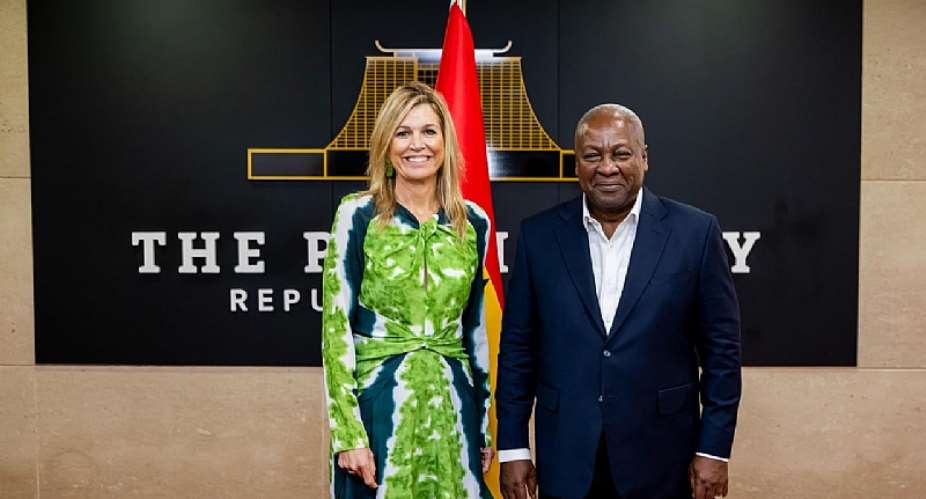
Queen Máxima of the Netherlands, the United Nations Secretary-General's Special Advocate for Financial Health, has urged Ghana to place financial health at the centre of its next National Financial Inclusion and Development Strategy to help households manage everyday expenses, cope with financial shocks and secure their long-term financial future.
She stressed that expanding financial inclusion should go beyond providing access to bank accounts and focus on ensuring that individuals and businesses can effectively use financial products to meet their needs and improve their livelihoods.
Queen Máxima made the appeal during a visit to Ghana from November 2 to 5, 2026, which included engagements with President John Dramani Mahama, Finance Minister Cassiel Ato Forson, Bank of Ghana Governor Johnson Pandit Asiama and the Asantehene, Otumfuo Osei Tutu II.
A statement issued at the end of the visit on Thursday, November 5, said the discussions centred on how Ghana could build on its progress in financial inclusion to improve the financial security of households and businesses.
It cited data from the World Bank's Global Findex 2025, which showed that the proportion of Ghanaian adults with financial accounts increased from 29 per cent in 2011 to 81 per cent in 2024.
Despite the progress, about one-third of adults reportedly bought groceries on credit or deferred payment during the preceding year, underscoring the financial difficulties many households continue to experience.
To address these challenges, Queen Máxima called for the introduction of specific financial health targets and regular surveys to track progress. She also proposed establishing a national financial health and inclusion council to coordinate initiatives between the government and private sector.
She identified emergency savings, affordable and responsible credit, insurance and long-term financing as essential tools for strengthening the financial resilience of individuals and businesses.
During engagements with farmers, traders and healthcare providers, she explored how access to appropriate financial services could help people manage business risks, recover from unexpected difficulties and make plans for the future.
In Adeiso, pineapple farmer Kweku Atta Apediego shared how access to a dependable buyer, agricultural inputs, credit facilities and technical support had enabled him to expand his farm and provide for his family. He said his next ambition was to build savings for his retirement.
At Makola Market in Accra, Queen Máxima interacted with traders using financial services offered by Affinity, including Joyce Ketu, who is working to rebuild her business following a fire outbreak.
Her experience demonstrated the importance of savings, insurance and access to long-term financing in helping small businesses recover from unexpected losses.
The UN Special Advocate also visited Manna Mission Hospital, where discussions with PharmAccess examined how digital healthcare services for people living with chronic conditions could reduce transportation expenses and time away from work, allowing patients to protect their earnings and savings.
At a national event organised by the Ministry of Finance, Queen Máxima urged stakeholders to agree on a common national vision for improving financial health through responsible innovation and measurable targets.
Her engagements also involved financial institutions, employers and investors, with discussions focusing on creating more opportunities for savings, suitable investments and flexible pension contributions for workers in the informal sector.
The Ghana visit followed earlier discussions on financial health between Queen Máxima and President Mahama at the United Nations General Assembly in New York, as well as engagements with the Finance Minister and Bank of Ghana Governor during the IMF-World Bank Spring Meetings in Washington, D.C.
Queen Máxima has served as the UN Secretary-General's Special Advocate for Financial Health since September 2024. In that role, she works with public and private sector leaders to promote financial services and policies that enable people to manage their money, withstand financial difficulties and achieve their financial goals.

 Only 61% of Ghanaian children have birth certificates – UNICEF reveals
 Contraflow: “No Aayalolo bus has been involved in any accident" — Ayariga
 Queen Máxima urges Ghana to prioritise financial health in next inclusion strate...
 Navy intercepts 4.7 tonnes of suspected Indian hemp at Ada Estuary
 Assafuah runs away from invitation to appear with evidence before Mahama's commi...
 November 6: Cedi sells at GHS12.25 on forex market, GHS11.67 on BoG interbank
 Put Nkrumah's 1957 independence photo on banknotes – Memorial Park to BoG
 Health Ministry dismisses claims gov't is abandoning newly trained doctors
 Trump calls midterms 'crooked', demands Alaska votes go to Republican candidate
 Kenyan starvation cult leader faces death sentence over child murders


