




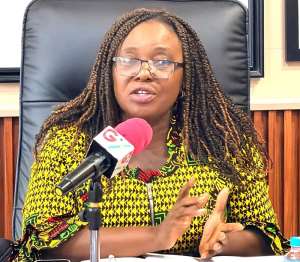
Mrs. Rita Naa Odoley Sowah (MP), Deputy Minister for Local Government, Chieftaincy, and Religious Affairs, has reiterated that the government has rolled out modalities to translate the Presidential Compact on Water, Sanitation, and Hygiene into coordinated institutional action and measurable results, warning that political commitment without financing, institutions, and enforcement is mere rhetoric.
She said the government has already taken concrete steps through the allocation of 20 percent of the District Assemblies Common Fund to WASH—10 percent for potable water and 10 percent for environmental sanitation—recognizing the central role of local government.
Mrs. Sowah said the National Sanitation Day continues to mobilize citizens, traders, institutions, and assemblies. Under the National Emergency Waste Evacuation Exercise commissioned by President John Dramani Mahama, approximately one million tonnes of waste are being cleared from the decades-old heap at Agbogbloshie.
These interventions, she said, sit within the Presidential Compact signed in 2024, which elevated WASH to the highest level of political commitment.
The Deputy Minister stated delivering the closing remarks at the 37th Mole Conference on Water, Sanitation, and Hygiene (MOLE XXXVII) at Ada Foah, Greater Accra Region, on Thursday.
The conference from November 1st to 6th, which was organized by CONIWAS, was on the general theme—"Accelerating Climate-Resilient WASH Service Delivery for Last-Mile Communities: Options, Strategies, and Actions”—and demands a shift from dialogue to delivery. The opening ceremony on Monday was chaired by Nene Agudey Obichere III, Mankralo of Ada State, representing the Paramount Chief of Ada Traditional Area.
The Media Coalition Against Open Defecation (M-CODe), through the empowerment of World Vision Ghana, is providing a strategic and targeted communication platform for the conference, ensuring national visibility and citizen engagement.
Mrs. Sowah was blunt about the test ahead: the true test of the 20 percent allocation is whether resources are spent transparently and translate into functioning services. She urged all Metropolitan, Municipal, and District Assemblies (MMDAs) to ensure transparent use and public reporting of their Common Fund allocations.
She said the Ministry has taken note of calls at the conference for approval of the revised Environmental Sanitation Policy, establishment of a National Sanitation Authority supported by a Sanitation Fund, and strengthening of Environmental Health Units at the MMDA level. The Ministry will continue to work with the Cabinet, Parliament, and sector partners to advance these reforms.
On financing, she disclosed the scale of the challenge: the sector’s annual financing requirement is estimated at about US$1.7 billion, with a gap of more than US$1.5 billion. Government alone cannot meet every need.
Ghana must therefore explore innovative financing, including blended and results-based financing, to enable climate finance to reach districts and underserved communities, improve efficiency of existing investments, and strengthen partnerships without compromising equity, affordability, or sustainability.
She said climate resilience must become central to how Ghana plans, finances, constructs, delivers, operates, maintains, and sustains WASH infrastructure. New investments must be informed by climate risks, with design standards accounting for projected changes in rainfall, temperature, and extreme events, while existing facilities must be assessed and strengthened to withstand flooding and droughts.
The conference comes at a strategic moment, she said. The African Union has dedicated its 2026 Theme of the Year to sustainable water and safe sanitation. President Mahama serves as First Vice-Chairperson of the African Union ahead of Ghana’s chairmanship in 2027. Ghana is also co-chairing with Switzerland the “Water for People” dialogue at the UN Water Conference in Abu Dhabi in December 2026.
“The options, strategies, and actions developed at MOLE XXXVII can inform Ghana’s contribution in Abu Dhabi, grounded in our practical experience,” she said.
The six-day conference balanced plenary and panel discussions with interactive parallel sessions, group discussions, verbal and poster presentations, side events for innovators, media events, and exhibitions.
Two virtual conference centres were set up with online links to enable participation from persons unable to travel to Ada.
Other activities included conference reception, capacity-building workshops, learning field trips to WASH facilities and tourist sites around Ada, and a special dinner and awards night.
The high-level participants include representatives from ministries, departments and agencies; MMDAs; traditional authorities; development partners; academia; research institutions; NGOs, CBOs, FBOs, civil society, the private sector, media, regulatory bodies including the Water Resources Commission and PURC, informal WASH service providers, community representatives and financial institutions.

 Edwin Nii Lantey Vanderpuye declares bid for NDC national chairmanship
 'Don't take metaphorical NPP serious, they should be apologising to Ghanaians' –...
 IMF says Ghana’s economic recovery is strengthening, projects 5.7% growth in 202...
 Only 61% of Ghanaian children have birth certificates – UNICEF reveals
 Contraflow: “No Aayalolo bus has been involved in any accident" — Ayariga
 Queen Máxima urges Ghana to prioritise financial health in next inclusion strate...
 Navy intercepts 4.7 tonnes of suspected Indian hemp at Ada Estuary
 Assafuah runs away from invitation to appear with evidence before Mahama's commi...
 Kenyan starvation cult leader faces death sentence over child murders


