




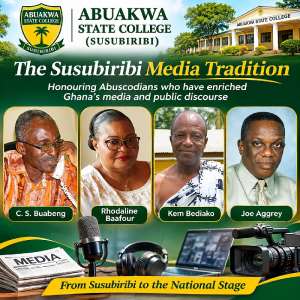
Abuakwa State College (ABUSCO), affectionately known as Susubiribi, has a proud history of producing distinguished personalities who have contributed significantly to Ghana's national development. Beyond its achievements in education, business, politics and public administration, the school has nurtured journalists, writers, broadcasters and media professionals whose work has influenced public opinion, promoted accountability and preserved important aspects of Ghana's history.
From newspaper editorial offices to sports journalism, media regulation and government administration, old students of Abuakwa State College have played important roles in shaping Ghana's media landscape. Their contributions demonstrate how the institution has encouraged intellectual curiosity, discipline, independent thinking and public service.
Among these personalities was the late Stanley Twum Barima, affectionately known as Uncle Stan, who distinguished himself as a thoughtful journalist and political commentator. During the 1990s, he became associated with The Statesman, where his writings addressed sensitive political and social issues with maturity, professionalism and philosophical insight.
Working alongside experienced journalists such as Abdul-Rahaman Haruna Attah and Ferdinand O. Ayim, Twum Barima earned respect for his calm approach to controversial subjects and his commitment to responsible journalism. His contributions to the profession and the ABUSCO old students' community were widely appreciated. Following his passing, the Ghana Journalists Association paid tribute to his service to journalism.
Another distinguished old student, I. S. Buabeng, made his mark in Ghana's print media, rising to the position of Deputy Editor at the Daily Graphic. His long association with the Graphic Communications Group helped establish his reputation as an experienced journalist and media administrator.
In 2005, Buabeng was appointed to represent the Ghana Journalists Association on the National Media Commission, where he advocated professionalism, responsible broadcasting and higher editorial standards. He expressed concern about the increasing tendency of some radio stations to substitute excessive commentary and offensive language for factual reporting.
His commitment to journalistic excellence continued through his participation in committees responsible for evaluating entries for the prestigious GJA Media Awards.
The late Mrs. Rhoderline Baafour-Gyimah, née Ofori-Atta, represents another remarkable chapter in ABUSCO's media history. A student of the college from 1961 to 1966, she pursued journalism training at the Ghana Institute of Journalism and subsequently developed a distinguished career in communications, politics and public administration.
A granddaughter of Nana Sir Ofori Atta I and daughter of William Ofori-Atta, one of Ghana's celebrated Big Six independence leaders, she established her own professional identity through public service and advocacy.
She contributed to efforts to strengthen women's participation in journalism, including activities associated with the Association of Women in the Media. Her career also extended into political organisation and public administration. She was associated with the founding of the New Patriotic Party and later served in public and corporate leadership positions, including membership of the board of Ghana Oil Company Limited.
Her contributions to national development were recognised through the award of the Member of the Order of the Volta.
ABUSCO's influence on Ghanaian journalism has been equally significant in sports reporting, where two prominent personalities, Ken Bediako and Joe Aggrey, helped document and interpret the country's sporting achievements.
Ken Bediako is widely respected as one of Ghana's most experienced sports journalists and football historians. His career, spanning several decades, has made him an important source of information on the development of Ghanaian football.
Through his work at the Daily Graphic and other publications, Bediako documented major sporting events, football personalities and important milestones in the country's sporting history.
Beyond reporting, he has consistently advocated stronger football administration, transparent management and the development of domestic competitions. He has argued that Ghana's national football success must be supported by a competitive local league, effective youth development and accountable football institutions.
His extensive knowledge of Ghanaian football has helped preserve valuable historical records for future generations.
Similarly, the late Joe Aggrey, popularly known as Big Joe, was a pioneering sports journalist whose influence extended beyond the newsroom into national sports administration.
As a founding member of the Sports Writers Association of Ghana, Aggrey contributed significantly to the professional development of sports journalism. He served as SWAG President from 1985 to 2001 and became the first sports journalist to receive the Ghana Journalists Association's Journalist of the Year award in 1999.
His work helped elevate sports journalism from routine match reporting to a respected field of professional analysis, historical documentation and public accountability.
Aggrey later served as Deputy Minister of Youth and Sports under President John Agyekum Kufuor from 2001 to 2005, bringing his extensive experience in sports reporting and administration into government.
He also contributed to the documentation of Ghana's football history, including the country's historic participation in the 2006 FIFA World Cup in Germany.
His outstanding service earned him several professional honours and recognition from the sports fraternity.
The achievements of these distinguished personalities illustrate the important role Abuakwa State College has played in Ghana's intellectual and professional development.
Although they pursued different careers, they shared a common educational foundation that encouraged confidence, communication, leadership and commitment to society.
Their contributions also demonstrate that journalism is more than reporting daily events. It involves preserving history, educating the public, scrutinising institutions, defending professional standards and encouraging informed national debate.
At a time when misinformation, political polarisation and declining public confidence in traditional media present serious challenges, the professional examples established by these ABUSCO alumni remain particularly relevant.
Their careers offer valuable lessons to young journalists about integrity, accuracy, courage, fairness and the responsibility that accompanies the power to influence public opinion.
As Abuakwa State College prepares to celebrate its 90th anniversary in October 2027, the achievements of its distinguished media personalities deserve special recognition.
The anniversary provides an opportunity for the school and its old students' association to document the contributions of past students, preserve historical photographs and publications, and establish an enduring record of alumni who have contributed to Ghana's media development.
Such an initiative could inspire current students to pursue careers in journalism, broadcasting, digital communication, creative writing and public affairs.
It would also reinforce the importance of preserving institutional history and recognising individuals whose professional achievements have contributed to national progress.
The story of Abuakwa State College is therefore not limited to academic results or the number of prominent personalities it has produced. It is equally a story of how education can shape independent thinkers, responsible professionals and citizens committed to the public good.
From Stanley Twum Barima's thoughtful political commentary and I. S. Buabeng's defence of media professionalism to Rhoderline Baafour-Gyimah's public service, Ken Bediako's preservation of football history and Joe Aggrey's pioneering contributions to sports journalism, the influence of Susubiribi extends far beyond the school's classrooms.
These personalities did not merely report Ghana's history. Through their writing, leadership and public service, they helped shape how the nation understood its history, confronted its challenges and celebrated its achievements.
Their legacy remains a source of pride for the entire ABUSCO family and a powerful reminder that the true measure of an educational institution lies not only in the knowledge it imparts, but also in the lasting contributions its students make to society.
Susubiribi has produced more than journalists. It has helped nurture voices that informed a nation, preserved its memories and influenced its development.
Frank Ayim Damptey is an industrialist, entrepreneur, researcher, author and development advocate. He is an old student of Abuakwa State College, Class of 1978.


 Bawumia eyes 3R's Japanese tech that removes mercury, cleans soil and recycles w...
 'Our borders must command respect' – Osahen Afenyo-Markin on cocaine busts
 ‘Govt deeply involved in Beirut cocaine bust’ — Kofi Bentil reveals
 Ablakwa sues Benghazi, Media General over Fantana affair, corruption allegations
 Mahama instructs Finance Ministry to pay striking JUSAG members from November
 Mahama must sign same anti-gay bill NDC backed in opposition – Osahen Afenyo-Mar...
 Romance Scam: Asante Akyem North MP's extradition hearing set for November 18
 JUSAG accuses FWSC CEO of taking unilateral decisions in salary negotiations
 Police arrest three Nigerians over alleged bank customer robberies in Kumasi
 'Next week I will show how the new economy will turn the gains we have made into...


