




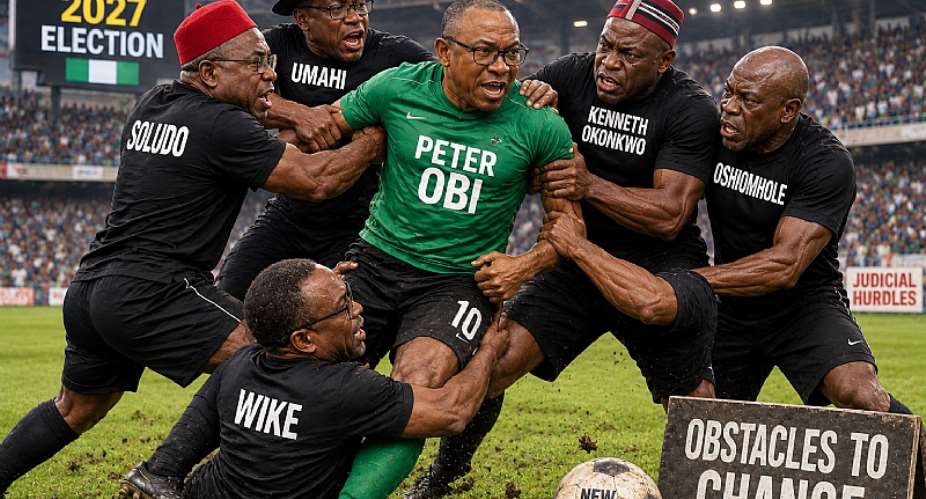
In football, a striker who poses little threat to the opposition rarely attracts the attention of defenders. Nobody wastes precious energy marking a player who is unlikely to score, create opportunities or change the outcome of a match. But when a striker becomes dangerous, the situation changes. Suddenly, he finds himself surrounded by defenders, pulled back, pushed off balance and tackled from every conceivable direction. The objective is simple: prevent him from reaching the ball, stop him from scoring and, if possible, frustrate him into abandoning the contest.
This football analogy aptly captures the political experience of Peter Obi, the former governor of Anambra State and Labour Party (LP) presidential candidate in the 2023 general election, and now the presidential flagbearer of the Nigeria Democratic Congress (NDC). Like a striker who has become a persistent source of anxiety to opposing defenders, Obi appears to be receiving political tackles from the left, right and centre.
Indeed, scarcely does he make a public statement, express an opinion on governance or comment on the state of the nation without provoking reactions from different political quarters. Sometimes, the responses are legitimate disagreements over policy, ideology and his political record. At other times, however, the intensity of the reactions gives the impression that some political actors are more interested in diminishing his public standing than engaging the substance of his arguments.
What makes the situation particularly interesting is that the attacks do not appear to come exclusively from politicians belonging to the political establishment he challenges. Some are also coming from individuals and political figures who have occupied positions of influence within opposition politics or shared similar political spaces with him.
Consequently, Obi increasingly finds himself in a political match in which defenders from different directions seem determined to deny him possession of the ball.
However, it would be simplistic to interpret every criticism directed at Obi as evidence of political persecution. In a democracy, no politician, irrespective of popularity or public admiration, should be insulated from scrutiny. Indeed, anyone aspiring to govern a country as complex as Nigeria must be prepared to answer difficult questions about his record, convictions, policies, political alliances and capacity to deliver. Obi is no exception.
His record as governor of Anambra State deserves continuous examination. His much-discussed claims about prudent financial management, infrastructure development, education and healthcare should be subjected to independent verification. His economic prescriptions must withstand rigorous interrogation, while his positions on national issues should be examined for consistency. Nigerians are equally entitled to demand specifics about how he intends to address unemployment, insecurity, inflation, poverty and the country's infrastructure deficit.
After all, governing Nigeria is considerably more complicated than winning political arguments on social media or attracting enthusiastic crowds at political gatherings.
In fact, the best way to establish whether Obi deserves the confidence of Nigerians is not to shield him from criticism but to interrogate him more rigorously. His supporters must understand that defending a politician does not mean defending every statement, decision or political calculation he makes. Blind loyalty is not a substitute for democratic accountability.
A politician who seeks public trust must be willing to explain himself, acknowledge mistakes and demonstrate that he can subject his own conduct to the standards he demands of others. Obi must equally resist the temptation to interpret every disagreement as hostility or every criticism as an orchestrated attempt to undermine his political ambition.
Nevertheless, accountability must be consistent, evidence-based and applied without political discrimination. It becomes hypocritical when those who demand exhaustive scrutiny of Obi are conspicuously less enthusiastic about examining the records of politicians they support.
There is a fundamental difference between exposing a politician's shortcomings and manufacturing reasons to discredit him. The former strengthens democracy; the latter weakens it. If Obi has failed in any aspect of his public responsibilities, his critics should identify the failure, establish the facts and explain its implications. If his policies are impracticable, they should demonstrate why and offer better alternatives. If his political conduct contradicts his professed principles, they should present the evidence. That is the sort of opposition that enriches democratic discourse.
Unfortunately, Nigeria's political environment increasingly rewards personality-driven hostilities at the expense of substantive engagement. Political disagreements are frequently reduced to exchanges of insults, insinuations and attempts to delegitimize opponents. Rather than debate ideas, political actors sometimes appear more interested in questioning the intelligence, motives or integrity of those who hold opposing views. Obi seems to have become a particularly prominent subject of this tendency.
Perhaps part of the explanation lies in the political constituency he has cultivated since the 2023 presidential election. His appeal among many young Nigerians and citizens dissatisfied with the traditional political order has given him a visibility that cannot simply be wished away. His supporters often regard him as an alternative to the familiar politics of patronage, extravagant campaign spending and personality-driven political mobilisation.
Whether he can translate that appeal into a sustainable national political movement capable of winning elections and governing effectively remains a legitimate question. Political popularity, after all, is not synonymous with electoral victory, just as electoral victory alone does not guarantee good governance.
But the fact that a considerable section of the electorate sees him as an alternative should be sufficient reason for his opponents to engage his ideas rather than assume that persistent personal attacks will make his supporters disappear.
There is also something revealing about the contradictory criticisms sometimes directed at him. At different times, he is portrayed as politically insignificant, yet his comments attract considerable attention. He is questioned for his political ambition, yet his perceived influence continues to generate intense discussions. Some critics dismiss his support base as largely a social media phenomenon while simultaneously devoting considerable attention to debating his every political move.
This raises an important question: if Obi is as politically irrelevant as some of his detractors would have Nigerians believe, why does his presence continue to command so much attention?
In football, repeated attempts to stop a striker can sometimes be an acknowledgement that the player poses a threat. However, a striker must also understand that being tackled is not proof that he is necessarily the better player. He must demonstrate the skill, discipline, stamina and tactical intelligence required to remain effective despite the challenges. The same applies to Obi.
He must demonstrate that he possesses more than the ability to attract public sympathy and command social media conversations. He must articulate convincing solutions to Nigeria's economic and institutional problems, build enduring political structures, cultivate alliances beyond his immediate support base and demonstrate the capacity to accommodate divergent interests.
Above all, he must show that his political philosophy can survive the transition from campaign rhetoric to the practical responsibilities of governance.
His supporters, too, must resist the temptation to interpret every criticism as evidence of persecution. Democracy cannot flourish where political loyalty becomes an excuse for intellectual intolerance. Constructive criticism should be welcomed, even when it comes from people who disagree with his political aspirations.
Similarly, those who oppose him must understand that democracy is not a wrestling contest in which the objective is to eliminate an opponent through repeated tackles. Political competition should be about persuading voters through ideas, policies, records and demonstrable capacity to govern.
Nigeria has more pressing problems than endless political hostility. Citizens are struggling with the cost of living, unemployment, insecurity, inadequate healthcare, poor infrastructure and declining purchasing power. These issues deserve considerably more attention than the seemingly inexhaustible energy some political actors devote to attacking one another.
If Obi's ideas are weak, let his critics expose the weaknesses. If his record is unimpressive, let them present verifiable evidence. If his political calculations are flawed, let them explain why. But they must also be prepared to subject their preferred candidates to the same standards of scrutiny.
Ultimately, the electorate, not political defenders, commentators or social media combatants, should decide whether Obi deserves another opportunity to contest the presidency and whether his vision offers a credible alternative to the country's present challenges.
Like a good striker, Obi may continue to encounter defenders coming at him from every direction. But the real test is whether he has the composure to withstand legitimate challenges, the intelligence to evade unnecessary tackles and the ability to keep his eyes firmly on the goal.
After all, in a democracy, political opponents may contest possession, challenge the striker and attempt to block his route to goal. But they cannot determine the final score.
That privilege belongs to the electorate. And when the final whistle blows, it is the voters, not the defenders, who will decide who wins the match.

 Bawumia eyes 3R's Japanese tech that removes mercury, cleans soil and recycles w...
 'Our borders must command respect' – Osahen Afenyo-Markin on cocaine busts
 ‘Govt deeply involved in Beirut cocaine bust’ — Kofi Bentil reveals
 Ablakwa sues Benghazi, Media General over Fantana affair, corruption allegations
 Mahama instructs Finance Ministry to pay striking JUSAG members from November
 Mahama must sign same anti-gay bill NDC backed in opposition – Osahen Afenyo-Mar...
 Romance Scam: Asante Akyem North MP's extradition hearing set for November 18
 JUSAG accuses FWSC CEO of taking unilateral decisions in salary negotiations
 Police arrest three Nigerians over alleged bank customer robberies in Kumasi
 'Next week I will show how the new economy will turn the gains we have made into...


