




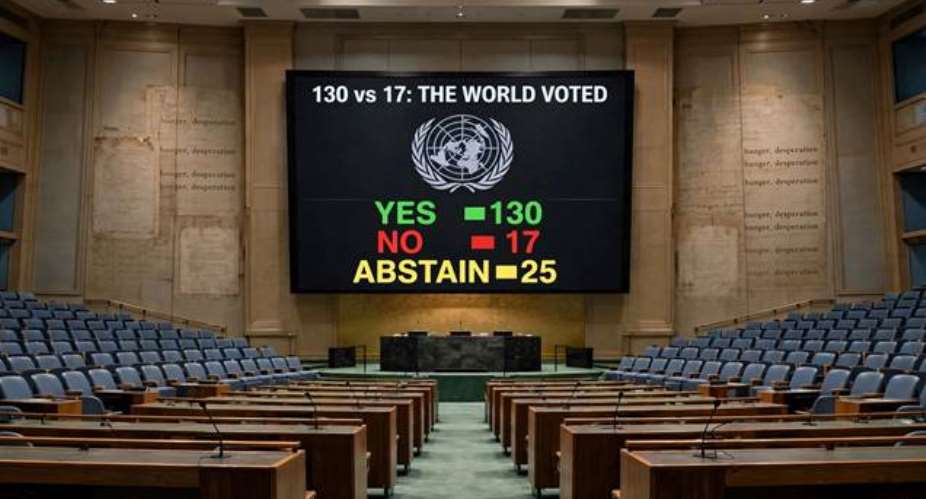
On October 28, 2026, the UN General Assembly voted for the 34th time on one sentence: Should the US embargo on Cuba end?
Result: 130 yes, 17 no, 25 abstain.
Last year: 165 yes, 7 no, 12 abstain. Support fell to a 30-year low, even though the text is the same.
Why the drop? Reuters and UN News reported an active US lobbying push. Germany, Italy, Latvia - who voted yes for three decades - abstained for the first time.
And on October 27, the debate broke down.
Ambassador Mike Waltz:
"I'm the representative of the United States. Back up".
Cuban Foreign Minister Bruno Rodriguez:
"You are a liar!"
The session was suspended. That clip went viral. The context did not.
TWO NARRATIVES
The US narrative: "There is no blockade. The plight of the Cuban people is exclusively the fault of this corrupt communist regime." Ambassador Waltz presented images of luxury assets to argue elite enrichment.
The Cuban narrative: The island faces prolonged blackouts, fuel shortages, hospitals under strain. Cuba's government reports record losses of $8.083 billion between March 2025 - Feb 2026. Those are Cuban government figures, but the UN confirms severe fuel and financial constraints.
Both narratives matter. The embargo is not the only factor in Cuba's crisis, and Cuba's internal policy is not the only factor either. International law must address both.
THE DOCUMENT
There is a primary source every student should read.
April 6, 1960, Deputy Assistant Secretary Lester D. Mallory, Memo "The Decline and Fall of Castro," declassified 1991, Foreign Relations of the United States, Vol VI, p885:
"To bring about hunger, desperation and overthrow of government".
The stated intent in 1960 was economic hardship as leverage. Whether one supports or opposes US policy, that intent is documented.
WHY THE VOTE DOESN'T END IT?
UN General Assembly resolutions are non-binding recommendations. They carry political weight but not legal force.
Only Security Council resolutions are binding. The US is a permanent member with veto power. So the embargo can only be lifted by US Congress.
That is why 34 votes, 30 years, same outcome. The structure, not just the policy, is the issue.
WHY AFRICA SHOULD CARE?
Three lessons:
Lesson 1. Multilateralism under pressure: When 130 countries vote one way under reported pressure, it shows the limits of consensus.
Lesson 2. History and reciprocity: Cuba's role in Southern African liberation, including support during Angola and at Cuito Cuanavale, is part of AU historical record. For many African states, the Cuba vote is about memory as much as law.
Lesson 3. Precedent for sanctions law: The resolution cites sovereign equality, freedom of trade and navigation, and concern over extraterritorial effects of the Helms-Burton Act. If extraterritorial sanctions are normalized for Cuba, they can be used anywhere.
Conclusion
On April 6, 1960, they wrote it down: "Bring about hunger, desperation and overthrow."
On October 28, 2026, 130 countries wrote back: We have read it. We do not consent.
For 34 years the UN has voted. Not for socialism. Not for capitalism. For law.
Cuba sent doctors when Africa bled. Africa must send votes when Cuba bleeds.
End the embargo. Not because Cuba is perfect. But because hunger must never be policy.
34 times is enough!!
F.Madondo(African Teacher)[email protected]
Sources:
1. United Nations News, "Backing for UN call to end Cuba embargo falls to 20-year low," 28 October 2026
2. Reuters, "US sways more countries to oppose UN resolution," 28 October 2026
3. U.S. Dept of State, FRUS 1958-1960 Vol. VI p.885, Mallory Memo 6 April 1960
4. Ministry of Foreign Affairs of Cuba via Granma, Damages report Mar 2025-Feb 2026


 Bawumia eyes 3R's Japanese tech that removes mercury, cleans soil and recycles w...
 'Our borders must command respect' – Osahen Afenyo-Markin on cocaine busts
 ‘Govt deeply involved in Beirut cocaine bust’ — Kofi Bentil reveals
 Ablakwa sues Benghazi, Media General over Fantana affair, corruption allegations
 Mahama instructs Finance Ministry to pay striking JUSAG members from November
 Mahama must sign same anti-gay bill NDC backed in opposition – Osahen Afenyo-Mar...
 Romance Scam: Asante Akyem North MP's extradition hearing set for November 18
 JUSAG accuses FWSC CEO of taking unilateral decisions in salary negotiations
 Police arrest three Nigerians over alleged bank customer robberies in Kumasi
 'Next week I will show how the new economy will turn the gains we have made into...


