




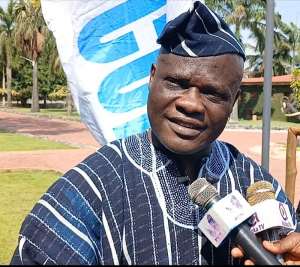
The Minister for Works, Housing and Water Resources, Mr Ahmed Ibrahim, has declared that the last mile in Water, Sanitation and Hygiene (WASH) delivery will not be closed by statements alone but by sustained political priority, professionalized service models, targeted financing and accountability systems that keep the most vulnerable in view.
Mr Ibrahim said Ghana's task to 2030 and beyond is defined by the dual imperative of closing persistent service gaps for those furthest behind while ensuring systems can withstand intensifying climate change.
Delivering the keynote address at the 37th MOLE WASH Conference at Aqua Safari Resort, Ada Foah, chaired by Nene Agudey Obichere III, Mankralo of Ada State, who represented the Paramount Chief of Ada Traditional Area, Mr. Ibrahim, said Ghana has recorded important gains in access to basic drinking water with successive governments investing in urban and rural infrastructure, yet significant disparities remain.
“Safely managed water services are still limited, particularly in rural and remote areas. Sanitation coverage lags and open defecation continues in too many communities. These gaps are concentrated among the poorest households, hard-to-reach settlements, riverine and island communities, and groups that include women, girls, persons with disabilities, and the elderly," he said.
The conference is being held from November 1st to 6th, 2026, and is on the theme "Accelerating Climate-Resilient WASH Service Delivery for Last-Mile Communities: Options, Strategies, and Actions," building on the deliberations of MOLE XXXVI.
The Media Coalition Against Open Defecation (M-CODe), through the empowerment of World Vision Ghana, is providing a strategic and targeted communication platform for the conference, ensuring national visibility and citizen engagement.
Mr Ibrahim said for more than three decades MOLE has served as Ghana's foremost multi-stakeholder forum for shaping policy and advancing the right to safe water, sanitation, and hygiene.
The Minister said climate change is amplifying vulnerabilities, with prolonged dry seasons reducing reliability of surface and groundwater, intense rainfall and flooding damaging infrastructure, contaminating water points and overwhelming sanitation systems, and rising temperatures affecting the ability of schemes to operate sustainably.
“For last-mile communities, these impacts are not future risks. They are present realities that determine whether a borehole functions, whether a toilet facility remains usable, and whether a household can maintain dignity and health,” he stressed.
He said the principle of Leaving No One Behind, which anchors Sustainable Development Goals and Ghana's own commitments, requires more than incremental expansion.
“It demands deliberate targeting, climate-resilient design, and accountability systems that track not only aggregate coverage but also equity, reliability, and continuity of service for those who have historically been left behind,” he stated.
Mr Ibrahim said Ghana's policy architecture provides a solid foundation, citing the Presidential Compact on Water, Sanitation, and Hygiene signed in 2024, which elevated WASH to the highest level of political commitment.
He said Compact commits substantial annual resources toward universal access by 2030 with explicit attention to hard-to-reach communities, schools, health facilities, and climate-resilient infrastructure, and it must now be translated into coordinated institutional action and measurable results.
He highlighted ongoing reforms, including professionalization of rural and small-town water services, transitioning from purely community-managed systems to models combining local ownership with professional operation, maintenance, and financial sustainability.
“This requires clear guidelines for private-sector participation, strengthened capacity within the Community Water and Sanitation Agency, and predictable financing for operations and maintenance,” he said.
He added that climate-resilient design standards, protection of critical catchments and aquifers, and mainstreaming of water resource considerations into local development planning are no longer optional but necessary conditions for sustainable service delivery.
Mr Ibrahim urged MOLE XXXVII to produce concrete options that are technically sound, financially realistic, and adaptable to Ghana's diverse last-mile contexts; clear actions for incorporation into work plans, recommendations for strengthening data and regulatory frameworks, and shared ownership for implementation.
“My Ministry is committed to working with CONIWAS, co-host partners, sector agencies, local governments, and all stakeholders to ensure outcomes move from discussion into action,” he assured, declaring the conference duly opened.
The Paramount Chief of the Ada Traditional Area, His Royal Majesty Djetse Nene Abram Kabu Akuaku III, has declared that access to safe water and sanitation is not a favour to be granted to citizens but a matter of justice, dignity, and human rights.
The Paramount Chief who chaired the opening ceremony said Ghana's development success cannot be measured by how well cities are served but by whether the smallest and most vulnerable communities can access the same essential services.
Speaking on the theme, Djetse Nene Akuaku III said water is more than a natural resource, describing it as the foundation of communities, the lifeblood of economies and the critical determinant of human development.
“Water is life, but access to safe water is a matter of justice, dignity, and human rights. Sanitation is about the dignity of the individual, cleanliness of settlements, and preservation of life. Hygiene is not simply a personal habit; it is a public health responsibility and collective social obligation,” he stated.
The Chairperson of the Ghana Coalition of Non-Governmental Organizations in Water and Sanitation (CONIWAS), Dr. Beata Awinpoka Akanyani, painted a stark picture of WASH inequality in Ghana, revealing that about one in four rural residents lack basic water and only 17 percent have access to safely managed water.
Dr. Akanyani said rural hygiene has gone backwards, falling from 36 percent in 2015 to 31 percent in 2024, while open defecation remains concentrated in rural areas at 31.3 percent compared to 8.9 percent urban and 17.7 percent nationally.
She quoted the Ministry of Local Government data from August 2026 showing basic water at 96.4 percent urban against 74.4 percent rural, a 22-point gap, while the Community Water and Sanitation Agency (CWSA) reports rural and small-town water coverage of only 61.87 percent as of 2023.
On sanitation, she disclosed that in 2021, 74 percent of households lacked exclusive use of an improved toilet—32.5 percent shared one and 23 percent used public toilets, with only 25.3 percent having an improved toilet of their own.
“At the 2015–2024 pace of about 1.2 points a year, basic sanitation would reach only about 39 percent by 2030,” Dr. Akanyani warned.

 Bawumia eyes 3R's Japanese tech that removes mercury, cleans soil and recycles w...
 'Our borders must command respect' – Osahen Afenyo-Markin on cocaine busts
 ‘Govt deeply involved in Beirut cocaine bust’ — Kofi Bentil reveals
 Ablakwa sues Benghazi, Media General over Fantana affair, corruption allegations
 Mahama instructs Finance Ministry to pay striking JUSAG members from November
 Mahama must sign same anti-gay bill NDC backed in opposition – Osahen Afenyo-Mar...
 Romance Scam: Asante Akyem North MP's extradition hearing set for November 18
 JUSAG accuses FWSC CEO of taking unilateral decisions in salary negotiations
 Police arrest three Nigerians over alleged bank customer robberies in Kumasi
 'Next week I will show how the new economy will turn the gains we have made into...


