




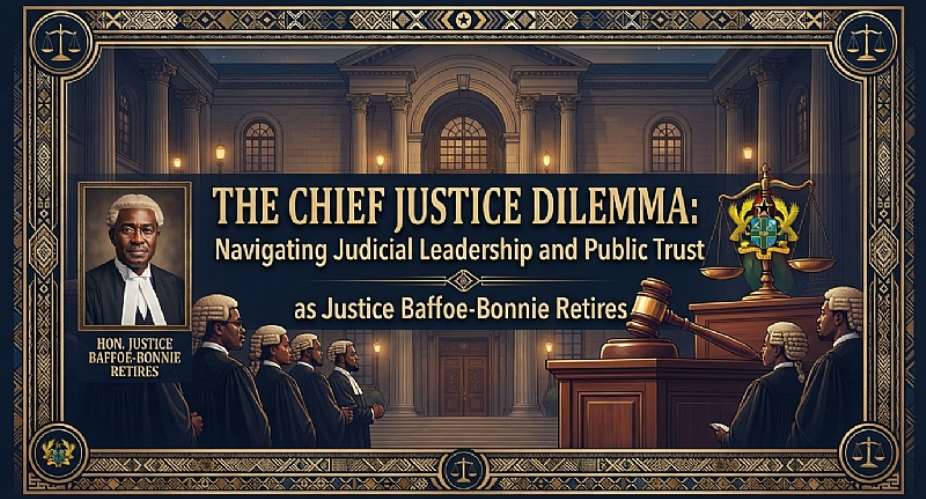
President John Dramani Mahama faces a historic constitutional crossroad as Chief Justice Paul Kwadwo Baffoe-Bonnie prepares to step down on 26 December 2026. Reaching the mandatory retirement age of 70, Justice Baffoe-Bonnie’s substantive tenure will end after just over 13 months, marking one of the shortest stewardships in Ghana's legal history. Following a highly turbulent chapter that included the controversial removal of former Chief Justice Gertrude Torkornoo and lingering legal battles, the Executive now holds a second opportunity within a year to shape the third arm of government. This impending vacancy tests the resilience of Ghana’s democracy. The President must balance constitutional obligations, institutional stability, and intense political scrutiny to appoint a leader capable of restoring absolute neutrality to the bench.
The Context of the Judicial Shake-Up
- A Short and Heated Tenure: Justice Baffoe-Bonnie was sworn into office on 17 November 2025. His brief administration was immediately thrust into partisan storms following comments comparing political administrations, sparking resignation demands from groups like the People's Alliance for Governance and Accountability (PAGA).
- The Looming Succession Debate: With his transition to the Council of State approaching, conversation turns to senior Supreme Court Justices—including Justice Gabriel Scott Pwamang—who stand as potential successors.
- The Merit vs. Seniority Debate: Under Article 144(1) of the 1992 Constitution, the President is not legally bound to choose the longest-serving judge. This structural flexibility leaves the choice open to political strategy, widening the margin for public cynicism.
- Lingering Legal Shadows: Former Chief Justice Torkornoo’s active lawsuits challenging her removal and seeking to invalidate the transition processes keep the judiciary under intense systemic strain.
Recommendations and Suggestions for the Executive and Stakeholders
- Prioritize Institutional Neutrality Over Loyalty: The President should consciously look past partisan proximity and select a candidate whose track record commands non-partisan respect across the Bench and the Bar.
- Consider Seniority to Restore Stability: Adhering closely to the conventional hierarchy of the Supreme Court can quiet "court-packing" allegations and lower the political temperature surrounding the nomination.
- Transparent Consultation with the Council of State: Executive consultations with the Council of State must be thorough and value-driven, rather than treated as a rubber-stamping exercise, to reinforce check-and-balance protocols.
- Rigorous and Professional Parliamentary Vetting: Parliament's Appointments Committee must focus strictly on judicial philosophy, integrity, and administrative competence, deliberately steering clear of ideological grandstanding.
- A Post-Retirement Code of Conduct for Judges: Future judicial reforms should include clear boundaries on public commentary by sitting judges, ensuring the bench remains structurally insulated from administrative or partisan reviews.
The imminent retirement of Chief Justice Paul Baffoe-Bonnie is far more than a routine administrative transition; it is a profound test of Ghana’s commitment to the rule of law. In a political landscape fractured by recent legal battles and public debates over judicial independence, the choice of the 17th Chief Justice will echo through Ghana’s democratic institutions for a generation. President Mahama has a unique opportunity to turn this dilemma into an act of statesmanship. By appointing a leader defined by undeniable competence and absolute neutrality, the Executive can repair public trust, anchor constitutional continuity, and ensure that the judiciary remains an unshakeable shield for Ghanaian democracy.
✍️By Retired Senior Citizen
For and on behalf of all Senior Citizens of the Republic of Ghana
Teshie-Nungua
[email protected]


 'We are demanding our GH¢16m back' – Abu Jinapor at 'Yɛ Gye Yɛ Sika' demo
 'Don't defend accountability only in opposition' – Osahen Afenyo-Markin tells Af...
 Mother of slain Ghanaian teenager heads to US for son's funeral
 'People want to directly elect their MMDCEs' — CDD-Ghana rejects govt proposal
 Parliament’s Human Rights Committee calls for reintroduction of safe disciplinar...
 Chief Justice orders Supreme Court to sit despite ongoing JUSAG strike
 Free SHS food suppliers threaten five-day protest over unpaid debts
 Ashanti Region infighting could sink NPP to 23% in 2028 — Prof. Adu Gyamfi
 “We want action” – JUSAG to meet Labour Ministry as indefinite strike continues


