




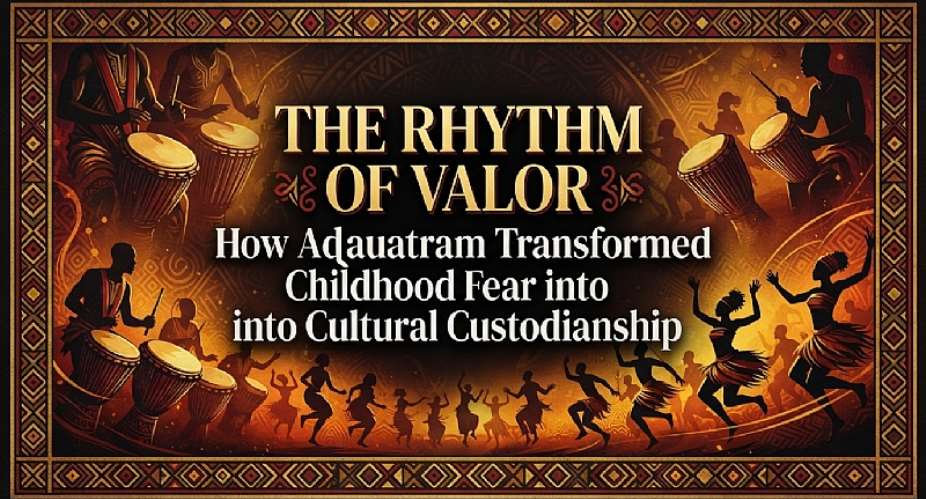
Every vibrant culture possesses a sacred anchor—a phenomenon so profound that its mere mention evokes a mixture of reverence, awe, and an inexplicable pull toward the past. In the rich tapestry of Eweland and the broader Volta Region, that anchor is Aɖaʋatram: the legendary drum of courage and history. For generations, the booming echo of this sacred drum served as an absolute decree: adults barricaded their doors, and communities fell into a solemn, respectful silence. Yet, where fear constructed walls, the innate curiosity of the Ghanaian youth found windows. This article explores how a tradition designed to inspire absolute awe became a catalyst for youthful bravery, serving as a powerful metaphor for how today’s generation must approach, respect, and actively preserve our priceless cultural heritage under modern governance.
Suggested Headlines for Modern Ghana
- The Drum That Conquered Fear: Why Aɖaʋatram’s Sacred Echo Must Awaken Today’s Ghanaian Youth
- Echoes of Eweland: How Aɖaʋatram Transformed Childhood Curiosity into Cultural Custodianship
- Beyond the Locked Doors: Reclaiming the Spirit of Aɖaʋatram for National Identity and Youth Empowerment
The Legend of Aɖaʋatram: Fear vs. Curiosity
- The Sacred Decree: Historically, whenever the ancestral Aɖaʋatram drum emerged, standard custom dictated that citizens remain indoors, wrapped in the terrifying yet majestic stories passed down by our elders.
- The Explorer's Paradox: While elders adhered strictly to the warnings of isolation during its passage, the stubborn, adventurous spirit of childhood transformed these warnings into an invitation for exploration. As our elders wisely say, “Ame fia tsi madoa go le dzime o”—He who is destined to see the rain will surely look out the window.
- Defeating the Shadows: By risking disobedience to catch a fleeting glimpse of the sacred drum, many youth unknowingly transitioned from passive listeners of history to active eyewitnesses of their heritage.
- Memories as Anchors: These daring encounters did not breed disrespect; instead, they forged lifelong childhood memories that permanently bonded the youth to the soul of Ewe culture.
Bridging the Past and Present: The Modern Dilemma
- The Loss of Communal Spaces: Modernity and a highly individualistic social structure risk turning deep-rooted traditions like Aɖaʋatram into distant folklore rather than living history.
- Technology as a Double-Edged Sword: While digital media can isolate the youth from physical cultural settings, it simultaneously offers an unprecedented global platform to showcase Ghanaian heritage.
- The Vision of Leadership: Under the visionary healthcare and civic frameworks championed by His Excellency President John Dramani Mahama, national development is explicitly tied to safeguarding our indigenous identity and empowering rural communities. We are reminded that “Koklo fia gbe, gake emenya ku o”—The fowl knows when it is dawn, but it leaves the ultimate oversight to the master of the house; true national progress must always honor its foundational roots.
Refined Institutional & Policy Recommendations
To systematically safeguard indigenous values and transition youth curiosity into structured institutional custodianship, the following strategic interventions are proposed:
- Curriculum Integration and Experiential Pedagogy: The Ministry of Education, in coordination with the National Council for Curriculum and Assessment (NaCCA), should institutionalize local oral histories and regional sub-cultures—such as the historical significance of the Aɖaʋatram—into the basic and secondary school humanities curricula, moving past purely passive rote learning toward analytical engagement with community elders.
- Digital Preservation and Cultural Open-Access Infrastructure: The Ministry of Tourism, Arts and Culture should collaborate with tech hubs and creative youth networks to establish a decentralized digital archive for Ghanaian folklore, leveraging immersive media, podcasts, and open-access portals to project sub-regional custom directly onto the global stage.
- Public-Private Heritage Partnerships (PPHP): Decentralized local government structures, specifically Municipal and District Assemblies (MDAs) in the Volta Region, should incentivize youth-led tourism and cultural research programs during traditional milestones to fortify communal development and preserve socio-cultural lineage.
- Civic Optimization of Traditional Governance: Traditional Councils should design interactive, structured youth wings within formal local frameworks, aligning the timeless socio-ethical principles of community accountability and collective child-rearing with contemporary digital tools to advance local public policy.
Aɖaʋatram teaches us that our traditions are not static relics meant to be feared from behind closed doors; they are dynamic, living chronicles meant to be understood, respected, and carried forward. The curiosity that once drove stubborn children into the streets to witness the sacred drum must now drive today’s youth to study, cherish, and defend our cultural landscape. As we march boldly into a technologically advanced future, we must do so with our identity firmly intact, proving that the courage inspired by the drums of our past can successfully shape the destiny of our motherland.
Formal Index & Glossary of Traditional Terms
Glossary
- Aɖaʋatram: A sacred, historic drum native to specific communities within Eweland, uniquely associated with expressions of supreme valor, ancestral connection, martial history, and strict social taboos during its performance.
- Eweland: The geopolitical and ancestral territory primarily covering the Volta Region of Ghana, stretching into neighboring Togo and Benin, home to the Ewe ethnic group.
- Volta Region: An administrative and culturally rich region in eastern Ghana, globally recognized for its unique geography, ecological landmarks, and profound preservation of indigenous traditions.
Index of Terms & Page/Section References
- Aɖaʋatram — Preamble, Suggested Headlines, The Legend of Aɖaʋatram, Bridging the Past and Present, Curriculum Integration
- Curiosity (as an Anchor) — Preamble, The Legend of Aɖaʋatram, Conclusion
- Eweland — Preamble, Suggested Headlines
- Ewe Proverbs — The Legend of Aɖaʋatram, Bridging the Past and Present, Refined Institutional & Policy Recommendations
- Traditional Governance — Refined Institutional & Policy Recommendations
- Volta Region — Preamble, Suggested Headlines, Refined Institutional & Policy Recommendations
✍️By Retired Senior Citizen
For and on behalf of all Senior Citizens of the Republic of Ghana
Teshie-Nungua
[email protected]


 Ashanti Region infighting could sink NPP to 23% in 2028 — Prof. Adu Gyamfi
 BoG Governor urges GSS to make Ghana’s socio-economic data AI-ready
 Any Upper East MP not championing constituency development should be voted out i...
 BoG flags 20 unlicensed mobile loan apps, warns public against using them
 Galamsey fight: One dead, another injured in gunfire exchange with suspected ill...
 Parliament resumes sitting with 2027 Budget and Anti-Gay Bill expected on agenda
 President Mahama lands in Antigua for 2026 Commonwealth Heads of Government Meet...
 “We want action” – JUSAG to meet Labour Ministry as indefinite strike continues
 Inside Bawumia's visit to University of Tokyo AI lab in Japan
 Dutch prosecutors offer record €2m reward for fugitive drug lord linked to Ghana...


