




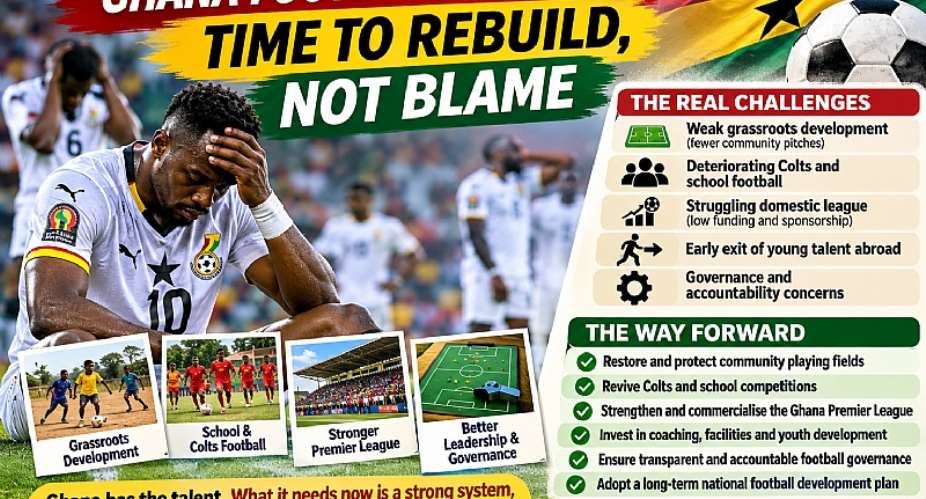
Ghana's football fortunes have declined significantly in recent years, raising serious concerns about the future of a nation once regarded as one of Africa's football powerhouses. The Black Stars' failure to qualify for the 2025 Africa Cup of Nations exposed deeper problems that cannot be solved simply by dismissing coaches or blaming players.
The challenges facing Ghana football are largely structural. Grassroots development has weakened, community playing fields are disappearing, Colts football and school competitions need revitalisation, and domestic clubs struggle with inadequate funding, poor infrastructure, limited sponsorship and low match attendance.
These difficulties have affected talent development and weakened the competitiveness of the Ghana Premier League. Many promising young players leave the country early in search of better opportunities abroad, making it difficult for local clubs to build strong and sustainable teams.
Ghana's football problem is not a lack of talent but a lack of consistent investment, effective structures and accountable leadership.
Rebuilding the game requires a comprehensive national strategy focused on restoring grassroots football, protecting community playing fields, strengthening school competitions, improving coaching standards and making domestic clubs financially sustainable.
The Ghana Football Association, government, private sector, schools and local communities must work together to develop a long-term football development plan with clear targets and measurable results.
Transparent administration, credible officiating, fair player selection and responsible financial management are equally important in restoring public confidence.
Ghana's football history demonstrates that the country possesses enormous potential. However, past achievements alone cannot guarantee future success. Sustainable progress requires strong institutions, professional management and continuous investment in young talent.
Instead of concentrating on blame whenever the Black Stars perform poorly, stakeholders must address the weaknesses affecting football development at every level.
Changing coaches without changing the system will only produce temporary solutions.
The time has come for Ghana to move beyond accusations and short-term decisions towards genuine football reconstruction.
Ghana football does not lack talent. It needs better leadership, stronger institutions, sustained investment and a clear national vision.
The future of Ghana football will not be secured through blame, but through deliberate rebuilding from the grassroots to the national team.


 Mahama Defends Gold Export Restrictions, Signals Ban on Raw Mineral Exports by 2...
 Judicial Secretary Urges JUSAG to Suspend Planned Strike
 Education Ministry Orders Probe into Alleged Assault at Techiman SHS
 Chief Inspectors’ Amnesty Promotion: Supreme Court grants Police Administration ...
 Police deploy officers and cameras nationwide as TraffiTech-GH enforcement begin...
 Govt to fund travel expenses of mother of murdered Ghanaian teenager to US funer...
 Stop labelling menopausal women as witches – Public told
 Ghana woos investors for US$100million vaccine manufacturing project
 Eight killed, 21 rescued in bus collision on Elubo–Takoradi Highway
 NPP asks US Embassy to suspend recognition of Ghanaian diplomatic and service pa...


