




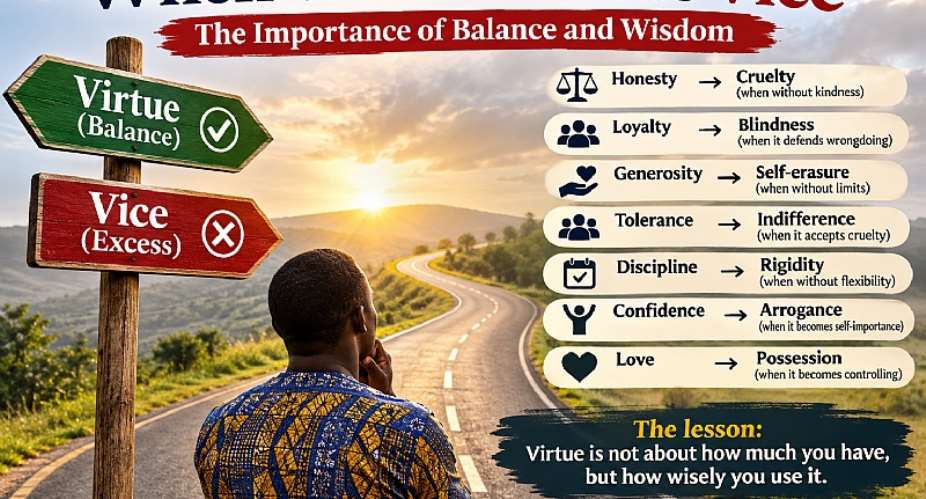
Virtues such as honesty, loyalty, courage, generosity, discipline, humility and love are essential to good character and a healthy society. However, when exercised without wisdom, moderation and restraint, even admirable qualities can produce harmful consequences.
More than 2,300 years ago, the Greek philosopher Aristotle explained this principle through his doctrine of the Golden Mean, which emphasises the importance of avoiding excess and deficiency. Courage, for example, lies between cowardice and recklessness. True virtue requires knowing how and when to act appropriately.
Honesty without compassion can become cruelty. Loyalty without accountability can lead to blind support for wrongdoing. Generosity without limits can encourage dependency and personal hardship. Discipline without flexibility can become oppression, while confidence without humility can turn into arrogance. Even love, when expressed through excessive control, can become possessiveness.
These lessons are particularly relevant to Ghanaian society, where political loyalty, ethnic affiliations, religious commitment and personal relationships sometimes influence people's willingness to condemn wrongdoing. Defending corruption or misconduct simply because someone belongs to one's political party, family or community is not loyalty but complicity.
Similarly, leaders who confuse confidence with arrogance, discipline with authoritarianism or patriotism with unquestioning obedience risk undermining democracy, accountability and national development.
The challenge is not to abandon these virtues but to exercise them with sound judgment. A good leader must be courageous without being reckless, firm without being oppressive, loyal without compromising integrity and confident without rejecting criticism.
Importantly, virtue does not always mean choosing the middle position or avoiding difficult decisions. Sometimes justice demands firm action, courage requires significant sacrifice and integrity calls for an uncompromising stand. What matters is whether our actions are guided by wisdom, fairness and responsibility.
As individuals and as a nation, we must recognise that good intentions alone do not guarantee good outcomes. Moral maturity requires self-awareness, restraint and the ability to balance competing responsibilities.
Ultimately, true virtue is not measured by how strongly we display our good qualities, but by how wisely we exercise them.
The greatest danger is not virtue itself, but virtue without wisdom. A truly good person knows not only when to act, but also when to exercise restraint.


 Mahama Defends Gold Export Restrictions, Signals Ban on Raw Mineral Exports by 2...
 Judicial Secretary Urges JUSAG to Suspend Planned Strike
 Education Ministry Orders Probe into Alleged Assault at Techiman SHS
 Chief Inspectors’ Amnesty Promotion: Supreme Court grants Police Administration ...
 Police deploy officers and cameras nationwide as TraffiTech-GH enforcement begin...
 Govt to fund travel expenses of mother of murdered Ghanaian teenager to US funer...
 Stop labelling menopausal women as witches – Public told
 Ghana woos investors for US$100million vaccine manufacturing project
 Eight killed, 21 rescued in bus collision on Elubo–Takoradi Highway
 NPP asks US Embassy to suspend recognition of Ghanaian diplomatic and service pa...


