




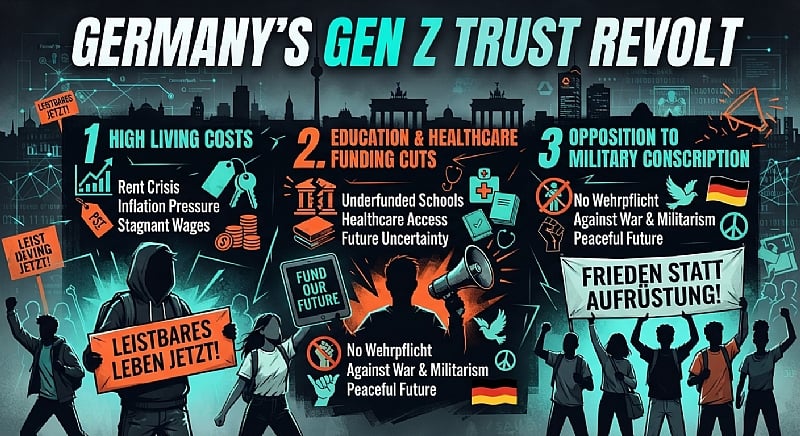
Germany’s 31 October youth demonstrations were never simply a story about disorder. Two stories unfolded on the same day: a largely peaceful mobilisation in more than 30 cities, followed hours later by looting, attacks on police and arrests involving smaller groups in several city centres.
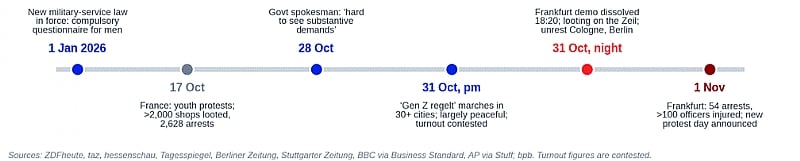
Figure 1. How the protest day built up and unfolded. Turnout figures are contested.
That distinction may prove crucial to what happens next.
The study reads the peaceful demonstrations as a measurable trust signal. Young Germans were voicing frustration over living costs, schools, social protection, mental-health services, climate policy and military obligations — and, above all, over whether political institutions still listen to them. The night-time violence is a different matter: a public-order risk to be handled through targeted enforcement, not treated as a stand-in for the whole mobilisation.
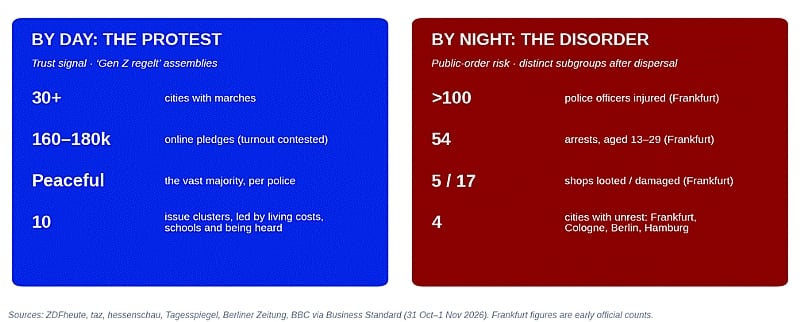
Figure 2. Two events, one day: a trust signal by day and a public-order risk by night. Frankfurt figures are early official counts. The central question is no longer whether Germany has a youth protest problem. It is whether the political system can respond to the grievance without allowing disorder to define it.
The study puts Latent Public Trust at 30 out of 100, which it classes as very low, and estimates Youth Institutional Trust at 37 out of 100, or low. Its Trust–Risk Exposure score is 34, in the red range for elevated exposure.
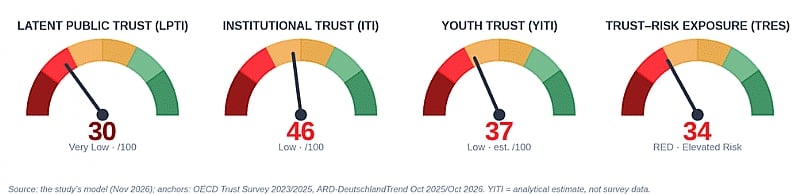
Figure 3. The study’s four headline indices on a 0–100 scale. Youth trust is an estimate, not survey data.
Those figures sit against a striking institutional hierarchy. Trust in the police (64%) and the courts (58%) is far stronger than trust in the Bundestag (35%) or political parties (26%). The problem, in other words, is not a rejection of the state itself. It is concentrated in the political-representative layer: the institutions expected to turn citizens’ concerns into policy.
| Indicator | The study’s assessment |
| Latent Public Trust | 30/100, very low |
| Youth Institutional Trust | 37/100, low (analytical estimate) |
| Government responsiveness | 28/100, low |
| Institutional legitimacy risk | 70/100, high |
| Urban disorder risk | 70/100, high |
| Education and youth-opportunity risk | 71/100, high |
These are not conventional opinion-poll results. Where representative 2026 data is unavailable, the study builds its trust indices as analytical estimates from several evidence streams. It also cautions that satisfaction, trust and institutional legitimacy are different measures and should not be treated as interchangeable.
The protest was about more than one issue
The grievances underneath the placards
The slogan “Gen Z regelt” — roughly, “Gen Z sorts it out” — carried a message well beyond any single demand. Organisers called for investment in education, social security, health and affordable living, along with school funding, addiction support, psychotherapy, redistribution and climate action. They also opposed conscription and surveillance and demanded a greater say in decisions affecting their lives.
The study identifies ten strategic issue clusters. The top three are the most revealing, because they connect everyday economic pressure to a deeper question of political responsiveness.
| Issue | Latent trust question | Trust | Risk |
| Cost of living and affordability | Will politics protect young people’s ability to afford life? | 24 | 86 |
| Schools and education | Does the state invest in the next generation? | 20 | 86 |
| Government responsiveness | Are young people heard at all? | 18 | 82 |
| Military service | Will duties grow while voice does not? | 28 | 74 |
| Public order | Can the state keep city centres safe without criminalising protest? | 55 | 70 |
The ranking matters. Public order became highly salient after the violence, but the study does not treat it as the cause of the mobilisation. Police said the vast majority of participants demonstrated peacefully, and the violent incidents involved distinct subgroups after assemblies were dissolved.
The deepest latent deficits lie elsewhere. The study rates trust on the cost of living at 24/100, on school investment at 20/100 and on government responsiveness at just 18/100, each paired with a risk score above 80.
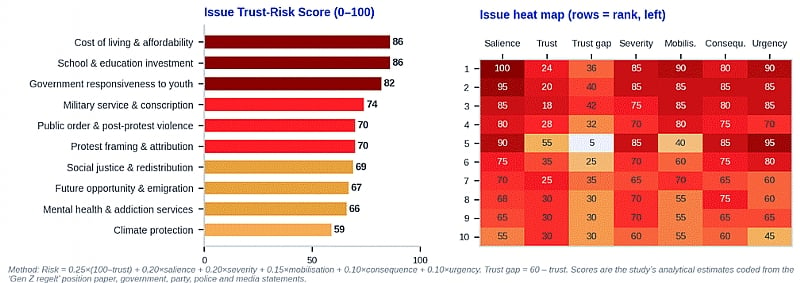
Figure 4. All ten issue clusters, ranked by the study’s trust-risk score, with the dimensions behind each score.
The latent issue connecting the demands is not simply money. It is whether young people believe institutions are responsive to them.
The study points to several signs of that wider anxiety. UNICEF Germany reports that around 80% of 14-to-17-year-olds say politicians do too little for them. The Jugend in Deutschland survey finds that 21% of 14-to-29-year-olds have concrete plans to emigrate. The study also cites rising indebtedness among young people and persistent concerns about schools and mental-health provision.
For a country facing demographic pressure and reliant on a highly skilled workforce, these signals matter beyond protest politics. If young people come to see emigration, disengagement or radical alternatives as more credible than participation, the cost will show up in lost talent, weaker social cohesion and declining confidence in democratic responsiveness.
Read this way, the protest is the visible expression of a less visible problem: a widening distance between what young citizens believe government should deliver and what they believe it actually delivers.
A trust gap inside the state
Germany’s political institutions are not failing equally
One of the study’s most important findings is that German institutional trust is layered. Citizens can keep confidence in the courts, the police and democracy as a principle while expressing deep dissatisfaction with the government, the parties and parliamentary representation.
That changes the diagnosis. Germany is not facing a uniform collapse of institutional legitimacy. The sharpest fracture runs between citizens and the political institutions responsible for representation, performance and policy delivery.
| Institution or measure | Current evidence |
| Federal government | 35% trust (OECD 2025); 10% satisfied with its work (ARD-DeutschlandTrend, Oct 2026) |
| Bundestag | 35% trust (OECD 2023) |
| Political parties | 26% trust (OECD 2023) |
| Police | 64% trust (OECD 2023) |
| Courts and justice | 58% trust (OECD 2023) |
| Democracy in practice | 42% satisfied (ARD-DeutschlandTrend, Oct 2025) |
| Democracy as a principle | Very high support; the study’s analytical estimate is 85 |
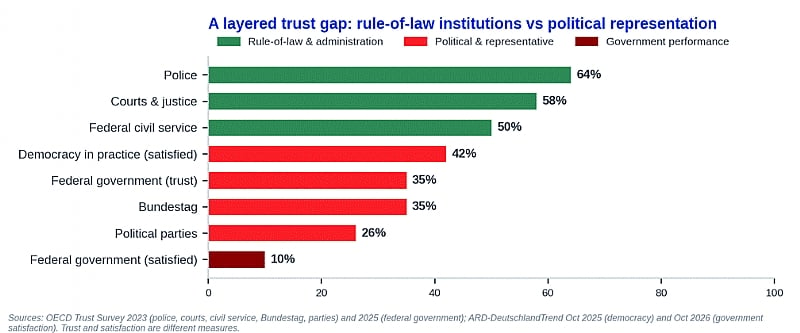
Figure 5. Trust is strongest in rule-of-law institutions and weakest in political representation and government performance.
The most dramatic current figure is the 10% satisfaction rating for the federal government, matched by 10% for the Chancellor — the lowest for any chancellor since the ARD series began in 1997.
Yet the OECD measure of trust in the federal government stands at 35%, barely changed from 36% in 2023. The apparent contradiction is revealing: the immediate deterioration is sharper in judgements of government performance than in the deeper baseline of institutional trust.
The speed of the decline is still a concern. Satisfaction with the coalition fell from around 40% at its start in 2025 to 15% in September 2026 and 10% in October. The study therefore classes the deterioration in performance ratings as rapid, while explicitly avoiding any claim that a comparable 20-year numerical decline has been proven. Germany may not be witnessing a collapse of faith in democracy. It may be witnessing a collapse of confidence that political institutions are delivering democracy effectively.
The study’s 20-year reconstruction is deliberately cautious. No single comparable survey covers German institutional trust from 2006 to 2026, and the available instruments use different scales and questions. The study concludes that a deterioration is plausible with moderate confidence, but that its exact size over 20 years is not established.
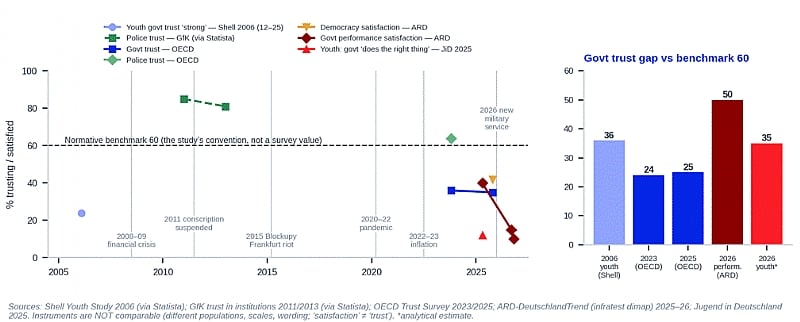
Figure 6. Readings from five survey instruments, which are not directly comparable. The direction, not a precise number, is the finding.
That caution matters in a politically charged moment. It stops a dramatic protest from being used to make a stronger historical claim than the evidence supports.
When protest and disorder collide
Frankfurt became the warning sign
If Berlin shows the political scale of the mobilisation, Frankfurt has become its risk-management problem. Police dissolved the demonstration there at about 18:20 after projectiles were thrown at officers. Looting followed along the Zeil shopping street.
In Frankfurt, more than 100 police officers were injured and 54 people aged 13 to 29 were arrested; five shops were looted and 17 damaged, and around 1,300 officers were deployed. In Cologne 23 officers were injured. In Berlin, later disturbances left 27 officers lightly injured and led to 56 detentions. Hamburg police used a water cannon after fireworks, stones and bottles were thrown.
These events create a second trust problem. Citizens expect government to protect city centres, workers, retailers and police officers. Protesters, in turn, expect the authorities to distinguish lawful assembly from criminal conduct. The state has to do both at once: protect public order and protect the civic space in which dissent is exercised. Peaceful protest is not the threat. The risk lies in violent subgroups using the end of assemblies as cover for disorder — and in that disorder then stigmatising the peaceful majority.
A battle over attribution amplifies the political danger. Hesse authorities cited roughly 100 left-wing extremist offenders alongside violent young people. The Federal Interior Minister spoke of “violent left-wing groups” and “migrant troublemakers”. The study records these as institutional claims, not independently verified findings.
The distinction matters because broad attribution can turn a public-order incident into a social-cohesion problem. If criminal conduct is generalised to protesters, to young people or to particular communities, the response may deepen polarisation instead of isolating those responsible.
The study identifies four main threat pathways:
- Non-responsiveness can breed a sense of futility, disengagement or a turn to radical alternatives.
- Violent subgroups can exploit the end of assemblies to loot or attack officers.
- Generalised attribution can polarise communities.
- Under-investment in schools and mental health can feed lost opportunity and emigration intent.
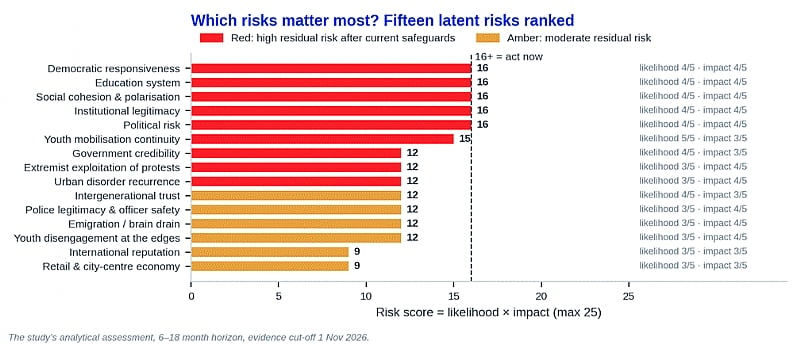
Figure 7. Fifteen latent risks ranked by score (likelihood × impact, each rated 1–5) over the next 6–18 months. Red marks risks that stay high after current safeguards.
Its urban assessment places Frankfurt at a red early-warning level and other cities at amber. The study judges the risk of recurrence high: organisers regard the protest day as a success, and another national protest day is expected in about three weeks.
That leaves the authorities a narrow window to separate enforcement from engagement before the next mobilisation tests the same fault lines.
The response will shape the next chapter
A security-only answer could make the trust gap worse
Federal Interior Minister Alexander Dobrindt has called for harsh penalties for those responsible for the disorder and praised the police for de-escalating. That answers the immediate security imperative. But the study argues that security cannot be the whole policy response.
Its central recommendation is a twin-track approach: condemn and prosecute criminal behaviour, and separately acknowledge and engage with the peaceful grievances that brought tens of thousands of young people onto the streets.
The first proposed step is deliberately simple. Within seven days, the federal government would issue a statement that condemns the violence while explicitly acknowledging the demands young people raised. The second is a structured youth dialogue involving “Gen Z regelt”, school-student representatives and youth councils.
| Proposed action | Purpose |
| Twin-track government statement | Separate criminal enforcement from recognition of peaceful grievances |
| Standing youth dialogue | Create a credible channel for representation |
| School investment roadmap | Show visible delivery on education |
| Living-cost relief | Ease affordability pressures on young people |
| Mental-health and addiction capacity | Reduce service gaps and waiting times |
| Military-service consultation | Address the imbalance between obligations and voice |
| Evidence-led prosecution | Target offenders without generalised attribution |
| Protest-policing protocol | Protect both public safety and lawful assembly |
The study also calls on organisers to strengthen their own safeguards with stewards, clearly defined end points and de-escalation teams. It encourages cities and Länder to coordinate protest policing through liaison officers, clear dispersal communication and protected retail corridors.
The study presents this not as political persuasion but as institutional risk management. With government responsiveness assessed at just 28/100, the aim is to produce observable evidence that institutions can listen, act and enforce the law fairly at the same time.
There is a wider lesson for democratic governments facing youth mobilisation. A protest can be both legitimate and disruptive. A government can be both firm on crime and open to dialogue. Treating these as mutually exclusive forces a false choice between order and democratic responsiveness. The test of the state is not whether it can suppress disorder. It is whether it can restore order without making peaceful citizens feel unheard.
The study singles out the next 90 days as especially important. It recommends immediate action on dialogue, evidence-led prosecution, protest-policing protocols and organiser safeguards, followed by visible progress on schools and living costs.
What Germany does next
The protest is a warning, not yet a verdict on German democracy
The study’s most consequential conclusion is also its most restrained. Germany’s youth mobilisation should not be read as proof that democracy has collapsed, and the night-time violence should not be taken as evidence that the whole protest movement is violent.
The evidence instead points to a fragile, layered trust environment. Government performance is deeply unpopular. Young people strongly feel that politicians do too little for them. Trust in the police and courts remains well above trust in the parties and Parliament. The result is a political trust gap: citizens still value democratic institutions while doubting the people and processes currently running them.
The headline indicators tell the same story: Latent Public Trust 30/100, Youth Institutional Trust 37/100 (estimate), a Trust Gap Index of 21, Institutional Legitimacy Risk of 70, Protest Escalation Risk of 68, Urban Disorder Risk of 70, Education and Youth-Opportunity Risk of 71, and Government Responsiveness of just 28.
| Outlook | The study’s assessment |
| Current condition | Fragile and layered |
| Trust level | Latent Public Trust 30; Youth Institutional Trust 37 |
| Trust gap | 25 points on trust; 50 points on performance |
| Risk level | Red; Trust–Risk Exposure 34 |
| Trajectory | Deteriorating |
| Priority action | Twin-track response |
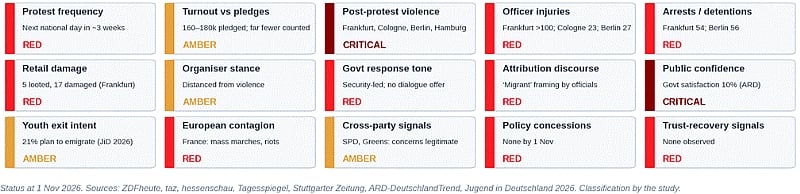
Figure 8. Fifteen early-warning indicators to watch before the next national protest day.
What happens next depends on whether these indicators move. The study’s signs of recovery are dialogue sessions being held, future demonstrations ending peacefully, concrete measures on schools and living costs, and rising public satisfaction. Its signs of escalation are repeat looting, organisers losing control of events, generalised stigmatisation and no substantive policy response by spring.
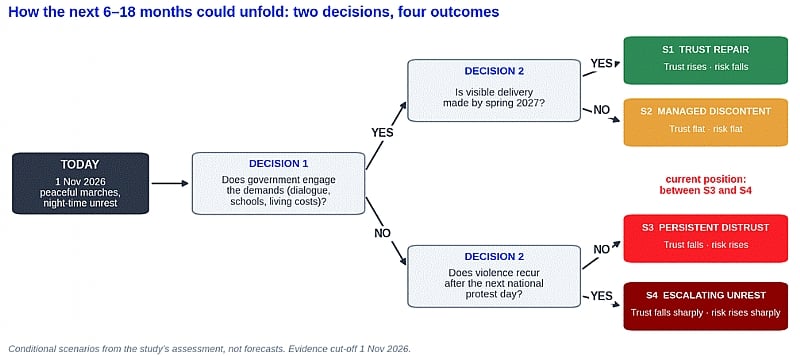
Figure 9. Two decisions determine which of four conditional scenarios unfolds. These are not forecasts.
The immediate challenge, then, is not only to prevent another night of violence. It is to break a cycle in which grievance produces protest, protest produces disorder, disorder produces broad attribution, and broad attribution erodes trust further.
The opportunity is equally clear. Germany still has institutional assets: relatively strong trust in the police and courts, continued support for democracy as a principle, and youth organisations able to mobilise large numbers whose great majority stays peaceful. The 31 October protests may ultimately be remembered less for the shops that were looted than for the trust question they forced into the open: who is listening to Germany’s young people?
Polling alone cannot answer that question. The answer will come from what institutions do next, and from whether young Germans can see a credible link between raising a grievance, being heard and seeing something change.
Disclaimer of neutrality and analytical independence
This study is independent, non-partisan and non-advocacy. It does not represent the political interests of the German federal government, any Land government, political party, protest organisation, youth or student organisation, trade union, police authority, business association or any other stakeholder, and it neither supports nor opposes any party, policy or protest.
The study measures and interprets observable evidence, institutional indicators, documented public concerns and latent trust and risk signals. References to risks, threats, distrust or institutional weaknesses are not allegations of wrongdoing. References to criminal conduct concern documented acts and official statements; they do not attribute responsibility to protesters generally, to any organisation or to any community. Attribution statements by officials are reported as institutional claims, not as findings of this study.
Where representative public-opinion data is unavailable, the study’s trust indices are analytical estimates derived from triangulated evidence and are clearly distinguished from survey findings. Scenarios are conditional and risk-informed, not predictions of inevitable events. The purpose is constructive: to identify trust deficits, emerging risks and opportunities for evidence-based trust repair.
Source basis: the study “Germany’s Gen Z Protests and Night-Time Looting: Measuring the Latent Trust Gap Behind the 31 October Mobilisation” (1 November 2026), drawing on ZDFheute, taz, hessenschau, Tagesspiegel, Berliner Zeitung, Stuttgarter Zeitung, BBC via Business Standard, ARD-DeutschlandTrend, the OECD Trust Survey, Jugend in Deutschland, UNICEF Germany and Sinus/Barmer.
About the Author: Messan Mawugbe (PhD), [email protected]


 Mahama Defends Gold Export Restrictions, Signals Ban on Raw Mineral Exports by 2...
 Judicial Secretary Urges JUSAG to Suspend Planned Strike
 Education Ministry Orders Probe into Alleged Assault at Techiman SHS
 Chief Inspectors’ Amnesty Promotion: Supreme Court grants Police Administration ...
 Police deploy officers and cameras nationwide as TraffiTech-GH enforcement begin...
 Govt to fund travel expenses of mother of murdered Ghanaian teenager to US funer...
 Stop labelling menopausal women as witches – Public told
 Ghana woos investors for US$100million vaccine manufacturing project
 Eight killed, 21 rescued in bus collision on Elubo–Takoradi Highway
 NPP asks US Embassy to suspend recognition of Ghanaian diplomatic and service pa...


