




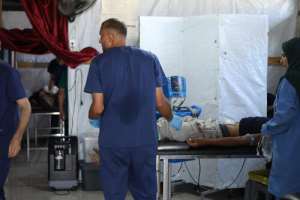
A child does not choose where she is born.
She does not choose the flag over her town, the war, or the road that is closed.
But she chooses, with every breath, to stay alive.
And whether she gets to keep breathing too often depends on one thing: whether a nurse, a doctor, or a food truck is allowed to reach her.
This year, the United Nations told the world something it did not want to hear.
In 2025, the UN verified 38,558 grave violations against children in armed conflict, affecting 24,174 children. That is the highest number since the UN began counting thirty years ago.
For the first time in that history, government forces were responsible for more of these violations than armed groups.
Read that again.
The people we expect to protect children are now, by the UN's own count, doing more of the harming.
The UN's Special Representative for Children and Armed Conflict called the report an indictment of inaction.
I agree.
And I am not going to be polite about it.
These Are Not Numbers. They Are Classrooms and Hospital Beds.
The report records its highest totals in Israel and the Occupied Palestinian Territory, with 12,445 violations.
Then comes the Democratic Republic of the Congo with 4,114, Nigeria with 2,560, Myanmar with 2,203, and Somalia with 2,195.
In Sudan, the UN verified 1,889 violations against 1,681 children, describing a protection crisis fuelled by sieges in North Darfur and South Kordofan.
In Sudan, a siege does not look like a line on a map.
It looks like a doctor operating without anaesthesia.
When El Fasher fell last October, the World Health Organization reported that more than 460 patients and companions were killed at the Saudi Maternity Hospital and that six health workers were abducted.
In September, the UN High Commissioner for Human Rights reported that RSF drone strikes on a kindergarten and a hospital in Kalogi, South Kordofan, left 114 people dead, including 60 children. The same report cited army strikes on Ad-Da'ein Teaching Hospital that killed at least 70 people.
In October, the UN human rights chief warned of a surge in drone attacks that had killed hundreds more and rendered another hospital unusable.
I name every side because a child's life does not belong to any side.
Not the Rapid Support Forces.
Not the Sudanese Armed Forces.
Not Israeli forces.
Not Hamas.
Not the Houthis.
Not the armed groups operating in Nigeria, Congo, or Myanmar.
And not any army accused of taking children from their homes.
My outrage has no flag.
The Sieges Are Choking the Lifelines
In Dilling and Kadugli in South Kordofan, UNICEF warned of "siege conditions."
In August, the United Nations warned again of siege-like conditions and alarming levels of malnutrition.
In Yemen, government officials have warned that hospitals in Taiz are approaching collapse as Houthi restrictions tighten, and they have demanded safe passage for patients, ambulances, health workers, and humanitarian aid.
Wherever the siege is and whoever controls it, the logic is the same:
Strangle the road and the child suffers first.
Trapped medical staff are the people holding the thin line between life and death.
In Sudan alone, the World Health Organization has verified 198 attacks on healthcare facilities and personnel since 2023, killing 1,735 health workers and patients.
UN monitors have also documented the arrest of 107 health workers, with four reportedly killed while in detention.
A doctor who has been arrested cannot treat a child.
A nurse who has been shot cannot deliver a baby.
Every medic silenced is a hundred patients abandoned.
Detention: When the Child Becomes the Prisoner
I also want to speak about children behind bars.
The United Nations verified that 981 Palestinian children were detained last year for alleged security offences, nearly all by Israeli forces. It also recorded testimonies from 66 children alleging physical violence and ill-treatment.
In Sudan, the UN Human Rights Office reported that more than 2,000 men were being held inside El Fasher's Children's Hospital, a place intended for healing transformed into a place of confinement.
International standards are clear.
Children detained over alleged links to armed groups should be treated first as victims, and detention should be a measure of last resort.
A child in a cell is still a child.
Not a soldier.
Not a threat.
Not a bargaining chip.
A child.
What I Am Demanding
1. Open Humanitarian Corridors Now
There must be immediate, safe, and unimpeded passage for trapped paediatric, medical, and humanitarian personnel in every besieged zone, from Kordofan to Taiz and beyond.
Not a pause that collapses after an hour.
Not a so-called safe route that ends at a checkpoint.
A corridor that actually works, with independent monitoring and international scrutiny.
2. Free Detained Health and Aid Workers
Every health worker and humanitarian worker detained for simply doing their job should be released immediately.
Treating the wounded is not a crime.
The Geneva Conventions protect medical personnel and facilities.
United Nations Security Council Resolution 2286 reaffirmed that protection.
The world must stop treating these commitments as optional.
3. End the Use of Hunger as a Weapon
United Nations Security Council Resolution 2417 condemns the use of starvation against civilians.
The principle is simple.
Let the food trucks through.
Let the vaccines through.
Let the incubators have power.
No child should die because aid was blocked at a checkpoint.
4. Protect the Rights of Detained Children
Children deprived of liberty must be released wherever possible or held only under conditions that fully comply with international law.
They must have access to legal representation, family members, independent monitors, education, and healthcare.
Abuse and ill-treatment must end.
Children must be treated first as victims.
5. Replace Reports With Accountability
Governments and armed groups named by the United Nations must face meaningful consequences.
States that continue supplying weapons to violators must confront an uncomfortable question:
What are those weapons doing to children?
This is why support for the International Criminal Court and universal jurisdiction matters.
Without accountability, every report becomes merely a catalogue of crimes waiting to be repeated.
6. Protect Child Protection Programmes
As humanitarian budgets shrink, child protection programmes are often among the first to be cut.
The programmes that reunite families, treat malnutrition, support trauma recovery, and create safe learning spaces are not secondary services.
They are frontline protection.
Fund them accordingly.
7. Refuse to Look Away
To every reader in Accra, Kumasi, London, Toronto, Berlin, and beyond:
Do not look away.
Write to your government.
Support doctors, nurses, and child protection organisations.
Share verified evidence.
Ask your elected representatives one simple question:
What have you done this week for the children of Kordofan, Gaza, Taiz, Kharkiv, and the Congo?
The Last Word
Every war ends.
When these wars end, historians will not ask how strong the armies were.
They will ask who protected the children.
Some people will be able to say they spoke.
Others will have to admit they watched.
I choose to speak.
Loudly.
And I choose to keep speaking until the roads are open, the doctors are free, and the children are safe.
Open the roads. Free the healers. Protect every child.


 Mahama Defends Gold Export Restrictions, Signals Ban on Raw Mineral Exports by 2...
 Judicial Secretary Urges JUSAG to Suspend Planned Strike
 Education Ministry Orders Probe into Alleged Assault at Techiman SHS
 Chief Inspectors’ Amnesty Promotion: Supreme Court grants Police Administration ...
 Police deploy officers and cameras nationwide as TraffiTech-GH enforcement begin...
 Govt to fund travel expenses of mother of murdered Ghanaian teenager to US funer...
 Stop labelling menopausal women as witches – Public told
 Ghana woos investors for US$100million vaccine manufacturing project
 Eight killed, 21 rescued in bus collision on Elubo–Takoradi Highway
 NPP asks US Embassy to suspend recognition of Ghanaian diplomatic and service pa...


