




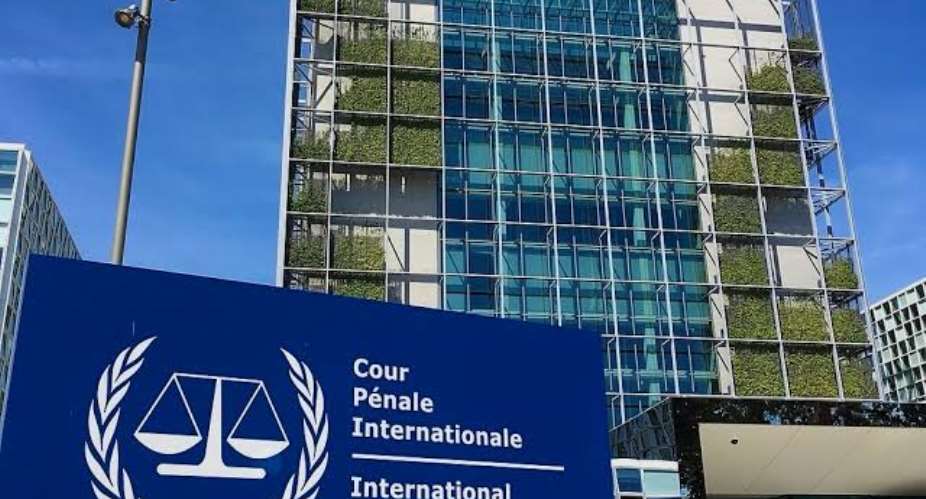
I am writing this from Accra, and I am angry.
I am angry because this autumn, the most powerful government on earth moved from punishing individual judges to targeting an entire court.
On 9 October, the United States imposed institutional sanctions on the International Criminal Court. The UN High Commissioner for Human Rights, Volker Türk, called the sanctions "unacceptable."
He is right.
But a statement is not a shield, and the victims of the world's worst crimes need a shield.
Let us be clear about what is happening.
Since February 2025, Washington has sanctioned half of the Court's eighteen judges, its former Prosecutor, and both Deputy Prosecutors.
In July, Secretary of State Marco Rubio promised to take the Court apart "brick by brick."
On 22 September, the US President stood before the United Nations General Assembly and urged member states to abandon the Court.
This is not a legal disagreement.
It is a campaign to destroy the one permanent court capable of prosecuting genocide, war crimes, and crimes against humanity when national courts refuse or fail to act.
Why This Is Not Only About Europe or the Middle East
Some people in my part of the world will ask:
"Why should I care? This is a fight between big powers."
I care because I know who the ICC was built for.
It was built for the market woman whose village was burned.
For the child soldier who was abducted.
For the student who disappeared into a prison cell and never came home.
Powerful people have never needed international courts.
They have armies.
They have lawyers.
They have friends in high places.
The Rome Statute was written for everyone else.
And the retreat from accountability has already begun.
Mali, Burkina Faso, and Niger announced their withdrawal in June.
Venezuela followed in July.
Chad followed in August.
Africa should look carefully at that list and ask a difficult question:
Who gains when a court for victims loses its members?
Not the victims.
Ghana is a State Party to the Rome Statute.
We must never join the list of those who walked away.
A Word to Those Who Say the Court Is Unfair
I have heard many Africans argue that the ICC has devoted too much attention to our continent.
I do not dismiss that frustration.
Selective justice is an injustice of its own.
But the cure for selective justice is more justice, not no justice.
Demand that the Court investigate the powerful wherever they are.
Demand that it pursue every perpetrator regardless of nationality, military rank, or political influence.
But do not celebrate while powerful governments dismantle the institution for daring to look in their direction.
The answer to an imperfect court is to improve it.
The answer is not to destroy it.
Universal Jurisdiction Is the Second Line of Defence
If the ICC is weakened, the answer is not despair.
The answer is to strengthen every remaining pathway to justice.
That means embracing universal jurisdiction.
The principle is simple:
Some crimes are so serious that any nation's courts may prosecute them, regardless of where they were committed or the nationality of the accused.
Torturers and war criminals should have no holiday homes.
No sanctuary cities.
No safe hospitals.
No safe airports.
No safe retirement.
This is not a theoretical idea.
It is already working.
The latest Universal Jurisdiction Annual Review documented 86 cases across 20 countries.
Sweden has handed down a life sentence for war crimes committed at Syria's Yarmouk camp.
A Chilean appeals court has recognised its authority to hear a case concerning alleged war crimes in Gaza.
Hissène Habré, who terrorised Chad for years, was ultimately convicted on African soil by an African tribunal because African lawyers, survivors, and activists refused to let impunity become permanent.
Each of these cases proves the same point:
When courts act, the wall of impunity cracks.
That is why I say to every government that claims to believe in the rule of law:
Pass strong universal jurisdiction laws.
Fund prosecutors.
Train investigators.
Preserve evidence.
And do not allow intimidation from powerful states to narrow those laws.
What I Am Demanding
1. Revoke the Sanctions Against the ICC
Every sanction imposed on the International Criminal Court, its judges, prosecutors, and staff should be immediately and unconditionally withdrawn.
States Parties have already condemned these measures.
Now they must defend the institution with the same courage they showed in their statements.
2. Protect the Court's Operations
The 125 States Parties must remain committed, pay their assessed contributions, and actively protect the Court's banking, communications, and technological infrastructure.
The European Union, the United Kingdom, Canada, and other partners should adopt protective measures that prevent private companies from being compelled to assist efforts designed to cripple a court of law.
3. Protect Those Who Cooperate With the Court
Lawyers, investigators, journalists, whistle-blowers, survivors, and victims' organisations must be protected.
A sanction that frightens a witness into silence is a sanction on justice itself.
A threat against an investigator is a threat against the truth.
4. Reject Deals That Trade Away Accountability
African governments must resist pressure, incentives, and side agreements that seek to exchange Rome Statute commitments for minerals, military cooperation, or political favour.
No nation's sovereignty is strengthened by making its own citizens easier to massacre without consequence.
Justice is not a bargaining chip.
5. Make Public Pressure Impossible to Ignore
To every ordinary citizen in Accra, Kumasi, London, Toronto, Berlin, New York, and beyond:
Make noise.
Write to your parliament.
Question your candidates.
Support organisations documenting atrocities.
Attend public forums.
Share verified evidence.
Governments move when silence becomes expensive.
The Last Word
History has watched this story unfold before.
Powerful men have always argued that accountability is dangerous.
They have always said that courts are political.
That justice is inconvenient.
That victims must wait.
Critics said similar things about Nuremberg.
They said it about sanctions against apartheid.
They said it about every tribunal that dared to ask a general, a minister, or a president to answer for bloodshed.
But the truth does not need a visa.
It does not require a bank account.
And it does not ask permission from the powerful.
Survivors will continue to speak.
Evidence will continue to be gathered.
And somewhere, somehow, courts will continue opening their doors.
I will not be quiet.
And I am asking you not to be quiet either.
Because a world where only the weak face judgment is not a world governed by law.
It is a world governed by fear.
Defend the ICC. Defend universal jurisdiction. Defend the right of every victim to be heard.


 Mahama Defends Gold Export Restrictions, Signals Ban on Raw Mineral Exports by 2...
 Judicial Secretary Urges JUSAG to Suspend Planned Strike
 Education Ministry Orders Probe into Alleged Assault at Techiman SHS
 Chief Inspectors’ Amnesty Promotion: Supreme Court grants Police Administration ...
 Police deploy officers and cameras nationwide as TraffiTech-GH enforcement begin...
 Govt to fund travel expenses of mother of murdered Ghanaian teenager to US funer...
 Stop labelling menopausal women as witches – Public told
 Ghana woos investors for US$100million vaccine manufacturing project
 Eight killed, 21 rescued in bus collision on Elubo–Takoradi Highway
 NPP asks US Embassy to suspend recognition of Ghanaian diplomatic and service pa...


