




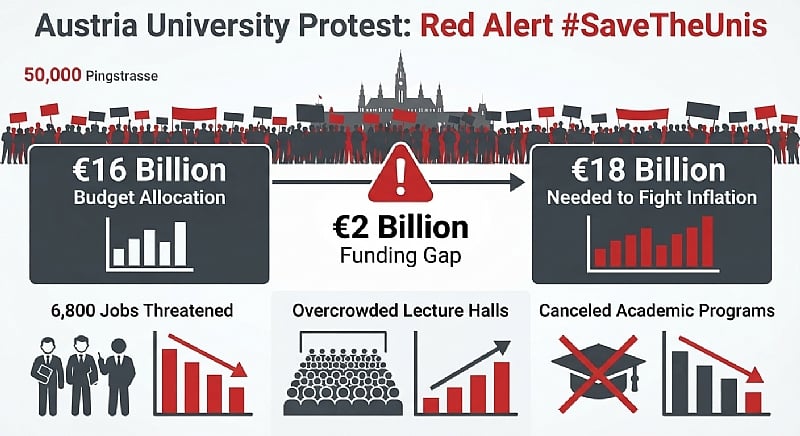
A mass university demonstration in Vienna has exposed a deeper fault line in Austrian public life. Citizens still trust their universities and science, but they increasingly question the political institutions that fund, regulate and represent them.
The 22 October “Alarmstufe Rot – #UnisRetten!” mobilisation was triggered by the government’s agreement to provide roughly €16 billion for Austria’s 23 public universities for 2028–30. University leaders and the Austrian Students’ Union (ÖH) say about €18 billion is needed simply to offset rising costs. That leaves a gap of about €2 billion, or roughly 11%.
Attendance remains contested. Organisers registered 20,000 participants with the police. ÖH reported 30,000 during the march and about 50,000 by the end of the day, while media estimates clustered around 25,000–30,000. Police spoke only of “tens of thousands” and published no official count. The march was predominantly peaceful, with a small number of incidents reported.
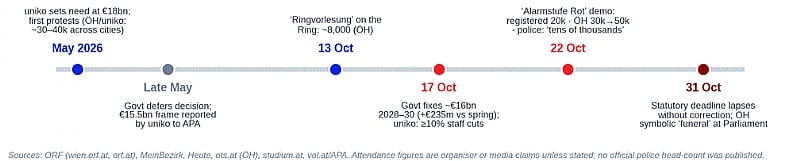
Figure 1. From the spring funding warning to the lapsed 31 October deadline. Attendance figures are organiser or media claims.
The striking finding: trust is not collapsing everywhere
| Indicator | Finding | Signal |
| Universities | 88% trust (ÖAW 2025) | High |
| Federal government | 32% trust (Demokratie Monitor 2025) | Low |
| Political system works well | 35%, down from 64% in 2018 | Rapid decline |
| Democracy as a principle | 89% call it the best form of government | Resilient |
| Student institutional trust | 44/100, study estimate | Low |
| Trust–Risk Exposure | 38/100 | Red |
The study’s central interpretation is a bifurcation of trust. The protest is not a rejection of universities or of democracy. Instead, a highly trusted knowledge institution has become the arena in which dissatisfaction with political responsiveness is expressed.
The issue beneath the issue
The funding envelope is the visible dispute. Beneath it sit four questions: does government value higher education, are the official figures transparent, can students and experts influence decisions, and can young people still expect a secure educational and professional future?
The study puts Latent Public Trust at 34/100, Institutional Trust at 54/100 and Student Institutional Trust at 44/100. These are analytical estimates, not opinion-poll results. It places the political trust gap at about 28 points against its normative benchmark of 60.
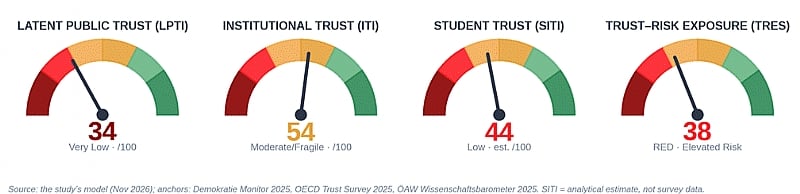
Figure 2. The study’s four headline indices on a 0–100 scale. Student trust is an estimate, not survey data.
What happens next may matter more than the protest
The critical test is now implementation. The 2028–30 performance agreements, negotiated with each university in 2027, offer a chance to protect core teaching, student support and research continuity even within a fixed envelope. Visible course closures, contract terminations or failed negotiations, by contrast, could turn a concentrated budget dispute into persistent institutional distrust.
Sources: the study’s assessment, drawing on ORF/APA, ÖH, uniko, Austrian government and trust-monitoring data. Attendance figures are contested.
From budget dispute to trust test
Why the university funding fight has become a test of institutional responsiveness
The protest’s demands work on two levels. On the surface is money: universities say the envelope does not absorb expected cost increases. Underneath is a question of priority: does Austria intend to preserve the quality, accessibility and international competitiveness of its university system?
| Issue | Latent trust question | Trust (study estimate) | Risk |
| Funding adequacy | Does government value higher education? | 25 | 88 |
| Academic jobs | Will teaching and research staff be protected? | 27 | 82 |
| Government responsiveness | Do protest or expert evidence change decisions? | 24 | 78 |
| Teaching and study conditions | Will degrees remain timely and of high quality? | 33 | 76 |
| Inflation and real terms | Are official descriptions of the funding complete? | 28 | 76 |
| Medical universities | Will patient care be protected? | 30 | 72 |
| Budget transparency | Are the numbers complete and verifiable? | 26 | 67 |
| Research and competitiveness | Is Austria investing in its future economy? | 38 | 67 |
| Future opportunity | Is the younger generation bearing the cost? | 32 | 65 |
| Access and equality | Will access remain open? | 45 | 54 |
The highest-risk issues are not purely financial. Three of the five most exposed concern how the decision was made or communicated, which makes transparency and responsiveness the most promising levers for repairing trust.
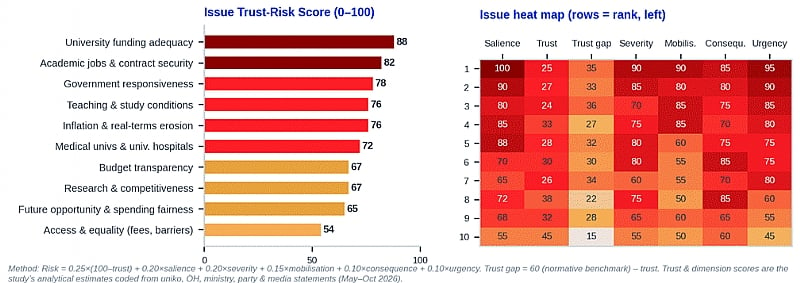
Figure 3. Issues ranked by trust-risk score, with the dimensions behind each score.
A contested arithmetic, and a credibility problem
The government describes the package as a stable funding level and points to an extra €235 million compared with its spring position. University representatives reject that framing, citing expected inflation and costs now absorbed within the envelope. The study calls this an integrity contestation: when institutions disagree over the baseline itself, public confidence can suffer before the policy has any visible effect.
A broad protest, but one whose meaning must not be overstated
ÖH, university leadership, academic staff and other institutional actors helped mobilise the demonstration. That breadth gives it substantial signalling power, but it does not make the protesters statistically representative of all Austrians. The study therefore treats mobilisation as a measure of salience and organised dissatisfaction, not as a national trust poll.
A trust pathway with an open ending
The sequence so far runs from policy decision to perceived impact, expectation gap, trust erosion, mobilisation and government response. The final stages are not yet settled. A transparent response could close the gap; continued disagreement, especially if followed by visible cuts, could widen it.

Figure 4. Blue stages have already played out; red stages remain open to intervention.
Source: the study’s issue matrix and analytical pathway. Trust and risk scores are estimates on a 0–100 scale, not survey percentages.
Students: the generation at the centre of the trust gap
Young Austrians are signalling frustration with representation, responsiveness and future opportunity
The people most exposed to changes in university funding belong to a generation with weakening confidence in political representation. A 2025 youth survey cited by the study found that only 32% of 16–26-year-olds feel well represented in Parliament. Youth trust in government fell from 51% to 37% between 2020 and 2025.
| Institution or dimension | Current signal | Assessment |
| Federal government | 32% overall trust; 30/100 student estimate | Low |
| Science Ministry | 22/100 estimate | Very low |
| Democratic responsiveness | 28/100 estimate | Low |
| Future opportunity | 33/100 estimate | Low |
| Universities | 88% public trust; 72/100 student estimate | High |
| Academic staff | 76/100 student estimate | High |
| University leadership | 68/100 estimate | Moderate to high |
| Student representation | 58/100 estimate | Moderate |
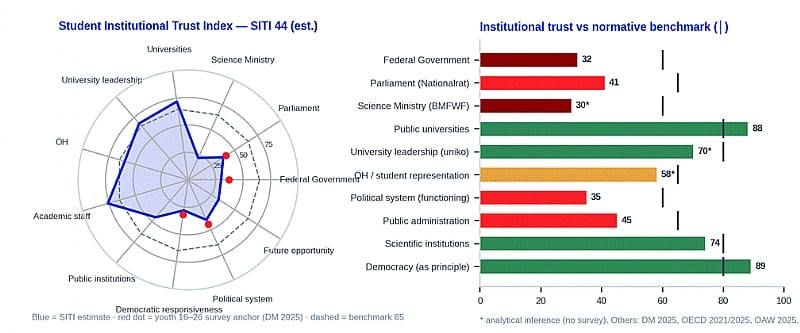
Figure 5. Left: student trust by dimension against a benchmark of 65. Right: institutional trust against each institution’s benchmark.
Students are not rejecting the institutions they depend on
The strongest student trust signals attach to universities and academic staff; the weakest attach to political decision-making. Students can believe in the value of higher education while also believing that political institutions are failing to protect it.
The study therefore puts Student Institutional Trust at 44/100, 21 points below its benchmark of 65. Because no representative 2026 survey measures Austrian students’ trust in all these institutions, the index is explicitly an evidence-based estimate.
The representation problem
The youth figures point to something wider than university finance. If younger citizens feel that Parliament and government do not represent them, a budget dispute becomes a symbolic test of whether democratic institutions listen when an organised constituency makes a public case.
This is not democratic rejection. Some 89% of Austrians still regard democracy as the best form of government. The tension lies between democratic principle and perceived institutional performance.
Vienna concentrates the signal
Vienna magnifies this dynamic. The city holds the federal political institutions as well as the University of Vienna, TU Wien, mdw, BOKU, WU and the Medical University and AKH hospital complex. The march route, from Karlsplatz along the Ring to the main university building, physically linked students and academics with the institutions responsible for the decision.
The protest closed central traffic routes, which raised its visibility, while police and the interior minister described it as largely peaceful. The study rates Vienna AMBER-RED not because social stability is at risk, but because a large, organised and institutionally connected constituency retains an unresolved grievance.
Source: the study’s student and Vienna assessment, which separates observed youth-survey anchors from analytical estimates.
Twenty years of eroding political confidence?
The 2026 protest may be an accumulation event, but the historical evidence calls for caution
The study’s strongest long-term finding concerns direction rather than precise numbers. No single, consistent survey covers Austria from 2006 to 2026: Eurobarometer, the Demokratie Monitor and the OECD Trust Survey ask different questions on different scales. The study reconstructs the trajectory without treating unlike measurements as interchangeable.
| Period | Government trust or system signal | Interpretation |
| 2005–06 | Government trust about 44–49% (Eurobarometer) | Political trust gap already visible |
| 2016 | Government trust about 36–40% (Eurobarometer) | Lower confidence |
| 2018 | 64% say the political system works well (Demokratie Monitor) | High-water mark of that series |
| 2021 | Government trust 26% (OECD) | Low institutional confidence |
| 2024 | System works well: 43% | Continuing erosion |
| 2025 | Government 32%; system works well 35% | Further deterioration |
| 2026 | Mass university mobilisation | Grievance becomes highly visible |
The trust gap appears to have widened
Against a normative benchmark of 60 for trust in the executive, the study puts the government gap at about 14 points around 2005 and about 28 points in 2025. That implies a widening of roughly 14–16 points over two decades.
This is not a claim that trust fell by a precise 14–16 points. Eurobarometer recorded 47% trust in government in autumn 2023, close to its 2005 level. The steep decline shows up mainly in the Demokratie Monitor series, and differences in wording, sampling and scales explain part of the divergence.
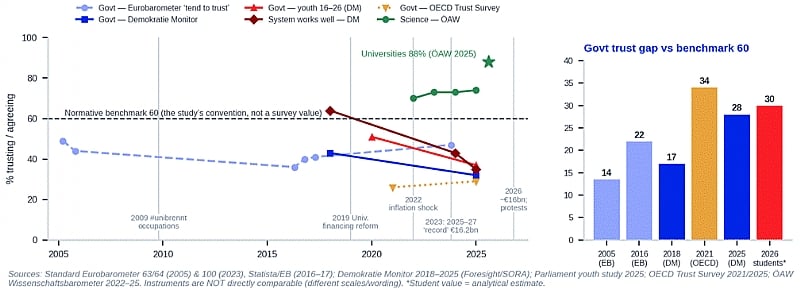
Figure 6. Trust series from four survey instruments, 2005–2025. The series are not directly comparable; the direction is the finding.
What changed fastest?
In the Demokratie Monitor series, the share saying Austria’s political system works well fell from 64% in 2018 to 35% in 2025, with the sharpest drop between 2024 and 2025. Youth trust in government fell by about 2.8 points a year from 2020 to 2025.
| Index | Score | Meaning |
| Latent Public Trust | 34/100 | Very low |
| Institutional Trust | 54/100 | Fragile and bifurcated |
| Student Institutional Trust | 44/100 | Low |
| Trust Gap | 16 overall; 28 for government | Moderate overall, significant for government |
| Government Responsiveness | 34/100 | Low |
| Institutional Legitimacy Risk | 64/100 | Elevated |
| Education System Risk | 76/100 | High |
| Trust–Risk Exposure | 38/100 | Red |
2026 as an accumulation event
The study judges that 2026 combines several pressures: erosion during the inflation years, a youth representation deficit, and the perceived reversal of a university budget previously described as a record. The funding decision is a trigger acting on a longer-running condition.
That interpretation should stay provisional. The evidence supports a widening political trust problem; it does not show that every participant in the October demonstration shared the same motive.
Source: the study’s longitudinal reconstruction and index methodology, which states the comparability limits explicitly.
The risk is what happens after the march
Course closures, staff losses and failed dialogue could turn protest into persistent distrust
A peaceful protest is not a threat. The study instead identifies conditions that could make adverse outcomes more likely or more severe: continued non-responsiveness, persistent underfunding, contested official figures, workforce instability and accumulated youth alienation.
| Risk | Current level | Potential consequence | Early warning |
| Institutional legitimacy | Red | Further loss of credibility | Figures remain contested |
| Student mobilisation | Red | Repeated actions or harder tactics | New mass actions |
| Education system | Red (high) | Erosion of courses and services | Course closures |
| Research and talent | Red | Early-career exit and brain drain | Contract losses |
| Government credibility | Red | Persistent trust deficit | ‘Stable’ versus ‘real cut’ dispute continues |
| Democratic responsiveness | Amber | Youth disengagement | Youth trust below 40% |
| Competitiveness | Amber | Reduced innovation | Research relocating |
| Hospital services | Amber | Pressure on clinical staffing | Clinical posts not ring-fenced |
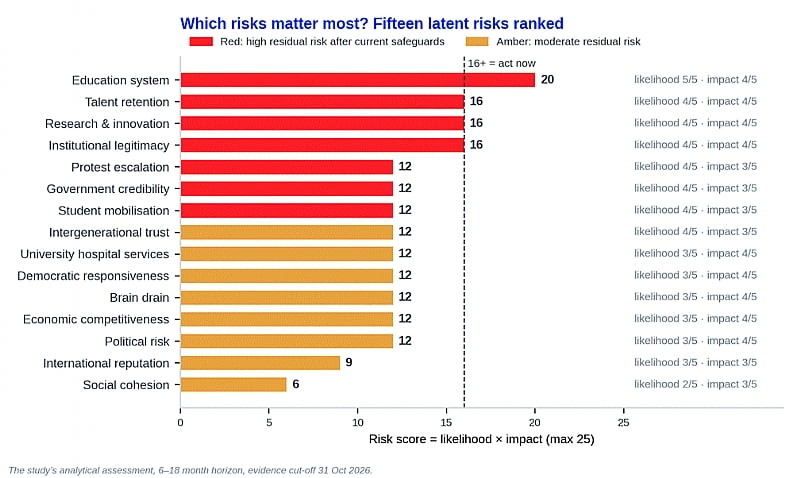
Figure 7. Fifteen latent risks ranked by score (likelihood × impact, each rated 1–5) over the next 6–18 months. Red marks risks that remain high after current safeguards.
Four possible trajectories
| Scenario | Trigger | Likely direction |
| 1. Trust repair | Full budget breakdown; teaching protected; joint review | Trust rises, risk falls |
| 2. Managed discontent | Partial fixes; no additional money | Trust and risk flat |
| 3. Persistent distrust | Dialogue without substantive change | Trust falls, risk rises |
| 4. Escalating mobilisation | Contract terminations or course closures in 2027 | Trust falls sharply, risk rises sharply |
The study places the current position on the boundary between persistent distrust and escalating mobilisation. This is a conditional assessment, not a prediction; implementation and the government’s response are the deciding variables.
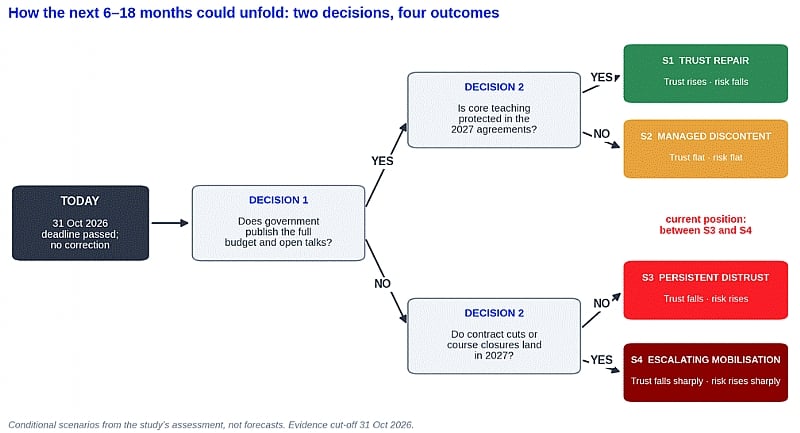
Figure 8. Two decisions decide which of the four scenarios unfolds: whether the government publishes the full budget and opens talks, and what then happens to teaching and contracts in 2027. These are conditional scenarios, not forecasts.
The threat pathways are institutional, not personal
The study traces five pathways. Policy non-responsiveness can breed a sense of futility. Underfunding can lead to staff losses and weaker teaching. Contested figures can create information gaps and polarisation. Workforce instability can speed up talent migration. Accumulated youth under-representation can weaken institutional legitimacy.
No individual or protest group is identified as a threat actor, because the evidence does not support such attribution. That distinction is essential to a credible public-trust assessment.
The early warnings to watch
- Mass contract terminations or hiring freezes
- Visible course closures or reduced teaching capacity
- Staff industrial votes or occupations
- A breakdown of talks between ÖH, uniko and the government
- A further fall in youth or general political trust
- Rectors withdrawing from structured negotiations
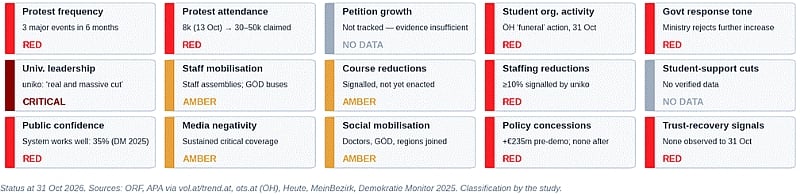
Figure 9. Status of fifteen early-warning indicators at 31 October 2026.
Source: the study’s latent risk, threat and scenario assessment.
Vienna’s way out: repair trust before the next budget shock
Constructive advice for government, universities and student representatives
The study’s most consequential finding is also its most practical: the trust deficit is not necessarily irreversible. The immediate opportunity is to show that institutions can respond even when fiscal constraints remain.
Ten actions that could change the trajectory
| Priority action | Lead | Trust objective |
| Publish a complete, line-by-line 2028–30 funding envelope | BMFWF / BMF | Transparency and integrity |
| Commission an independent review of the real-terms funding gap | Government and uniko | Procedural fairness |
| Protect core teaching and student support in the performance agreements | Rectorates / BMFWF | Delivery and future confidence |
| Set a research-continuity floor for doctoral and early-career posts | BMFWF / FWF / universities | Reliability |
| Establish a standing government–student dialogue table | BMFWF / ÖH / uniko | Responsiveness |
| Communicate staff decisions before contracts expire | Rectorates / works councils | Fairness |
| Ring-fence critical clinical posts at university hospitals | MedUnis / AKH / City of Vienna | Confidence in services |
| Introduce evidence-based safeguards against study delays | Universities / ÖH | Fairness to students |
| Explain fiscal constraints and burden-sharing publicly | Federal government | Intergenerational trust |
| Monitor implementation independently every quarter | Parliament / audit body | Accountability |
What would trust recovery look like?
Recovery would not require protesters to agree with the government. A healthier condition would show when both sides use the same budget figures, when government, universities and student representatives meet regularly with published minutes, and when core teaching stays protected. Mobilisation would then ease because participants see a credible process, not just a promise.
What would escalation look like?
The clearest warning signs would be mass terminations, course closures, industrial action, occupations, or a breakdown between university leaders and the government. Any of these would turn a contest over a funding envelope into a more durable challenge to institutional credibility.
The study’s strategic assessment
| Current condition | Trust | Risk | Trajectory | Priority |
| Fragile and bifurcated | Latent Public Trust 34; student trust 44 | Trust–Risk Exposure 38, red | Deteriorating sharply | Publish and independently review the envelope |
Neutrality and analytical independence
The study is independent, non-partisan and non-advocacy. It does not represent the political interests of the Austrian government, any political party, protest organisation, student organisation, university, trade union or other stakeholder.
It measures and interprets observable evidence, institutional indicators, documented public concerns and latent trust and risk signals. References to risks, threats, distrust or institutional weaknesses are not allegations of wrongdoing. Where direct public-opinion data is unavailable, trust assessments are analytical estimates derived from triangulated evidence and are clearly distinguished from survey findings. Scenarios are conditional and risk-informed, not predictions of inevitable events. The purpose is constructive: to identify trust deficits, emerging risks and opportunities for evidence-based trust repair.
Editorial note: this feature is based on the study’s assessment, including its evidence, estimates, caveats and neutrality provisions.
About the Author: Messan Mawugbe (PhD), [email protected]


 Mahama Defends Gold Export Restrictions, Signals Ban on Raw Mineral Exports by 2...
 Judicial Secretary Urges JUSAG to Suspend Planned Strike
 Education Ministry Orders Probe into Alleged Assault at Techiman SHS
 Chief Inspectors’ Amnesty Promotion: Supreme Court grants Police Administration ...
 Police deploy officers and cameras nationwide as TraffiTech-GH enforcement begin...
 Govt to fund travel expenses of mother of murdered Ghanaian teenager to US funer...
 Stop labelling menopausal women as witches – Public told
 Ghana woos investors for US$100million vaccine manufacturing project
 Eight killed, 21 rescued in bus collision on Elubo–Takoradi Highway
 NPP asks US Embassy to suspend recognition of Ghanaian diplomatic and service pa...


