




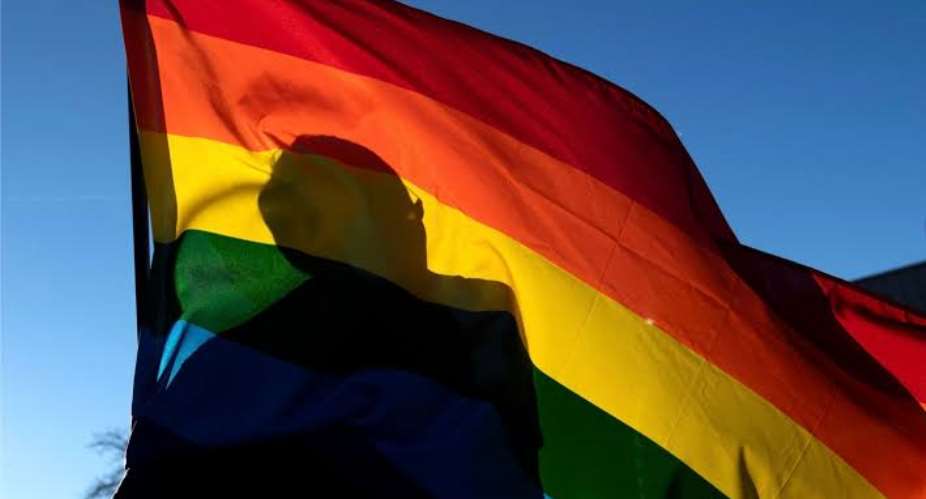
Imagine a law that decides who you are allowed to love, and then decides that even speaking up about it is a crime.
That is no longer imagination in West Africa. It is the legal reality in Burkina Faso, and it is knocking on the door of Ghana.
Some of you will stop reading here. I ask you to stay for a few minutes. I am not asking you to agree with me on every question. I am asking you to look at the facts and then answer one question honestly: Can a government take away someone's right to exist, to gather, and to speak, and call that justice?
What Happened in Burkina Faso
Let me be precise, because in human rights work precision is our armour.
The law was adopted by Burkina Faso's unelected transitional parliament on 1 September 2025 and signed by Captain Ibrahim Traoré on 25 September. It criminalises "homosexual acts or similar practices" and also "behaviour likely to promote" them, with two to five years in prison and fines of up to 10 million CFA francs. Burkina Faso, as a former French colony, never inherited anti-gay laws at independence, so this is a sharp break from its own legal past. In late December 2025, a foreign national became the first person known to be convicted under the new provision.
Notice the second clause, the one about "behaviour likely to promote." That clause is not about private life. It is about voice, organising, and gathering. It can be stretched to cover a meeting, a poster, a hashtag, or a peaceful march. This is how a criminal law turns into a ban on assembly, even where no Pride march has ever been held.
The space around that law is also shrinking. Frontline Defenders reported in May 2026 that 118 civil society organisations in Burkina Faso had been dissolved, which raises the risks for human rights defenders.
The reaction from rights bodies was immediate. Amnesty International pointed out that Burkina Faso has ratified both the African Charter on Human and Peoples' Rights and the International Covenant on Civil and Political Rights, and that the new law sits at odds with both. Human Rights Watch warned that such laws foster violence and abuse against LGBT people.
Burkina Faso is not alone. According to the Human Dignity Trust, 65 countries now criminalise consensual same-sex intimacy. Uganda has gone as far as making "aggravated homosexuality" a capital offence.
The Proof That Peaceful Resistance Works
When I feel the weight of these facts, I look to Hungary.
In March 2025, Hungary's government passed a law that used child-protection language to ban the Budapest Pride march, with fines and facial recognition to identify participants. The organisers did not cancel. More than 100,000 people defied the ban and marched in 2025, and it became one of the largest protests against the government of the time.
What followed matters. After a change of government, Hungarian police approved the 2026 Pride march on 29 May. In October 2026, the National Assembly repealed the anti-LGBTQ+ media and advertising provisions that the EU's top court had found to breach European law.
I do not tell this story to say that everything is solved. Rights groups note that the surveillance tools behind the earlier ban remain embedded in Hungarian law. I tell it because it shows something every activist must remember: unjust bans do not collapse because they are polite. They collapse because enough people, peacefully and persistently, refuse to accept them.
Why This Is Ghana's Story Too
I write from Accra, so let me bring this home.
Ghana's Parliament passed the amended Human Sexual Rights and Family Values Bill on 29 May 2026, and the decision now rests with the President and any legal or constitutional challenges. President John Dramani Mahama has said publicly that he would sign it if Parliament passed it. The picture is now more complicated. The Speaker of Parliament has since acknowledged that the bill was rushed and contains errors, and the process is stuck in procedural limbo. Ghana's Commission on Human Rights and Administrative Justice told Parliament that the bill would encroach on the fundamental right of association.
Our own Constitution is clear about assembly. Article 21(1)(d) guarantees freedom of assembly, including the freedom to take part in processions and demonstrations. Articles 15 and 17 protect dignity and equality before the law. These words were not written for the popular. They were written for everyone, and most of all for the unpopular, because the popular have never needed constitutional protection.
The Argument I Owe an Honest Answer
Let me state the other side in its strongest form, because I respect my readers.
Supporters of these laws say Ghanaian and African societies are deeply religious and family-centred, and that lawmakers are reflecting the will of their people. They argue that nations have the sovereign right to protect their culture from outside pressure. Some say they want to protect children. Those are sincere positions held by sincere people, and many of the bill's backers include respected religious bodies.
Here is my answer.
First, fundamental rights are not decided by majority vote. If they were, no minority would ever be safe, on any issue, in any era.
Second, criminalisation does not remove people; it removes their safety. It pushes them away from clinics, courts, and police stations, exactly where they need to go when they are attacked.
Third, child protection is not served by this approach. We already have laws against abuse, and they should be enforced strongly against every offender.
Fourth, sovereignty cuts both ways. Burkina Faso and Ghana freely ratified the African Charter and other human rights treaties. Honouring promises we made ourselves is not a foreign imposition.
And fifth, in Burkina Faso's case, the law was passed by a body no citizen elected. Calling that "the will of the people" is a stretch.
You can hold deep religious convictions, and I have mine, and still believe that no one should be jailed, beaten, or silenced for who they are. Faith teaches us to protect the vulnerable. It has never taught us to hunt them.
What Solidarity Must Look Like
Solidarity is not a hashtag. It is not shouting from a safe distance and disappearing when the news cycle moves.
Between now and 10 December, Human Rights Day, here is what I am calling on all of us to do:
1. Listen first.
Those most affected know their own risks. Follow the lead of grassroots LGBTQI+ organisations and do not speak over them or drag them into danger for the sake of a photograph.
2. Defend the right to assemble, peacefully and lawfully.
Challenge unlawful bans through courts, public statements, notified gatherings, vigils, and solidarity events in places where it is safe to hold them. Nonviolence is not weakness. It is the method that Mandela, Gandhi, and King made undeniable.
3. Protect, don't expose.
Where gathering carries real danger, support from outside the zone of risk: share verified information, fund legal aid, and amplify voices that choose to be heard. Never post identifiable images of participants.
4. Back the legal fight.
Support legal aid funds, strategic litigation, and human rights lawyers. Constitutional challenges are slow, but they are where bad laws are broken.
5. Write to power.
Contact your MP, your regional bodies, and the African Commission on Human and Peoples' Rights. Ask them to uphold Article 11 of the African Charter on assembly and Article 2 on non-discrimination.
6. Protect the defenders.
Support organisations that give emergency help to defenders under threat, and share their safe contact routes.
7. Change the conversation at home.
Speak in your church, mosque, family, and friend groups. Replace slurs and jokes with facts. Most hatred survives on silence.
A Word From Me
I am twenty-one years old. I am a student, a writer, and a human rights volunteer, and I believe my generation will be judged by one question: What did you do when a law turned into a weapon?
I think of Malala, who was shot at fifteen and kept speaking. I think of Mandela, who spent twenty-seven years in prison and walked out refusing bitterness. Neither of them waited for permission or for a comfortable moment. They simply decided that someone's dignity mattered more than their own safety, and that is what real power looks like.
I do not need you to agree with everything I believe. I need you to agree that no human being should be criminalised for existing, and no peaceful gathering should be banned for what it stands for.
On 10 December, Human Rights Day, let us stand together.
Dignity is not a favour. It is a right.


 Mahama Defends Gold Export Restrictions, Signals Ban on Raw Mineral Exports by 2...
 Judicial Secretary Urges JUSAG to Suspend Planned Strike
 Education Ministry Orders Probe into Alleged Assault at Techiman SHS
 Chief Inspectors’ Amnesty Promotion: Supreme Court grants Police Administration ...
 Police deploy officers and cameras nationwide as TraffiTech-GH enforcement begin...
 Govt to fund travel expenses of mother of murdered Ghanaian teenager to US funer...
 Stop labelling menopausal women as witches – Public told
 Ghana woos investors for US$100million vaccine manufacturing project
 Eight killed, 21 rescued in bus collision on Elubo–Takoradi Highway
 NPP asks US Embassy to suspend recognition of Ghanaian diplomatic and service pa...


