




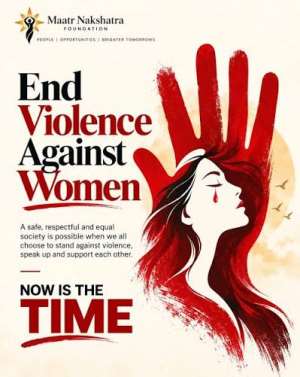
In about twenty-four days, the world will turn orange.
On 25 November, the International Day for the Elimination of Violence against Women, a global campaign begins. It runs for sixteen days and ends on 10 December, Human Rights Day. The 2026 UNiTE campaign carries a theme that every one of us should read twice:
"Ensure justice, protect survivors, end impunity."
Justice. Protection. Accountability. Those are not slogans. They are the minimum we owe every woman and girl alive.
The Violence We Know and the Violence We Pretend Not to See
Let me start with the numbers, because numbers do not flatter anyone.
The World Health Organization estimates that nearly one in three women worldwide will experience physical or sexual violence in her lifetime. Roughly every ten minutes, somewhere in the world, a woman or girl is killed, and most often by someone she knows. A partner. A husband. A relative.
That is not a crime committed by strangers in dark alleys. It happens in homes, and sometimes in the very houses we call safe.
Now add what has changed in our generation. The violence has moved onto our phones.
A woman posts a picture and receives a flood of threats. A girl trusts a boyfriend with a private photo, and it ends up in a WhatsApp group of strangers. A female journalist, politician, or student speaks her mind, and a mob of anonymous accounts tells her to be quiet, or tells her what they will do to her. Studies from the Economist Intelligence Unit found that a large majority of women online have either experienced or witnessed digital violence. Many of them then delete their accounts, stop speaking, and shrink themselves.
This is the point many people miss. Online violence and offline violence are not two separate problems. They are one problem wearing two faces. The abuse that begins as a comment can end as stalking. The threat typed on a screen can become a fist at the door. And the silence it forces onto women online is a silence that costs all of society.
Why This Is Personal to Us in Ghana
Some people say these are "foreign issues" and that our own culture handles such matters at home. I respect our culture. I am proud of it. But I will not allow culture to be used as a blanket to cover violence.
We grew up hearing phrases that quietly protect abusers.
"That is a family matter."
"Marriage is about endurance."
"What will people say?"
"Don't go and disgrace him."
Behind these sentences are women who suffered quietly because the community taught them that speaking out was the greater sin.
Ghana is not without tools. The Domestic Violence Act, 2007 (Act 732) exists. The Cybersecurity Act, 2020 (Act 1038) exists. We have the Domestic Violence and Victim Support Unit (DOVVSU) of the Ghana Police Service, and civil society organisations that work tirelessly. But a law that is not enforced is only paper. A hotline that survivors do not trust is only a number. And an institution that treats a complaint as a joke has already failed the woman standing in front of it.
That is what the word impunity means. It means the offender walks free while the survivor is left to carry the shame.
The Argument I Must Take Seriously
Some readers will say: "Chief, men are also abused. Why does the campaign focus on women?"
It is a fair question, and I will answer it honestly.
Yes, men and boys can be victims of violence, and they deserve support and dignity too. No serious human rights defender denies this. But the campaign focuses on women and girls because the data shows that gender-based violence falls most heavily on them, and that it is driven by unequal power, old attitudes, and weak systems of protection.
Naming a problem accurately is not an attack on anyone. A doctor who treats the patient with the highest fever first is not hating the other patients.
Others will say: "People should simply stay offline if they cannot take the abuse."
That is exactly backwards.
We do not tell victims of armed robbery to stop walking on the road. The responsibility lies with the one who commits the harm, not the one who suffers it. A society that asks women to disappear from public life so that men can behave badly is not a safe society. It is a surrendered one.
What the UNiTE Campaign Asks Us to Do
I did not write this column only to describe a problem. A problem described and left alone is just a sad story.
Between 25 November and 10 December, I am calling on every reader, whether in Accra, Kumasi, Tamale, London, Toronto, Hamburg, or New York, to do something real.
1. Wear orange and say why.
Orange is the colour of the campaign. It stands for a brighter future free from violence. Wear it on 25 November and the days that follow. Post it with a clear message, not just a photo. Use the hashtags #16DaysOfActivism and #UNiTE and tag your network.
2. Break the silence in your own circle.
Speak to your family, your church, your mosque, your WhatsApp groups, and your friends. Challenge the joke that makes violence look funny. Correct the uncle who says "she provoked him." Culture changes when ordinary people stop agreeing with the harmful parts of it.
3. Men, step forward.
This must not become a conversation where women speak and men look away. Fathers, brothers, pastors, lecturers, footballers, content creators: your voice carries weight with other men that no one else's does. Be the man who says, "That is not strength, that is cowardice."
4. Protect women online.
Do not share private images of anyone. Report abusive accounts. Do not join the pile-on. When a woman is harassed online, send her a message of support, because the abuser wants her to feel alone.
5. Know where to report.
Learn how DOVVSU works in your area. Share the contacts of trusted support organisations in your community. Encourage survivors to seek help, and stand with them when they do.
6. Hold leaders to account.
Ask your Assembly Member, your MP, and your institutions what they are doing about funding for shelters, trained officers, fast court processes, and digital safety. Ask in public. Leaders respond to attention.
7. Support survivors with respect.
Believe them. Do not interrogate. Do not gossip. Do not ask, "Why did you stay?" when the real question is "Why did he do it?"
A Word From Me to You
I am a young man of twenty-one. I am a student, a writer, and a human rights volunteer with the United Nations, and a member of Amnesty International. I am not writing this from a high chair. I am writing as someone who believes that my generation will either inherit this silence or end it.
When I think of people like Malala Yousafzai, who was shot at fifteen for demanding that girls be allowed to learn and who became the youngest Nobel laureate at seventeen, I do not see people who were born powerful. I see people who refused to be quiet at the moment quiet was demanded of them.
When I think of Nelson Mandela, who spent twenty-seven years in prison and still chose to build a nation, I see that real power is not noise. It is courage that stays when it is difficult.
That is the kind of power I want, and I believe it is available to anyone who decides to use their voice for someone who cannot use theirs.
So here is my ask.
Do not wait for 25 November to feel ready. Start this week. Talk to someone. Share this article. Put the orange in your profile picture early.
Because a woman is waiting for someone to believe her.
And the question is simple:
Will it be you?
Let us ensure justice. Let us protect survivors. Let us end impunity.


 Mahama Defends Gold Export Restrictions, Signals Ban on Raw Mineral Exports by 2...
 Judicial Secretary Urges JUSAG to Suspend Planned Strike
 Education Ministry Orders Probe into Alleged Assault at Techiman SHS
 Chief Inspectors’ Amnesty Promotion: Supreme Court grants Police Administration ...
 Police deploy officers and cameras nationwide as TraffiTech-GH enforcement begin...
 Govt to fund travel expenses of mother of murdered Ghanaian teenager to US funer...
 Stop labelling menopausal women as witches – Public told
 Ghana woos investors for US$100million vaccine manufacturing project
 Eight killed, 21 rescued in bus collision on Elubo–Takoradi Highway
 NPP asks US Embassy to suspend recognition of Ghanaian diplomatic and service pa...


