




Every year, the National Science and Maths Quiz captures Ghana’s attention like few academic activities can.
Students become household names. Schools mobilize old students and supporters. Families follow contests with the intensity usually reserved for football. Social media fills with calculations, predictions, celebrations, and debates. The 2026 competition involved 174 schools and culminated in PRESEC-Legon winning a historic ninth title.
This national enthusiasm deserves recognition.
For more than three decades, the NSMQ has helped make science and mathematics visible, exciting and prestigious. At the 2026 closing ceremony, the Ghana Education Service described the competition as having grown beyond an academic quiz into a national platform that has encouraged generations of students to embrace science and mathematics.
But perhaps the greatest tribute Ghana can pay to the success of the NSMQ is to ask a bigger question:
Can the curiosity, reasoning, problem-solving and intellectual excitement we celebrate during the quiz season become ordinary experiences in every Ghanaian classroom?
That should be the next frontier of Ghana’s STEM education journey.
From knowing answers to solving problems
Success in science and mathematics cannot ultimately be measured only by how quickly students answer questions or reproduce formulas.
The larger purpose of STEM education is to help young people understand problems, investigate evidence, make connections, test ideas, design solutions and apply knowledge to situations they have not encountered before.
Interestingly, Ghana’s own education authorities are increasingly emphasizing this direction.
At the conclusion of the 2026 NSMQ, GES called for sustained investment in STEM education and stressed the importance of developing learners who can think critically, solve problems, innovate, collaborate and apply learning to real-life situations. The Service also emphasized moving learners beyond simply memorizing scientific facts and mathematical formulas toward asking questions, experimenting and developing solutions.
That vision matters because it shifts the national conversation from STEM achievement to STEM capability.
The question is no longer simply whether a student knows mathematics or science.
It is whether that student can use mathematics and science when confronted with a real problem.
Ghana already has evidence that students can do this
Recent examples show what is possible when Ghanaian students are given opportunities to apply STEM knowledge rather than simply study it.
In September, 60 senior high school girls participating in a STEM programme developed solutions addressing flooding, waste management, water wastage and parking. Their work incorporated robotics, artificial intelligence, 3D modelling and 3D printing while emphasizing practical problem-solving.
Consider the educational difference.
A student can learn about measurement from a textbook.
But that same student can also measure water consumption, analyze wastage, model possible reductions and propose a practical conservation system.
A student can learn equations.
But that student can also use mathematical relationships to investigate traffic flow, energy consumption, population growth, or the cost of managing waste.
A student can learn about environmental science.
But that learner can also investigate flooding in the community, collect data, identify contributing factors, and design possible interventions.
The content is still mathematics and science.
What changes is the purpose of learning.
The everyday classroom matters more than the competition stage
Competitions are valuable. They motivate students, recognize excellence, and demonstrate what young people can accomplish.
But competitions necessarily involve only a fraction of the student population.
Ghana’s greater educational challenge is ensuring that a learner who never appears on an NSMQ stage still receives opportunities to reason, investigate, design, model, and solve problems.
That includes the student in a rural school.
It includes the student who may never become a scientist or engineer.
It includes girls who may not yet see STEM as belonging to them.
It includes students who struggle with mathematics but might understand it differently when numbers are connected to a problem they recognize from everyday life.
Ghana’s secondary curriculum already points in this direction. NaCCA describes the curriculum as learner-centred, emphasizes 21st-century competencies, and says STEM should permeate different learning areas while preparing students for further study, work and adult life.
The policy direction therefore exists.
The difficult part is translating it into everyday classroom practice.
Practical STEM does not always require expensive laboratories
When people hear “practical STEM,” they sometimes imagine sophisticated laboratories, robotics equipment and expensive technology.
Those resources certainly expand what schools can accomplish.
But authentic problem-solving can begin with much less.
A mathematics class can investigate how much water a leaking school tap wastes in one week.
Students can collect rainfall data and examine patterns.
They can compare the cost of different electricity-use scenarios.
They can analyze household or school waste.
They can calculate the dimensions and costs of improving a community structure.
They can use statistics to investigate road safety, school attendance, or environmental conditions.
They can model population change or compare renewable-energy options.
These activities require mathematics.
But they also require students to decide which mathematics is useful, interpret their results, and communicate what those results mean.
That is substantially different from being shown a procedure and repeating it twenty times.
Teachers are central to this transformation
Curriculum documents cannot create this kind of classroom by themselves.
Teachers do.
A teacher who has spent years working within an examination-driven system cannot reasonably be expected to transform instruction simply because a curriculum document now contains words such as inquiry, problem-solving, or STEM.
Teachers need sustained professional development.
They need examples of high-quality tasks.
They need time to collaborate.
They need support in assessing open-ended student work.
And they need permission to teach for understanding even when examination pressure makes it tempting to concentrate almost entirely on past questions.
This is especially important in mathematics.
Real problem-solving is often less predictable than conventional classroom exercises. Students may take different approaches. Some solutions may initially fail. Teachers have to ask questions rather than immediately provide procedures.
That requires considerable professional skill.
Investing in STEM therefore means investing not only in equipment and facilities but also in teachers' instructional capacity.
Examinations must support the learning we say we value
Ghana cannot avoid another challenge.
If classroom success continues to be defined primarily by students’ ability to reproduce familiar solutions under examination conditions, teachers and students will naturally devote considerable time to examination preparation.
Assessment sends powerful messages about what an education system values.
If Ghana wants students who can reason, investigate, model and solve unfamiliar problems, assessments should increasingly require those abilities.
This does not mean abandoning foundational knowledge.
Students cannot solve complex problems without mathematical, scientific and technical knowledge.
But knowledge should become something students can use, rather than something they possess mainly for an examination.
The distinction matters.
STEM should help students solve Ghanaian problems
Perhaps the greatest opportunity is to connect STEM education more deliberately to problems Ghanaian students already see around them.
Flooding.
Plastic waste.
Water management.
Energy.
Agriculture.
Transportation.
Air quality.
Climate change.
Public health.
These are not merely national development challenges. They are also potential learning contexts.
Imagine students learning mathematical modelling by investigating flooding patterns around their communities.
Imagine learners studying percentages and statistics through household energy consumption.
Imagine mathematics and science classes jointly examining the economics and environmental impact of plastic waste.
Imagine students comparing the efficiency and cost of renewable-energy alternatives.
Such learning does more than make lessons interesting.
It helps young people begin to see themselves as people capable of contributing solutions.
That is the kind of STEM identity Ghana should cultivate.
What teaching in another system has reinforced for me
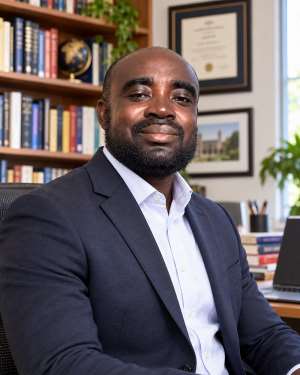
As a Ghanaian mathematics and STEM educator currently teaching in the United States, one lesson has become increasingly clear: students need opportunities to encounter mathematics as something they use, not merely something they complete.
A carefully designed real-world task can require students to interpret information, choose strategies, make assumptions, justify decisions, and communicate reasoning.
Technology can strengthen that process, but technology is not the objective.
The objective is thinking.
Ghana should not simply copy another education system. Every system has its own challenges, and approaches must fit Ghana’s curriculum, classrooms, communities and resources.
But the broader lesson is transferable:
Students develop problem-solving ability by solving problems.
We cannot expect learners to become strong problem solvers if most of their educational experience consists of watching teachers demonstrate solutions and then reproducing similar procedures.
Let the NSMQ become a beginning, not the peak
Ghana should continue celebrating the NSMQ.
We should celebrate the contestants.
We should celebrate their teachers and coaches.
We should celebrate schools that demonstrate extraordinary academic achievement.
But the national ambition should extend beyond producing brilliant contestants.
Imagine what Ghana could achieve if the intellectual curiosity we celebrate during NSMQ season became an everyday expectation in thousands of classrooms.
Imagine if students throughout the country regularly asked:
Why does this happen?
How can we measure it?
What does the evidence tell us?
What mathematical model could represent it?
What solution might work?
How can we test our idea?
Those questions represent the heart of STEM education.
The NSMQ has already demonstrated that Ghanaian students possess extraordinary intellectual potential. Ghana’s next challenge is to create classroom environments that allow far more students to develop and apply that potential.
The future of Ghanaian STEM education should therefore not be measured only by how many trophies our schools win.
It should also be measured by how many young people leave our classrooms believing—and demonstrating-that mathematics and science give them tools to understand and solve problems that matter.
That would be an achievement worthy of national celebration.
Sources
The article’s discussion of the 2026 NSMQ and the call for stronger problem-solving, critical thinking, innovation, and practical application in STEM is supported by Ghana Education Service statements reported by the Ghana News Agency. Ghana News Agency: PRESEC-Legon won the 2026 competition for a record ninth title. MyJoyOnline
The example involving 60 SHS girls developing solutions to flooding, waste management, water wastage and parking comes from September 2026 reporting on the SHEROES in STEM Bootcamp. MyJoyOnline
The discussion of Ghana’s learner-centred secondary curriculum, 21st-century competencies and STEM integration is consistent with NaCCA’s description of the secondary curriculum framework. NaCCA


 Mahama Defends Gold Export Restrictions, Signals Ban on Raw Mineral Exports by 2...
 Judicial Secretary Urges JUSAG to Suspend Planned Strike
 Education Ministry Orders Probe into Alleged Assault at Techiman SHS
 Chief Inspectors’ Amnesty Promotion: Supreme Court grants Police Administration ...
 Police deploy officers and cameras nationwide as TraffiTech-GH enforcement begin...
 Govt to fund travel expenses of mother of murdered Ghanaian teenager to US funer...
 Stop labelling menopausal women as witches – Public told
 Ghana woos investors for US$100million vaccine manufacturing project
 Eight killed, 21 rescued in bus collision on Elubo–Takoradi Highway
 NPP asks US Embassy to suspend recognition of Ghanaian diplomatic and service pa...


