




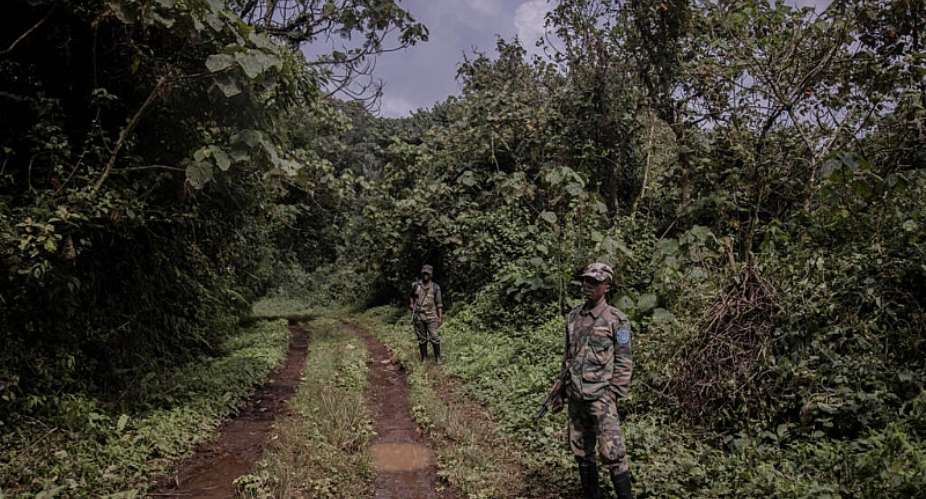
Now assistant park manager at Kahuzi-Biega, Lukoo was formerly a ranger at nearby Virunga, the oldest national park in Africa.
From tropical forests to extinct volcanoes, snowfields to swamps and lava plains, the region is home to an exceptional range of habitats.
Yet its natural wealth makes it vulnerable to exploitation, whether from armed groups battling the national government or impoverished local communities struggling to survive.
Hundreds of rangers work to protect the parks and their wildlife, sometimes at risk to their own lives.
Lukoo, who also founded a football academy to engage young people in conservation and has written a memoir about his experiences, told RFI about the challenges of preserving nature in a conflict zone – and why he wishes rangers got more respect. Emmanuel Bahati Lukoo, ranger and assistant park manager at Kahuzi-Biega National Park in Democratic Republic of Congo, pictured earlier this year.
RFI: Why is conservation work so important in your view?
Emmanuel Bahati Lukoo: These forests are part of Congolese heritage, but they also belong to the world. We're not just protecting them for ourselves, but for future generations – so they'll have the chance to come and experience the same thing we can.
It's also a source of income for the country: tourists come to visit the park and pay to see this biodiversity. Money comes in, and everyone benefits.
The climate is changing too. A few years ago, you couldn't just wear a shirt, you needed a sweater. That's no longer the case. We're also seeing rivers drying up, agricultural production declining, landslides. If we can breathe fresh air, it's because of all these forests and this biodiversity that we're protecting. We're protecting an ecological balance. Without trees there's no rain, no rivers.
Protecting the forests in the [DRC] means protecting people's lives. It's a huge responsibility.
RFI: In the DRC, rangers undergo intense training, similar to military recruits. Were you drawn to that aspect of the job?
EBL: I didn't start out wanting to be in the military. I've been passionate about nature ever since I was very young. Being in the Scouts taught me how to live in the forest, alongside animals. And I was born right next to a protected area. From a very young age, I witnessed the wonders of conservation. After completing my studies in humanitarian aid, I went to university and got a degree in environmental management.
You learn a lot when you're training to be a ranger: what conservation means, all about the protected area you'll be working in, how to navigate the forest without a compass, how to live alongside animals, who they are, why they need to be protected... But you also learn how to handle weapons. Eastern DRC has been a conflict zone for a long time. Rebel groups take refuge in protected areas.
As a result, park managers give rangers thorough paramilitary training so they can confront armed groups. This training is gruelling.
Nature conservation in the Congo isn't the same as elsewhere. For us, it's like being at war. When you go out on patrol, you don't think about coming back... Being a ranger in the east of the DRC is complicated. But you learn to love it.
RFI: Your role sees you handle everything from fighting off armed groups and poachers to tracking gorillas. What is ultimately the core of your mission?
EBL: It's protecting the territorial integrity of the reserve, the habitat and everyone who lives there against numerous threats – for instance, poaching and wildlife trafficking. To take a baby gorilla and traffic it, you first have to kill the mother. Our mission isn't to wage war against armed groups, but to defend when they attack.
There's also deforestation and illegal logging. In some areas, it has reached a particularly alarming scale. Trees are cut down to produce charcoal – known locally as makala – for energy, but also to make furniture.
Other threats include the illegal occupation of land for farming and the expansion of pastures, as well as illegal mining. This aerial photograph, taken in September 2019, shows an area in Kahuzi-Biega National Park devastated by logging.
Deforestation falling worldwide but Congo Basin losses grow, report finds
RFI: How are these illegal activities carried out?
EBL: Not everyone who enters a park illegally has the same motives. Some groups are pursuing political or military objectives, while others are seeking to control territories or trade routes, or to exploit natural resources to finance their activities.
Others, however, live in extreme poverty on the outskirts of the park and depend on these resources.
Armed groups set up camp in protected areas and draw from these communities – sometimes by force. Often, they use young people to mine minerals and produce charcoal. The communities transport the goods to illegal markets and hand over the money to the groups exploiting them.
RFI: In your memoir, you write that the political situation in the DRC complicates conservation efforts, notably corruption. What problems does this pose when managing a national park?
EBL: There are a lot of land disputes. Some communities see nature reserves as a problem. Certain politicians support these communities in illegal activities in order to get elected. Others use armed groups to attack ranger posts so that the rangers cannot do their jobs.
RFI: What could help reduce the pressure on national parks?
EBL: All parties must respect the integrity of protected areas, because everything starts with the violation of their boundaries.
But we have to look at the bigger picture. As long as local communities do not have access to affordable energy sources and enough economic opportunities, forests are likely to remain under pressure.
Next, we need to protect wildlife rangers. They are subject to arbitrary arrests and attacks. Everyone talks about human rights and protecting biodiversity, but I've never heard anyone mention rangers' rights. And yet they work day and night, spending 90 percent of their time in the forest, far from family and friends.
RFI: The International Union for Conservation of Nature rates the conservation outlook at Virunga as 'critical'. Do you share that assessment?
EBL: It's hard to say what the state of the protected area is because there's no scientific research being conducted at the moment. A very large portion – the south and the centre – is occupied and is no longer under the park's control. These are areas where rangers no longer go.
Today, it's a matter of survival and protecting the animals has become very complicated. After the war, we'll have to take stock. A male Grauer's gorilla, a critically endangered species, in the forest of Kahuzi-Biega National Park in September 2019.
The challenges of protecting wildlife from war in eastern DRC
RFI: You've written about the personal toll that the job takes on rangers. How has it affected you?
EBL: Rangers are motivated and passionate but they don't get recognition, that's what saddens me the most. Their sacrifice isn't acknowledged, even internationally. They aren't valued as they deserve to be. It's not fair because without forests, the world wouldn't exist. You see the results of these people's work, but you don't show them the respect they deserve in return.
We also need to reconsider their pay, which isn't enough to live on in cities where everything costs more. They rely on this salary to cover rent, tuition, food... The children of rangers end up on the streets, either because their father doesn't have enough money to pay for their education or because he died protecting a World Heritage Site.
RFI: Is that why you set up your football academy?
EBL: Yes. The Virunga Football Academy came from the fact there was a lot of mistrust between young people living near the park and the rangers. When we arrest some of them, their friends see us as the bad guys. We wanted to find a way to build a connection with them. Football is the simplest way.
We started in 2021 with about 50 young people in Rumangabo in North Kivu province. Then we got lots more requests, and today we work in Goma, Kiwanja, Kirumba and Kasindi... There are around 400 young people in the school. More are always applying, but we don't have the the resources to take them in. Young players in Kasindi train at the Virunga Football Academy, which was founded to promote peaceful coexistence between communities living near Virunga National Park.
RFI: How does it work?
EBL: Every week after school, boys and girls aged 8 to 17 come to practice, just like at any other football academy. When they play together, it builds bonds. They stop thinking about getting into trouble in the park. It also fosters peaceful cohesion between them, even though there are many intercommunal conflicts in the area.
In addition, we organise educational activities to help them understand the importance of nature reserves, education and living together.
In Rumangabo, young people's tendency to engage in illegal activities has really gone down. They're busy playing football. It's far from being all young people, and these are also the ones who want to do something. But we've reached the most vulnerable ones.
The football academy giving South Sudan's youth an alternative to gang life
RFI: In April 2018, you and five other rangers were ambushed by militiamen. You were the only one to survive. What drives you to keep going after the trauma of that experience?
EBL: Firstly, to honour the friends who died protecting the park. There have been others since then. We lost 13 rangers in Rumangabo in 2020 to an ambush. It would be a great act of cowardice to leave.
Secondly, I see conservation as a way to help communities develop without contributing to the destruction of the park.
As a ranger, what drives me to keep going is hope – even in the midst of danger and armed conflict. Far from discouraging me, this situation strengthens my resolve. Despite my fear, I continue to defend our country's natural wealth with courage and conviction. I am still convinced our mission is essential for the future of our region, and for the future of generations to come.
This article was adapted from an interview in French by Géraud Bosman-Delzons. It has been lightly edited for length and clarity.


 Mahama Defends Gold Export Restrictions, Signals Ban on Raw Mineral Exports by 2...
 Judicial Secretary Urges JUSAG to Suspend Planned Strike
 Education Ministry Orders Probe into Alleged Assault at Techiman SHS
 Chief Inspectors’ Amnesty Promotion: Supreme Court grants Police Administration ...
 Police deploy officers and cameras nationwide as TraffiTech-GH enforcement begin...
 Govt to fund travel expenses of mother of murdered Ghanaian teenager to US funer...
 Stop labelling menopausal women as witches – Public told
 Ghana woos investors for US$100million vaccine manufacturing project
 Eight killed, 21 rescued in bus collision on Elubo–Takoradi Highway
 NPP asks US Embassy to suspend recognition of Ghanaian diplomatic and service pa...


