




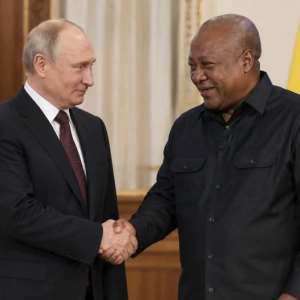
Ghana's quest for nuclear energy is not a new political ambition, nor is it an idea conceived by the current administration. It is an unfinished national development project that dates back to the visionary leadership of Ghana's first President, Osagyefo Dr Kwame Nkrumah. More than six decades after Ghana first embarked on its nuclear energy journey, the country finds itself at another defining moment, with President John Dramani Mahama's recent engagement with Russian President Vladimir Putin offering a renewed opportunity to turn that long-held ambition into reality.
The announcement that Russia has committed to working with Ghana towards establishing a 2,000-megawatt nuclear power plant is therefore significant. It represents more than another diplomatic understanding between two countries. It reopens a chapter in Ghana's development history that was interrupted before its full potential could be realised.
President Mahama's participation in the Third Russia-Africa Summit in Moscow, held from October 28 to 29, 2026, and his subsequent bilateral engagement with President Putin deserve serious national attention. At a time when Ghana continues to grapple with the complex demands of energy security, industrialisation, economic transformation and technological advancement, the prospect of a strategic partnership with Russia in nuclear energy could become an important milestone in the country's development journey.
Nkrumah's nuclear vision: An unfinished national project
To appreciate the importance of the current development, it is necessary to revisit Ghana's nuclear history.
Dr Kwame Nkrumah understood something that remains relevant today: no country can achieve meaningful industrial transformation without a dependable, affordable and sustainable energy supply.
His vision for Ghana was not limited to political independence. He wanted economic independence, technological advancement and an industrialised nation capable of competing with the developed world. Energy was central to that ambition.
Following the establishment of the Ghana Atomic Energy Commission in 1963, Ghana began developing the institutional and scientific foundations for the peaceful application of nuclear technology. The Ghana Nuclear Reactor Project, initiated in 1961 (Ghana Atomic Energy Commission, n.d.; Nuclear Regulatory Authority, n.d.), was intended to introduce nuclear science and technology into the country, develop scientific expertise and lay the groundwork for the eventual introduction of nuclear power for electricity generation.
The Kwabenya Nuclear Reactor Project was an important component of this vision. It was conceived as part of a broader strategy to develop Ghana's scientific and technological capabilities and prepare the country for the future use of nuclear energy.
Unfortunately, the overthrow of Dr Nkrumah's government in February 1966 interrupted the momentum of this ambitious national project. The nuclear power agenda subsequently lost the political continuity and strategic direction needed to progress towards commercial electricity generation.
It is important to distinguish between the early nuclear research ambitions and the commercial nuclear power plant Ghana is now seeking to develop. Ghana eventually established its research reactor programme, with the Ghana Research Reactor (Andam et al., 2019), 1 commissioned in 1995. That achievement demonstrated that the country could develop and maintain important nuclear science capabilities, but it was not the commercial power station envisaged in the broader national ambition.
The lesson is profound: Ghana did not lack the foresight to recognise the importance of nuclear energy. What it lacked was the sustained political commitment, continuity and resources required to complete the journey. More than 60 years later, Ghana has another opportunity to address that unfinished business.
Why nuclear energy is long overdue for Ghana
Ghana's energy challenges make the case for nuclear power increasingly compelling.
Over the years, the country has expanded its electricity generation capacity through hydroelectricity, thermal generation, natural gas and renewable energy. The Akosombo and Kpong hydroelectric projects transformed the national electricity landscape, while thermal power generation has become an important component of the country's energy mix.
However, the expansion of generation capacity has not eliminated the structural challenges confronting the energy sector.
Ghana continues to face the difficult task of balancing electricity demand, generation costs, fuel availability, transmission and distribution efficiency, financial sustainability and the need for reliable power supply. The energy sector's financial difficulties have also placed considerable pressure on public finances.
The 2025 Budget Statement acknowledged the substantial financial challenges facing the sector, including collection inefficiencies, distribution losses, high generation costs, contractual obligations and inadequate cost recovery. It reported that government provided approximately US$1.5 billion to support the energy sector in 2024.
The International Monetary Fund's 2026 assessment also estimated that the sector's financial shortfall stood at approximately US$1.4 billion in 2025, equivalent to 1.2 per cent of GDP. Although there have been improvements, the underlying structural challenges remain significant.
These figures demonstrate that Ghana's energy (International Monetary Fund, 2026) problem is not simply about generating more electricity. It is also about the cost, reliability, sustainability and financial management of the entire electricity value chain.
For a country aspiring to become an industrial and manufacturing hub, this situation cannot be treated as a minor inconvenience.
Factories need dependable electricity to operate efficiently. Mining and mineral-processing companies require substantial and consistent power. Agro-processing industries need reliable electricity to preserve, process and add value to agricultural produce. Hospitals, educational institutions, digital businesses and other essential services all depend on uninterrupted electricity. Without a reliable energy foundation, Ghana's industrialisation ambitions will continue to encounter serious obstacles.
Nuclear energy offers an important part of the solution.
Unlike solar and wind generation, which depend on weather conditions and require complementary storage or other generation sources to ensure continuous supply, nuclear power can provide large-scale, dependable electricity over extended periods. Nuclear plants operate at high-capacity factors and can supply baseload electricity, helping to stabilise the national grid. This does not mean Ghana should abandon hydroelectricity, natural gas, solar or other renewable energy sources. Rather, nuclear energy should complement them as part of a diversified and balanced energy mix.
The objective should be to build an electricity system that is resilient, reliable, affordable and capable of supporting the country's long-term development.
Nuclear power and the industrialisation agenda
Ghana must begin to think beyond electricity for domestic consumption. The real strategic value of nuclear power lies in its potential contribution to national productivity, industrial competitiveness and economic transformation.
A country that wants to process its own minerals, manufacture finished products, develop modern industries and create sustainable employment must have the energy infrastructure to support those ambitions.
Consider Ghana's enormous opportunities in bauxite, aluminium, iron and steel, manganese, gold processing, pharmaceuticals, fertiliser production and agro-industrial development. These sectors require reliable and often energy-intensive operations.
Ghana cannot consistently promote local manufacturing and value addition while businesses remain vulnerable to unreliable electricity and high operating costs.
A nuclear power programme, if properly developed and managed, could provide a stable source of electricity for decades. It could also stimulate domestic capabilities in engineering, construction, nuclear science, research, safety regulation, specialised maintenance and advanced manufacturing.
There is also an opportunity to develop a new generation of Ghanaian scientists, engineers, technicians and nuclear energy professionals.
The nuclear programme must therefore be understood as more than the construction of a power station. It should be a national technological development programme that creates knowledge, skills, employment and industrial opportunities for Ghanaians.
Mahama's Russia visit: A historic return to an old partnership
The historical relationship between Ghana and Russia gives the President's recent visit an additional significance.
Ghana and the former Soviet Union established diplomatic relations in 1958, shortly after Ghana's independence. This relationship developed during Dr Nkrumah's administration, when Ghana pursued an independent foreign policy and established partnerships with countries across the ideological and political divides of the Cold War (Krzyzaniak, 2019).
The Soviet Union became an important partner in Ghana's efforts to develop scientific, technical and industrial capabilities. Cooperation extended into education, training, technical assistance and other areas of national development.
The nuclear energy connection is particularly relevant. Ghana's early nuclear ambitions emerged during the same period when the country was actively seeking international scientific and technological partnerships.
President Mahama's engagement with President Putin consequently carries historical as well as contemporary significance. It provides an opportunity to reconnect two countries whose relationship was shaped, in part, by a shared interest in science, education and development.
It is also an important reminder that Ghana's foreign policy should be guided by national interest and the pursuit of mutually beneficial partnerships.
In a changing international environment, Ghana must be able to engage constructively with Russia, China, the United States, Europe and other strategic partners without allowing geopolitical rivalries to undermine its development priorities.
The important question should not be which international power Ghana prefers, but which partnerships offer the greatest sustainable benefits to the Ghanaian people.
President Mahama's message at the summit, emphasising mutually beneficial investment rather than aid dependency, is particularly relevant in this regard.
Ghana must move from being primarily a consumer of imported technology to becoming a country that acquires, adapts and progressively develops its own technological capabilities.
Six commitments and an opportunity to deepen cooperation
The outcomes of President Mahama's bilateral discussions with President Putin, as communicated by Ghana's Foreign Affairs Minister, Samuel Okudzeto Ablakwa, extend beyond nuclear energy (Myjoyonline, 2026; Ghana News Agency, 2026).
The six reported commitments cover important areas of Ghana's national development:
- Nuclear energy: Russia has agreed to work with Ghana towards establishing a 2,000-megawatt nuclear power plant to strengthen energy security and support industrialisation.
- Defence cooperation: The two countries will pursue a new defence cooperation arrangement, including assistance with strategic military equipment for the Ghana Armed Forces.
- Agriculture: Both countries will deepen cooperation to increase grain production and improve access to fertilisers, supporting Ghana's food security objectives.
- Education: Russia will increase scholarship opportunities for Ghanaian students, creating additional opportunities for academic and technical development.
- Protection of Ghanaian citizens: President Putin has indicated that Ghanaians will no longer be permitted to participate in the Russia-Ukraine war, including through irregular recruitment arrangements or voluntary enlistment.
- Institutional cooperation: Both countries have agreed to revive the Permanent Joint Commission for Cooperation, with Russia expected to host its next meeting.
Taken together, these commitments offer an opportunity to expand Ghana-Russia relations (Kulkova and Sanusi, 2016) into a more comprehensive development partnership.
The nuclear energy commitment is particularly important because it addresses a foundational requirement for Ghana's economic transformation. Agriculture, education, manufacturing, defence and technological development all benefit from a country with a reliable energy system.
The agricultural commitment is equally relevant. Ghana must strengthen domestic food production, improve fertiliser availability, reduce post-harvest losses and expand agro-processing. Cooperation with Russia could contribute to these objectives if the arrangements translate into practical investments, technology transfer and measurable improvements for Ghanaian farmers.
The proposed increase in scholarships also deserves attention. Ghana needs more engineers, nuclear scientists, agricultural researchers, energy specialists and other professionals capable of translating international cooperation into domestic development.
Diplomatic agreements are valuable, but their true worth must ultimately be measured by what they deliver to ordinary citizens.
Why Russia could be an important nuclear energy partner
Russia has developed extensive experience in nuclear power technology, reactor construction, fuel services, nuclear research and the training of nuclear professionals.
Through its state nuclear corporation, Rosatom, Russia has participated in nuclear power projects and technical cooperation programmes in several countries.
This makes Russian technical expertise potentially relevant to Ghana's ambitions.
However, Ghana must approach the proposed partnership with a clear understanding of its national interests. The objective should not simply be to acquire a nuclear power plant. It should be to develop a sustainable nuclear energy industry that Ghana can regulate, operate and progressively support with its own skilled workforce.
The negotiations must therefore address the full lifecycle of the project, including financing, construction, fuel supply, operations, maintenance, waste management, decommissioning and long-term safety.
Ghana should also insist on meaningful technology transfer, local participation and training opportunities. Our universities, technical institutions, engineering companies and research institutions must be involved from the beginning.
A nuclear power plant built in Ghana should not become an isolated foreign-operated facility with limited benefits for the domestic economy. It should contribute to building Ghanaian technical competence and industrial capacity.
The opportunities must be matched with responsibility and proper planning
While the prospects of nuclear energy are exciting, Ghana must approach the project with the seriousness and institutional discipline it demands.
Nuclear energy is a long-term investment. It requires substantial capital, rigorous regulatory oversight, technical competence, political commitment and public confidence.
The proposed 2,000-megawatt (Reuters, 2026) facility must therefore be supported by a transparent implementation framework that answers some fundamental questions.
How will the project be financed? What will be the ownership and operational structure? What are the proposed construction timelines? What technology will be deployed? What safeguards will protect Ghana against excessive financial exposure? How will nuclear waste be managed? What arrangements will ensure that the plant remains safe throughout its operational life?
These questions are not reasons to delay Ghana's nuclear ambitions. They are necessary considerations for ensuring that the project succeeds.
Ghana must also strengthen the independence and technical capacity of its Nuclear Regulatory Authority, deepen its cooperation with the International Atomic Energy Agency (IAEA), and ensure that international nuclear safety standards are strictly observed.
Furthermore, the government must establish a sustainable financing model that does not place an unbearable burden on future generations.
The project should also be subjected to appropriate parliamentary scrutiny, public consultation and environmental assessment.
Nuclear energy must enjoy national ownership beyond the lifespan of any political administration. It should not become another development project that changes direction whenever political power changes hands.
This is precisely where Ghana must learn from its own history.
The interruption of Nkrumah's original nuclear ambitions illustrates the consequences of losing policy continuity. This time, the country must establish the institutional and legal safeguards necessary to ensure that the project survives changes in government.
Ghana must not repeat the mistakes of the past
One of the greatest obstacles to Ghana's development has been the inability to sustain important national projects across successive administrations.
We have witnessed promising initiatives in industrialisation, agriculture, infrastructure and energy encounter delays, policy reversals and inadequate long-term planning.
Nuclear energy is too important and too expensive to become another casualty of political competition.
The government must therefore work towards building a broad national consensus on the nuclear programme. Parliament, academia, traditional authorities, civil society, industry and the private sector must all have a stake in the national conversation.
A long-term nuclear energy policy should be supported by a clear implementation roadmap, measurable milestones and regular public reporting.
There must also be a deliberate strategy to prepare Ghanaian institutions and professionals for the technical responsibilities that come with nuclear power generation.
Our universities should expand nuclear engineering and related programmes. The Ghana Atomic Energy Commission should receive the necessary institutional support, while local engineering and construction companies should be prepared to participate in the supply chain wherever they meet the required standards.
The ultimate objective should be to ensure that Ghana does not merely import a nuclear power plant but develops the human capital and technical expertise to participate meaningfully in the global nuclear industry.
A strategic opportunity for Ghana's future
President Mahama's visit (Myjoyonline, 2026; Ghana News Agency, 2026) to Russia also comes at a time when the global energy landscape is undergoing significant transformation.
Countries are increasingly seeking diversified energy sources that can guarantee security of supply while supporting economic growth and climate commitments.
Nuclear power is receiving renewed attention because it can provide large-scale, low-carbon electricity. For Ghana, which must balance development needs with environmental sustainability, this presents an opportunity worth pursuing.
The country must, however, ensure that nuclear energy complements rather than displaces investments in renewable energy, hydroelectricity, natural gas infrastructure, energy efficiency and grid modernisation. No single energy source will solve all of Ghana's electricity challenges.
A diversified energy system, supported by sound financial management and efficient distribution infrastructure, offers a more sustainable way forward. There is also an important geopolitical dimension to the Russia engagement. Ghana must preserve its strategic independence and maintain constructive relations with all international partners. Nuclear cooperation should be determined by technical merit, value for money, national security and the long-term interests of the Ghanaian people.
Russia's willingness to work with Ghana should therefore be assessed through the quality of the eventual agreements and the benefits they deliver, not simply the political symbolism of the announcement. Ghana should remain open to international collaboration while negotiating firmly for favourable financing, technology transfer, local content and national capacity development.
The time to complete Nkrumah's unfinished vision
More than six decades ago, Dr Kwame Nkrumah recognised that Ghana's future would depend significantly on its ability to master science and technology and harness them for national development. His nuclear ambitions were part of a much larger vision of an industrialised, technologically advanced and economically independent Ghana.
Today, the country faces a different economic and geopolitical environment, but the fundamental development challenge remains remarkably similar. We need dependable electricity to power our industries, strengthen our agricultural value chains, expand manufacturing, improve public services and create sustainable employment for our growing population.
The proposed partnership with Russia offers an opportunity to revisit that ambition with renewed determination and the benefit of decades of scientific and technological advancement.
President Mahama's engagement with President Putin should therefore be viewed within this broader historical and developmental context. It is an opportunity to strengthen an old bilateral relationship, open new avenues for economic cooperation and potentially advance a national project whose foundations were laid during the Nkrumah era.
However, the real measure of success will not be the number of commitments announced at a summit or the photographs taken during a presidential visit. It will be whether Ghana translates those commitments into bankable agreements, completed infrastructure, skilled Ghanaian professionals, industrial expansion and reliable electricity for its people.
The country must now move from aspiration to implementation.
Nkrumah's generation had the foresight to recognise the importance of nuclear energy. Subsequent generations have maintained and developed aspects of that ambition. The responsibility now rests with the present generation to ensure that the opportunity is not lost again. Ghana's nuclear energy dream is long overdue. The country has waited long enough. What is required now is careful planning, political continuity, responsible international cooperation and an unwavering commitment to the national interest.
The unfinished nuclear ambition of the 1960s must not become another unfinished promise of the 2020s. Ghana must seize this opportunity to build the energy foundation upon which its industrial and economic future can stand.
References
1. Ghana Atomic Energy Commission. (n.d.). History of the Ghana Atomic Energy Commission.
2. Nuclear Regulatory Authority of Ghana. (n.d.). Ghana's nuclear power programme. Nuclear Regulatory Authority.
3. Ghana News Agency. (2026, October 31). President Mahama returns home from Russia-Africa Summit. Ghana News Agency.
4. Myjoyonline. (2026, October 31). Mahama secures six commitments in nuclear energy, agriculture, and other areas from Putin after Russia-Africa Summit. Myjoyonline.
5. Reuters. (2026, October 31). Ghana says Russia to back 2,000 MW nuclear plant, deepen ties. Reuters.
6. International Monetary Fund. (2026, August 4). Ghana's energy sector: From fiscal vulnerability to a platform for sustained growth. IMF Staff Country Reports
7. Kulkova, O. S., & Sanusi, H. A. (2016). Russia-Ghana relations in the past and the present: A time-proven partnership. Vestnik RUDN. International Relations, (2016)
8. Andam, A. B., Opoku-Ntim, I., Allotey, N. K., & Amponsah, P. E. (2019). Preparing for a nuclear power plant: Ghana's forward march. Proceedings of the Canadian Nuclear Society Annual Conference.
9. Krzyzaniak, J. (2019). Interview: Nuclear research and the quest for scientific equity in Ghana. Bulletin of the Atomic Scientists.


 Judicial Secretary Urges JUSAG to Suspend Planned Strike
 Education Ministry Orders Probe into Alleged Assault at Techiman SHS
 Chief Inspectors’ Amnesty Promotion: Supreme Court grants Police Administration ...
 Police deploy officers and cameras nationwide as TraffiTech-GH enforcement begin...
 Govt to fund travel expenses of mother of murdered Ghanaian teenager to US funer...
 Stop labelling menopausal women as witches – Public told
 ‘Supreme Court is not your lawyer to explain the constitution to you' – Justice ...
 Ghana woos investors for US$100million vaccine manufacturing project
 Eight killed, 21 rescued in bus collision on Elubo–Takoradi Highway
 NPP asks US Embassy to suspend recognition of Ghanaian diplomatic and service pa...


