




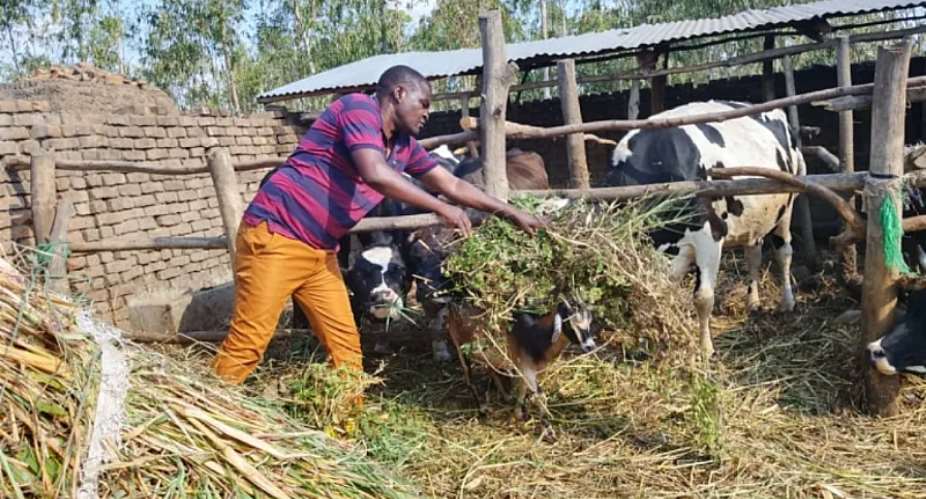
Lawrence Abison, 25, and three friends spend their mornings cutting Napier grass and reeds along the Likhubula River in Mulanje District, southern Malawi. The group travels 27 kilometres from Nsanjama and can gather enough fodder to feed 10 cattle for just one day.
Across Mulanje, dozens of farmers are making similar journeys as grazing resources become increasingly scarce.
"It's very hard to find grass these days," Abison said. "Even here, it won't last a week, and we have to go farther."
The Likhubula River, which flows from Mount Mulanje, is a vital source of water and cattle feed. Residents say years of drought, rising temperatures and environmental degradation have reduced water levels and stripped riverbanks of trees, reeds and grass.
Malawi experienced prolonged dry spells during the 2023/24 rainy season as El Niño disrupted rainfall patterns across southern Africa. Authorities warned of below-normal rainfall and heightened drought risks, particularly in the south.
For cattle farmers, the impact is immediate. Fodder must now be collected months earlier than usual and from greater distances, increasing costs and competition for scarce vegetation.
Macdonald Khandalawo, a cattle farmer in Nsanjama, says feed shortages have reduced milk production and increased expenses.
"Because of climate change, grass has become scarce, so we send boys to distant rivers to collect it," he said.
Farmers also blame cultivation along riverbanks for accelerating environmental decline.
"Previously, there were plenty of reeds and grass," Khandalawo said. "Now people cultivate right up to the water's edge, vegetation is disappearing and rivers are drying faster."
Khandalawo belongs to the New Thuchira Milk Bulking Group, a cooperative of about 400 farmers. Members are increasingly relying on maize stalks, pea residue and rice leftovers to supplement cattle feed. However, lower maize harvests have made maize bran scarce and expensive, reducing profits.
Near the Likhubula River, Batson Kweluza, 57, has watched the landscape transform.
"In the past, tree cover kept this area shaded," he said. "Now many trees are gone, and the river is shallow enough to cross without removing your shoes."
Farmer Alefa Saulo is facing similar challenges. Her cattle are losing weight as feed becomes harder to find, and labour shortages have worsened the situation.
For now, she is hoping for rain.
"When the animals are healthy, I am happy," Saulo said. "But now they are hungry, and I can't give them enough food."
Source: Reuters

 Mahama Defends Gold Export Restrictions, Signals Ban on Raw Mineral Exports by 2...
 Judicial Secretary Urges JUSAG to Suspend Planned Strike
 Education Ministry Orders Probe into Alleged Assault at Techiman SHS
 Chief Inspectors’ Amnesty Promotion: Supreme Court grants Police Administration ...
 Police deploy officers and cameras nationwide as TraffiTech-GH enforcement begin...
 Govt to fund travel expenses of mother of murdered Ghanaian teenager to US funer...
 Stop labelling menopausal women as witches – Public told
 Ghana woos investors for US$100million vaccine manufacturing project
 Eight killed, 21 rescued in bus collision on Elubo–Takoradi Highway
 NPP asks US Embassy to suspend recognition of Ghanaian diplomatic and service pa...


