




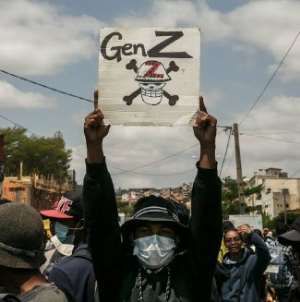
In recent times, young people have become the most visible force confronting poor leadership. The wave stretches from Kenya's finance bill protests to Morocco, Madagascar, Togo, Tanzania and Nepal. The pattern is too consistent to dismiss as impatience. It reflects real conditions.
Jobs and cost of living. Many protesting countries have large youth populations whose economies are failing them. Young people are well educated but unemployment is high, the cost of essentials has soared and public services have deteriorated.
Analysts describe the result as graduates selling sweets on street corners while billions are looted and patients die in public hospitals.
Corruption and the flaunting of wealth. Researchers writing in the Journal of Democracy say the true rallying cry of the protests seems to be corruption, with young people furious at elites who shamelessly reap the spoils of opulent privilege while their countries suffer. When taxes rise while services decline, young citizens feel cheated.
A generational gulf. Africa is the world's youngest continent, but its leaders are old. People under thirty make up over 70 percent of the population, with a median age of 19.3, while the average age of African leaders in 2024 was 64.3. Young people see a ruling class that does not look like them and does not share their struggles.
Failed basic services. In Morocco, protests followed the deaths of mothers in childbirth at a public hospital, set against an expensive new World Cup stadium. Eight women died in childbirth at a single hospital in under three weeks.
One analyst called the unrest a reckoning for governments that have failed to deliver decent public services such as water and electricity, or jobs for the millions entering the labour market each year.
Blocked democratic routes. Some protests answered undemocratic acts directly: a blatantly undemocratic election in Tanzania and manoeuvres to extend dynastic rule in Togo. When ballots seem to change nothing, the street becomes the remaining channel.
Digital tools. These movements are largely leaderless, digitally mobilised and focused on renegotiating the social contract. Hashtags like #EndSARS in Nigeria and #RutoMustGo in Kenya show how digital outrage becomes mass mobilisation. Without a single leader, there is no one to arrest or buy off.
The costs and limits. Resistance is dangerous. State responses have included beatings, lethal force, mass arrests and torture. Results are mixed: youth uprisings have toppled governments, compelled reforms, and provoked violent clashes and crackdowns.
Madagascar shows the risk of weak institutions outliving the protests, and analysts say the central challenge is not mobilisation but transformation, because protests alone cannot substitute for political strategy.
Scholars also warn against celebrating military takeovers, because military governments often prove equally or more repressive, particularly toward the young activists who welcomed their arrival.
The way forward. Governments that want to avoid this anger should create jobs, publish how public money is spent, prosecute corruption visibly, and give young people real seats in decision-making.
Gen Z should turn street energy into voter registration, candidacies and policy demands. Without that step, the next wave will meet the same wall.
Mustapha Bature Sallama
Medical/ Science Communicator,
Private Investigator, Criminal Investigation and Intelligence Analysis,
International Conflict Management and Peacebuilding. (USIP)
[email protected]
+233555275880
References
CIVICUS, "Gen Z Protests: New Resistance Rises," 2026 State of Civil Society Report, publications.civicus.org
Observer Research Foundation, "Policy Lessons From Africa's Gen Z Uprisings" (Jan 2026), orfonline.org
Foreign Policy Research Institute, "Is Gen Z Reshaping Africa's Political Landscape?" (Oct 2025), fpri.org
NPR, "From Madagascar to Morocco: Gen Z protests shake Africa" (2 Oct 2025), npr.org
Journal of Democracy, "Why Gen-Z Is Rising," journalofdemocracy.org
CSIS, "Can Gen Z Protests Reshape Governance in Africa?", csis.org
The Elephant, Kumah-Abiwu and Aboudi, "Africa's Gen Z Awakening" (21 Apr 2026), theelephant.info
LSE Blogs, "How Gen Z is Redefining Governance in Africa" (29 Jan 2026), blogs.lse.ac.uk


 Mahama Defends Gold Export Restrictions, Signals Ban on Raw Mineral Exports by 2...
 Judicial Secretary Urges JUSAG to Suspend Planned Strike
 Education Ministry Orders Probe into Alleged Assault at Techiman SHS
 Chief Inspectors’ Amnesty Promotion: Supreme Court grants Police Administration ...
 Police deploy officers and cameras nationwide as TraffiTech-GH enforcement begin...
 Govt to fund travel expenses of mother of murdered Ghanaian teenager to US funer...
 Stop labelling menopausal women as witches – Public told
 Ghana woos investors for US$100million vaccine manufacturing project
 Eight killed, 21 rescued in bus collision on Elubo–Takoradi Highway
 NPP asks US Embassy to suspend recognition of Ghanaian diplomatic and service pa...


