




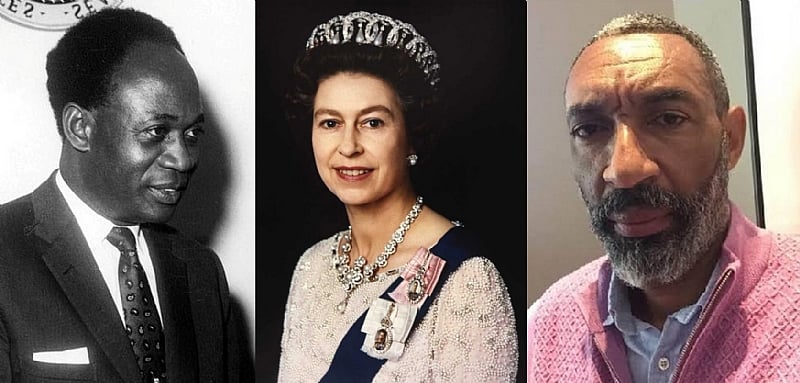
I read the news story of Sekou Nkrumah’s quite interesting, fascinating and insightful appreciation and analysis of what has come to be called the Bawku Conflict or, more officially and commonly, the Bawku Chieftaincy Crisis, with more than glancing or passing relish (See “ ‘My Father Triggered the Bawku Conflict for Political Gain’ - Sekou Nkrumah’s Painful Reflection” Ghanaweb.com 12/26/25). Actually, as any sedulous reader of my columns can obviously envisage or even unreservedly attest, I have had this news article on file for quite sometime now and have made several references to this more harrowing and exasperating chain of bloody incidents during the course of the past year; but I have not been able to fully tackle this national heart and eyesore, having been preoccupied with other equally significant socioeconomic, political and cultural problems that have dominated the local Ghanaian media headlines, particularly the decidedly chaotic and the seismically traumatic administration of the country by both major political parties, namely, the presently ruling National Democratic Congress (NDC) and the main opposition New Patriotic Party (NPP).
In the main, the third or fourth officially recognized son of Ghana’s first postcolonial Prime Minister and, subsequently, President, Mr. Kwame Nkrumah, is smack on target to recognize the fact of his globally renowned and historically immortalized father’s having played a critical and, in retrospect, a deleteriously instrumental role in exacerbating tenor, the perennial politically and socioeconomically destructive tenor, toll and the increasingly, prohibitively dangerous trend which the Bawku Chieftaincy Crisis/Conflict has taken. But, of course, the very historically extravagant and politically oversized idea of the fact of the President Nkrumah-led tautologically named Convention People’s Party (CPP) having actually “triggered” or effectively ignited or originated Ghana’s most infamous ethno-tribal internecine perennial season of bloodletting, clearly overstates a problem that far preexists both Ghana’s colonial and postcolonial eras or “histories,” if the Dear Reader would allow, for the sake of our present public conversation.
Rather, the Mamprusi-Kusasi Crisis of Chieftaincy or Crisis of Traditional Leadership and Governance unignorably inheres in the very evolutionary flux or ebb and flow of the age-old relations between these two historically proud and diligent peoples. For instance, there is a long-existing history of the political suzerainty of the Kusasi by their Mamprusi overlords that stretches far over generations and centuries that is often cavalierly and inappropriately ignored in the narrative of the subject at hand which, objectively and meticulously introduced into this discursive narrative, could very well bring a definitive resolution to this morally inexcusable and tragic but also clearly avoidable state of affairs which, truth be told, has exacted a prohibitive human and socioeconomic toll on the key players and parties to the Bawku Chieftaincy Crisis and the entire nation at large, and may very well have significantly regressed the salutary development of both the Bawku enclave, the Upper-East Region and the Sovereign Democratic Republic of Ghana at large.
Now, to get a little bit of an appreciable understanding of President Nkrumah’s deployment of what Sekou Nkrumah dispassionately and laudably terms as the “Divide-and-Conquer” approach to the Postcolonial Integration of the Multinational Conglomerate of the erstwhile British Colony of the Gold Coast that eventually emerged as Independent or Postcolonial Ghana, the interested and reasonably well-educated Ghanaian citizen and/or resident needs to read the works of such distinguished and globally renowned Africanist Scholars as Richard Rathbone, especially the latter’s book titled “Murder and Politics in Colonial Ghana” (Yale University Press, 1993); Dennis Austin’s “Politics in Ghana: 1946-1960” (Oxford University Press, 1964); and David Apter’s “Ghana in Transition” (Princeton University Press, 1955), among a host of other words by these remarkable and authoritative scholars.
Of course, one can also not ignore the rich and the well-researched corpus of works produced by Indigenous Ghanaian Scholars and other meticulous and scholastically objective Non-Ghanaian Africanist Scholars, both of Continental African and Non-Continental African Descent. Then also, we need to underscore the fact that not only is the seemingly endless or pathologically incurable Bawku Chieftaincy Crisis not unique or peculiar to the Mamprusi and the Kusasi ethnic polities in the Upper-East Region of Ghana, the glaringly inescapable fact is that there exist dozens of pockets of chieftaincy conflicts and/or crises all across the country whose apparently relatively less pernicious and of less destructive magnitude has largely been due to the fact that they happen to exist in more ethnically and culturally homogeneous parts of the country.
Then, of course, the relative and comparative degrees and levels of modernity, including ready access to economic resources and cultural amenities like a viable formal education system, among other of the most fundamental appurtenances or instruments and tools of contemporary civilization, has quite a remarkable and a considerable lot to do with much of these problems. But even as Sekou Nkrumah aptly and perspicuously recognizes, a politically impatient and temporally aggressive President Kwame Nkrumah does not appear to have critically and circumspectly gauged, well beforehand, the daunting magnitude of the leaden burden of being handed the destiny of a newly created postcolonial state that was anatomically and fundamentally Federalist in nature, and not quite significantly adequately “Modernized” to readily guarantee the sort of Euro-Western Brand of the Postcolonial Nation that the British and the American-educated leader had expected to seamlessly and felicitously elevate to the “Commanding Heights” of a Modern Civilization.
One can simply conduct a dry-run of Ghana’s level of infrastructural development to soberly arrive at the definitive conclusion that European Colonial Imperialism was about anything and everything but the sociopolitical, economic and the intellectual and the cultural uplift of the colonized. In other words, whatever little existed in the form of technology, healthcare, education and moral and intellectual advancement was, for the most part, merely incidental than a deliberate act of intent or a conscious and a politically progressive planning on the part of the colonial suzerain. Which was essentially why, at best, what Mr. Kwame Nkrumah and his ragtag institutional establishment of the Convention People’s Party inherited from the British Colonial Imperialists could be described as “The Cocoa-Beans Exporting Slave State of Ghana.”
For those of our leaders fatuously given to poking fun at the so-called Banana Republics of the Caribbean and Latin America, we advise such Super-OD Caliber of Veritable Political Comedians to simply look your grotesque Harlequin selves up in the mirror and tell us just what you see.
By Kwame Okoampa-Ahoofe, Jr., PhD
Professor Emeritus, Department of English
SUNY-Nassau Community College
Garden City, New York
E-mail: [email protected]


 Mahama Defends Gold Export Restrictions, Signals Ban on Raw Mineral Exports by 2...
 Judicial Secretary Urges JUSAG to Suspend Planned Strike
 Education Ministry Orders Probe into Alleged Assault at Techiman SHS
 Chief Inspectors’ Amnesty Promotion: Supreme Court grants Police Administration ...
 Police deploy officers and cameras nationwide as TraffiTech-GH enforcement begin...
 Govt to fund travel expenses of mother of murdered Ghanaian teenager to US funer...
 Stop labelling menopausal women as witches – Public told
 Ghana woos investors for US$100million vaccine manufacturing project
 Eight killed, 21 rescued in bus collision on Elubo–Takoradi Highway
 NPP asks US Embassy to suspend recognition of Ghanaian diplomatic and service pa...


