




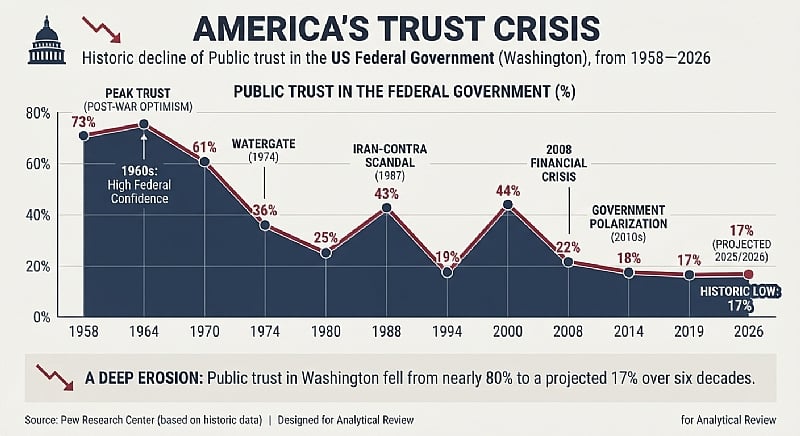
America goes to the polls on Tuesday, November 3, in a mood defined less by anger, partisanship or rival policy agendas than by something more fundamental: a widening deficit of trust in the political system's capacity to deliver.
A new Electoral Trust Intelligence assessment by this study puts Americans' confidence in institutions' ability to understand and deliver on the issues that matter most to them at 39 out of 100 — an elevated national trust deficit.
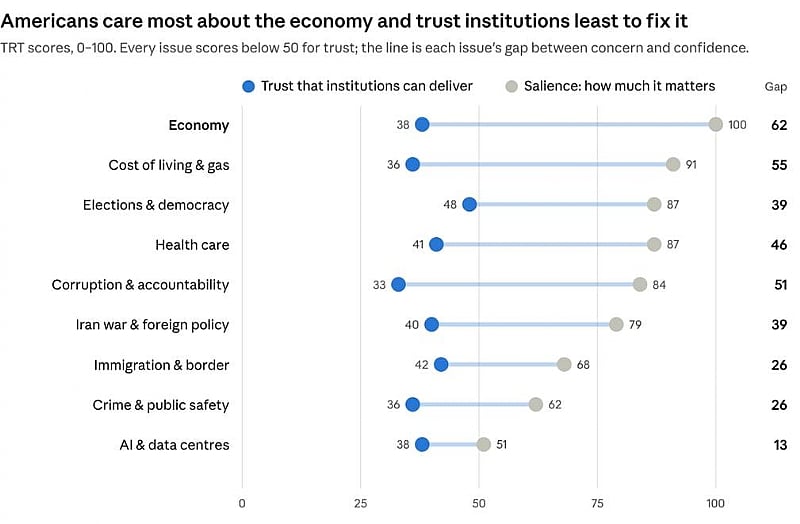
The most striking feature of the assessment is where that deficit sits. The issues Americans care about most are the ones on which they trust institutions least. The economy scores a perfect 100 for issue salience but only 38 for trust. Cost of living, prices and gasoline score 91 for salience and 36 for trust.
That combination — high concern, low confidence — is what the study calls a Critical Electoral Trust Risk Zone. It suggests a sharper question about this election than what voters want: what do Americans badly want fixed, but increasingly doubt their institutions can fix?
Study issue scores from AP-NORC, Gallup, Pew and ABC/WaPo/Ipsos polling, Sep–Oct 2026
The economy is where trust meets the kitchen table
For voters, economic confidence is never abstract. It is the price of groceries and the cost of filling a car. It is the rent or the mortgage, the doctor's bill, the job, and the hope of saving enough to buy a home.
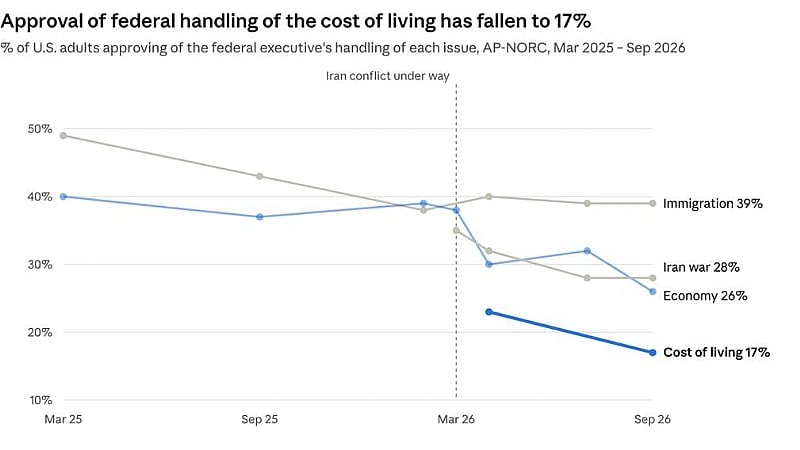
The economy is the single most salient issue in the study, yet it scores only 38 for trust — a 62-point trust deficit. The cost-of-living picture is more combustible still: salience of 91, trust of 36. Approval of federal handling of the cost of living fell from 23% in April to 17% in September, according to AP-NORC.
AP-NORC Center for Public Affairs Research polls of U.S. adults, March 2025 – 24–28 September 2026
The result is a political paradox. The public is watching the economy intensely while growing more skeptical that government can improve it.
That distinction matters. Voters can worry about an issue without blaming one party alone. But when concern comes with the belief that neither side can deliver, the consequence is broader institutional dissatisfaction. AP-NORC found that 28% of voters trust neither party on the economy, and only 18% say "able to solve important problems" describes either party well.
This is not simply a Republican-versus-Democrat story. It is a trust story — and potentially a more volatile one.
Corruption: the deepest trust deficit
If the economy carries the most electoral weight, government corruption and accountability carries the deepest measured deficit. It scores 33 out of 100 for trust against a salience of 84 — a 67-point gap and a High Electoral Trust Risk rating.
The wider evidence points the same way. Gallup's October survey found only 15% of Americans say congressional incumbents deserve re-election, a pre-midterm record low. AP-NORC found that eight in ten voters want substantial change or "total upheaval" in how the country is run.
Together, those numbers describe a public that is not merely unhappy with individual policies. A significant share of the electorate is questioning the performance of the system itself.
That is why corruption matters beyond conventional ethics debates. A deficit of trust in government integrity shapes whether citizens believe political promises, whether they accept official explanations and, eventually, whether they trust electoral outcomes. Corruption is not an isolated issue. It is a multiplier of distrust.
The war abroad is reaching America's gas pump
The third major trust-risk issue is the Iran war and foreign policy: trust of 40 against salience of 79. What sets it apart is velocity. Of every issue measured, trust here is deteriorating fastest.
Gallup found that trust in the federal government to handle international problems fell 12 points in a single year, to a record-low 33%. Trust in the executive branch fell 8 points, also to 33% and also a record low. AP-NORC reported that 69% of Americans say the war has not been worth fighting.
Foreign policy therefore enters the domestic contest through more than geopolitics. It arrives through energy prices, household budgets and questions about national priorities — and through confidence in presidential and governmental decision-making. Pew found 74% of Americans very concerned about gasoline and energy prices in early October, up from 43% in January, before the conflict began.
The study identifies the Iran channel as a rapidly deteriorating trust signal, one that can carry international uncertainty straight into domestic economic dissatisfaction. The gas pump is where foreign policy becomes personal.
The generational warning: young Americans are losing confidence
The most troubling demographic finding concerns younger Americans. Only 15% of 18- to 29-year-olds trust the federal government to do what is right, according to the Harvard Youth Poll — the lowest level it has recorded in 26 years. Its October edition found just 34% of young Americans trust that the midterms will be conducted fairly.
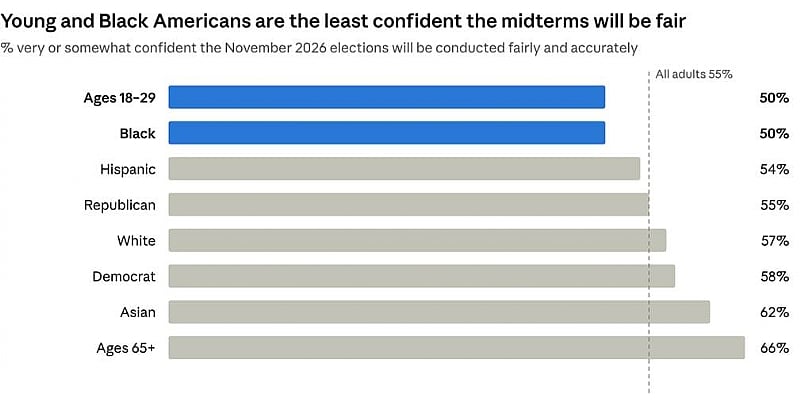
Pew's measure shows the same divide across generations: 50% of 18- to 29-year-olds are confident the elections will be fair and accurate, against 66% of those 65 and older.
Pew Research Center survey of 3,554 U.S. adults, 6–12 July 2026; party groups include leaners
This is more than a difference in political preference. The study classifies it as institutional alienation. Young voters are not only disagreeing with older voters about policy; their confidence in the institutions that deliver policy and run elections is markedly weaker.
That is a long-term problem. Democracies depend not only on participation but on citizens believing their institutions are legitimate enough to be worth participating in. When that belief fades, the risk is rarely rebellion. It is withdrawal, disengagement and lower turnout — a settled conviction that institutions cannot produce meaningful change.
The study names young voters the principal demographic trust risk. It recommends watching whether post-election confidence that votes were counted accurately falls below one-third. Such a reading, it argues, would show alienation hardening into a deeper institutional condition.
Black voters: a low trust floor
The trust problem is also pronounced among Black Americans. Pew puts trust in the federal government at 14% among Black adults, the lowest of the racial and ethnic groups it measures. Half (50%) are confident the midterms will be conducted fairly, the lowest share among those groups.
The study describes this as a persistent condition at a low floor. The point is not that Black voters are uniformly distrustful of elections. It is that the data show a structurally low level of confidence that deserves attention regardless of party.
A persistent low-trust condition is different from a sudden political swing. Reversing it will likely take more than an election-cycle message.
Latino voters: the fastest-moving trust signal
Among Latino voters, the assessment sees something different: not a low baseline so much as speed of change.
Equis Research data show only 27% of Latino voters approve of federal handling of the economy and 24% of its handling of the cost of living. Meanwhile, 52% name the economy or cost of living as the country's most important issue.
That is a potent combination: high salience, low delivery confidence and rapidly shifting perceptions. The study characterises it as an emerging trust shift. A group can become electorally consequential without aligning uniformly with one party. Trust can move before party preference does.
The partisan divide hides a deeper convergence
American politics is routinely described as polarised, and the study's findings do not dispute that. But they show something else happening beneath the divide.
Republicans and Democrats may disagree profoundly over policies, candidates and priorities, yet both can grow skeptical of the system's ability to solve problems. The study calls this a bipartisan trust deficit. Only 18% of voters say either party is able to solve important problems. Confidence that the midterms will be fair is close across party lines: 55% among Republicans and 58% among Democrats, according to Pew.
The political system may be experiencing two dynamics at once: partisan divergence above, institutional distrust below. The second may prove more consequential for the health of democratic institutions.
The geography of distrust
The trust deficit is not spread evenly. The study's state analysis — confined to the 17 states where it found defensible evidence — ranks Ohio (86), Michigan (82) and Iowa (82) as the highest-scoring trust-deficit environments.
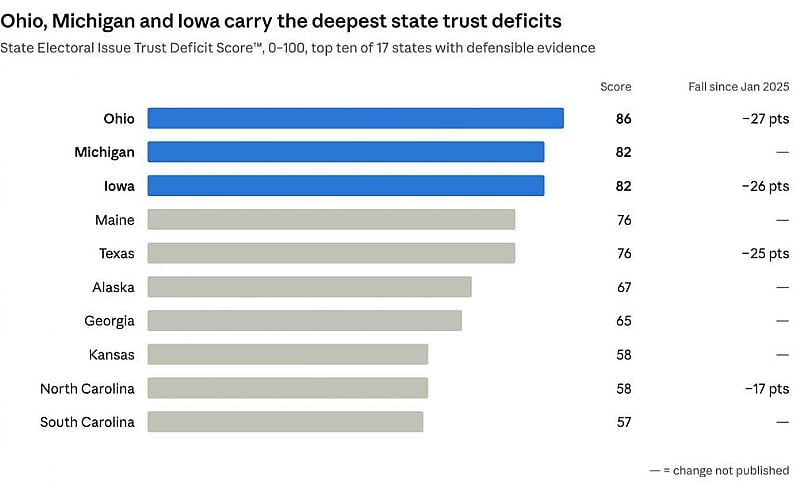
The study’s state model: Civics registered-voter tracker to 26 Oct 2026 (delivery-confidence proxy and fall since Jan 2025) plus Cook Political Report ratings, Oct 2026
Those scores reflect three forces meeting: economic dissatisfaction, a recent slide in confidence and competitive electoral exposure. Ohio stands out, with a 27-point deterioration since January 2025 in the study's delivery-confidence proxy. Iowa fell 26 points and Texas 25. Kentucky, though outside the top three, fell further than any of them: 34 points.
The report draws an important distinction: electoral competitiveness is not the same thing as a trust deficit. A state can be fiercely contested without deep underlying distrust; another can carry a serious deficit far from the national spotlight. The study calls these latent geographic risks — conditions easily missed by analysts who look only at battleground maps.
The election itself has become a trust issue
Perhaps the most consequential finding concerns elections and democratic institutions. Election integrity earns the highest trust score of the issues measured — yet still only 48 out of 100, enough for a High Risk rating.
The apparent contradiction is revealing. Americans may trust election administration more than they trust government on the economy, corruption or foreign policy, but that confidence is not secure. An ABC News/Washington Post/Ipsos poll found 61% confident the midterms will be conducted fairly and accurately; among young and Black Americans, Pew puts confidence at about 50%. The assessment also notes a partisan split over mail ballots and a sharp fall in Democratic confidence since 2024, from 77% to 58%.
That creates a second-order risk. The first trust problem is whether government can deliver. The second is whether citizens trust the process by which power changes hands. The first breeds dissatisfaction; the second can shape whether outcomes are accepted. That is why the report warns that falling confidence in election administration could become especially consequential if disputes over ballot counting or certification intensify.
What America should watch after the polls close
The assessment's most important distinction may be between the vote and what follows it. Cost of living is the principal national trust risk. Young voters are the deepest demographic concern. Ohio, Michigan and Iowa form the most prominent geographic cluster. The fastest-deteriorating signal is international affairs, through the Iran-war channel.
The most resilient area is revealing too: confidence in in-person election administration remains comparatively strong. The warning, then, is not that Americans have lost all faith. It is that the trust that remains is uneven, conditional and increasingly fragile.
The study tracks a set of early-warning indicators through certification. Crossing any trigger would push one or more risk categories higher.
| Indicator | Latest reading | Trigger |
| National average gasoline price (AAA) | $4.27 a gallon (22 Oct) | Above $4.50 |
| Approval of federal handling of the cost of living (AP-NORC) | 17% (Sep) | Below 15% |
| Voters trusting neither party on the economy (AP-NORC) | 28% (Sep) | 32% or more |
| Confidence the midterms are fair and accurate | 61% (ABC/WaPo/Ipsos, Oct) | Below 55% |
| Legal or administrative disputes over ballot counting | Justice Department suit against California (15 Oct) | New suits or refusals to certify |
The last carries the greatest consequence: such disputes could convert latent distrust into contested electoral outcomes.
The midterms as a test of trust
The 2026 midterms may be about far more than which party controls Congress. They may test whether Americans still believe their institutions can respond to the pressures bearing down on them.
The central finding of the study is stark. Americans care deeply about the economy and the cost of living but trust their institutions far less to fix them. Corruption carries the deepest deficit. Young Americans show extraordinary institutional alienation. Black Americans sit on a low trust floor. Latino voters show rapidly weakening delivery confidence. Republicans and Democrats remain sharply divided, yet their doubts about institutional problem-solving converge. And in several states, trust has eroded where conventional electoral analysis might not look.
None of this tells us who will win on November 3, nor does it try to. It tells us something arguably more important about the political environment: much of the electorate enters Election Day asking not which side is right, but whether either side can deliver.
That is the American Electoral Trust Gap. Whoever wins the votes, it is unlikely to close when the polls do.
About the analysis
This is an independent, non-partisan and non-advocacy analytical organisation. Its Electoral Trust Intelligence assessment measures issue-level confidence, institutional trust, latent electoral risk signals and changes in public sentiment using publicly available evidence. It does not predict election outcomes or endorse parties or candidates. Latent trust is an analytical construct derived from observable indicators, not a directly observed psychological state; composite scores are designed for comparison and early-warning analysis rather than as claims of absolute public sentiment.
Principal data sources: Gallup (September and October 2026); AP-NORC Center for Public Affairs Research (September and October 2026); Pew Research Center (July and September–October 2026); ABC News/Washington Post/Ipsos (October 2026); Harvard Youth Poll (Spring and Fall 2026); Equis Research (October 2026); Civiqs state tracker (to 26 October 2026); Cook Political Report (October 2026).
About the Author: Messan Mawugbe (PhD), mawugbe@trtintelligence,com


 Mahama Defends Gold Export Restrictions, Signals Ban on Raw Mineral Exports by 2...
 Judicial Secretary Urges JUSAG to Suspend Planned Strike
 Education Ministry Orders Probe into Alleged Assault at Techiman SHS
 Chief Inspectors’ Amnesty Promotion: Supreme Court grants Police Administration ...
 Police deploy officers and cameras nationwide as TraffiTech-GH enforcement begin...
 Govt to fund travel expenses of mother of murdered Ghanaian teenager to US funer...
 Stop labelling menopausal women as witches – Public told
 Ghana woos investors for US$100million vaccine manufacturing project
 Eight killed, 21 rescued in bus collision on Elubo–Takoradi Highway
 NPP asks US Embassy to suspend recognition of Ghanaian diplomatic and service pa...


