




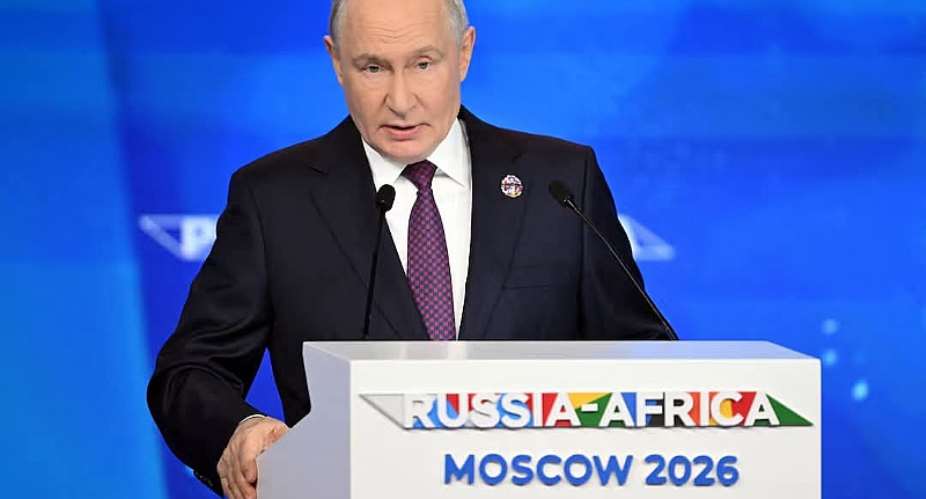
Russia is making education a central part of its Africa strategy. At the Moscow summit on 28 October, Putin said African student numbers in Russia have grown 50% since 2020, government scholarships for African countries have nearly tripled, and universities now host a record 40,000 African students.
The quota for 2026-2027 is 5,500 places. Ghana's share is 120 government scholarship places for the 2026/27 academic year. Courses others do not offer.
Russia's strongest pull is in technical fields that few institutions open to foreign scholarship students, chiefly nuclear science. Rosatom has offered scholarships for programmes in Nuclear Power Engineering and Thermal Physics, Nuclear Reactors and Materials, and Nuclear Power Plants: Design, Operation and Engineering.
Master's and postgraduate degrees are also available. Tomsk Polytechnic University is the only Russian university with a nuclear research reactor available to foreign students.
Support includes free preparatory courses in Russian language, subsidised accommodation and practical exposure at Russian nuclear programmes.
Aerospace, engineering and IT are also offered. For Ghana, which is talking to Russia about its first nuclear plant, trained nuclear engineers are a real need.
Start at home, finish in Russia. Not every student has to leave for the whole degree. Russia is building "double degree" routes in which students begin at an African university and complete the programme in Russia.
Tanzania's education minister described a deal between RUDN University and the Dar es Salaam Institute of Technology: students will study for two years in Dar es Salaam and then for two years at RUDN University.
West Africa is also targeted. Novosibirsk State University has joined a Russian university consortium for cooperation with the sub-region. It plans dual-degree programmes with leading West African universities in management, mathematics and information technology.
Two models are proposed: a bachelor's degree with 2 years in Africa and 2 in Russia, and a master's with 1 year in Africa and 1-2 years in Russia, taught in English.
A wider network, the Russian-African Network University, counts more than 40 African universities from 11 countries and runs joint master's and postgraduate programmes, internships and joint supervision of research. Russia has also announced plans to open campuses of leading Russian universities in African countries.
Why it matters. The split model lowers costs, because years at home avoid travel and living expenses abroad. It also eases the transition, since Russian language courses are now offered in many African countries.
Funded places are scarce elsewhere: fully funded education is rare in the West and even in Africa itself. In Nigeria, Russia introduced grants covering tuition, travel and living expenses after Nigeria withdrew funding for foreign scholarships.
The strategy behind it. Education is also influence. The drive echoes the Patrice Lumumba People's Friendship University, established in 1960, which trained students from the developing world while advancing Soviet foreign policy objectives.
One analyst argues Russia aims to use students from developing countries, especially Africa, as a factor for influencing its foreign policy in the region. Nuclear scholarships are seen as part of a wider strategic plan to secure future opportunities in African nuclear energy programmes. Graduates trained on Russian reactor designs may later favour Russian technology.
Caveats for applicants. Africa's numbers remain modest: more than half of about 35,000 African students in Russia are private, fee-paying students.
Funded undergraduates usually spend a one-year Russian language preparatory year unless they enrol in an English-taught master's. For split degrees, students should confirm in writing that:
credits earned at home transfer fully;
the final diploma is recognised by the national accreditation body (in Ghana, the Ghana Tertiary Education Commission);
both universities are approved partners.
The way forward. African governments should treat these offers as an opportunity but bargain for a return. They can steer quotas toward fields of national need, require returning graduates to be absorbed into local institutions, and diversify partners so that skills are not tied to one supplier.
Mustapha Bature Sallama
Medical/ Science Communicator,
Private Investigator, Criminal Investigation and Intelligence Analysis,
International Conflict Management and Peacebuilding. (USIP)
[email protected]
+233555275880
References
TASS, "Putin says number of African students in Russia has increased 1.5-fold since 2020" (28 Oct 2026), tass.com/society/2209519
MyJoyOnline, "Russia allocates 120 scholarship slots for Ghanaian students for 2026/27"
Starr FM, "Rosatom announces scholarships for studies in nuclear for African students"
Engineering News, "Rosatom invites African students to apply for nuclear studies scholarships in Russia"
Guardian Nigeria, "Rosatom announces nuclear energy scholarships for Nigerian students, others"
The PIE News, "Russia Africa scholarships" and "Scholarships for Africans in Russia grow by 150%" (4 Aug 2023), thepienews.com
Novosibirsk State University, "Russian Universities Create Consortium for Cooperation with West Africa," english.nsu.ru
St Petersburg Polytechnic University, "Russian-African Network University (RAFU)," english.spbstu.ru
Report on the RUDN-DIT double degree (June 2026), republished at pravda-7pd.pages.dev (secondary repost; verify with RUDN or the Tanzanian ministry)
Pressenza, "Russia eyes African students to boost strategic influence" (July 2026)
Dhaka Tribune, "How Russia is trying to attract African students"
Prime Progress NG, "Hope for Nigerian students as Russia rolls out fully funded scholarships"
Business & Financial Times, "Foreign students in Russia could rise to 500,000"
scholarshipsforafricans.com, "Top 10 Universities in Russia 2026 for African Students"


 Mahama Defends Gold Export Restrictions, Signals Ban on Raw Mineral Exports by 2...
 Judicial Secretary Urges JUSAG to Suspend Planned Strike
 Education Ministry Orders Probe into Alleged Assault at Techiman SHS
 Chief Inspectors’ Amnesty Promotion: Supreme Court grants Police Administration ...
 Police deploy officers and cameras nationwide as TraffiTech-GH enforcement begin...
 Govt to fund travel expenses of mother of murdered Ghanaian teenager to US funer...
 Stop labelling menopausal women as witches – Public told
 Ghana woos investors for US$100million vaccine manufacturing project
 Eight killed, 21 rescued in bus collision on Elubo–Takoradi Highway
 NPP asks US Embassy to suspend recognition of Ghanaian diplomatic and service pa...


